Choosing between an FHA 203(b) loan and a Conventional 97 loan is the single most consequential financing decision most first-time buyers make. Both allow down payments in the 3-3.5% range, both are widely available, and both will get you the keys. But they treat mortgage insurance, credit scores, and multi-unit properties very differently, and those differences can swing your total cost by tens of thousands of dollars over a ten-year hold.
This guide walks through both programs rule by rule, prices them side by side on a real $350,000 duplex, and ends with a decision framework you can apply to your own numbers.
Investor insight from Toheeb Ekundayo, MBA: "If you are buying a duplex or triplex to house hack, a low-down-payment loan preserves the cash you will need for repairs and reserves. Just make sure you account for FHA's 1.75% upfront premium when you calculate your real loan balance and starting equity. It is financed, so it is easy to forget it is there."
What the FHA 203(b) loan is
The 203(b) is the standard FHA-insured mortgage and the most-used FHA program by a wide margin. The Federal Housing Administration does not lend money; it insures loans made by approved lenders, which is why lenders will accept lower scores and smaller down payments than they would on their own.
Key rules, from HUD Handbook 4000.1:
- Minimum down payment (minimum required investment): 3.5% of the purchase price with a credit score of 580 or higher. Scores from 500 to 579 require 10% down.
- Upfront Mortgage Insurance Premium (UFMIP): 1.75% of the base loan amount, normally financed into the balance.
- Annual MIP: for 30-year loans at or below $726,200, 0.55% per year with less than 10% down (LTV above 95%) and 0.50% with 10% or more down. Larger loans pay 0.70-0.75%. Paid monthly.
- MIP duration: life of the loan when the down payment is under 10%; 11 years when it is 10% or more.
- Occupancy: you must occupy one unit as your primary residence within 60 days.
- Property types: 1-4 unit properties. On 3-4 units, the building must also pass the FHA self-sufficiency test.
- Debt-to-income: FHA's automated underwriting commonly approves total DTI ratios in the 45-50% range with compensating factors, and manual underwriting can reach 50% with strong reserves.
- Seller concessions: up to 6% of the price toward closing costs and prepaids.
The defining trait is that FHA insurance is flat-priced and durable: it does not care much about your credit score, and it usually never cancels.
What the Conventional 97 loan is
"Conventional 97" refers to Fannie Mae's (and Freddie Mac's equivalent) 97% loan-to-value program: a 3% down payment on a conventional mortgage that the lender can sell to the agencies.
Key rules, from the Fannie Mae Selling Guide:
- Minimum down payment: 3% of the price on a one-unit principal residence. At least one borrower must be a first-time homebuyer (no ownership interest in a residence in the past three years) for the standard 97% program; HomeReady removes that requirement for income-eligible buyers.
- Minimum credit score: 620.
- Private mortgage insurance: required below 20% down, priced by credit score and LTV, and cancellable.
- PMI cancellation: you can request removal when the balance reaches 80% of the original value, it terminates automatically at 78%, and it must end at the midpoint of the loan term. Fannie Mae also allows cancellation based on a new appraisal once you have at least 25% equity after two years or 20% after five.
- 2-4 units: the 97% program does not apply, but Fannie Mae's standard guidelines now allow 5% down (95% LTV) on 2-4 unit owner-occupied purchases, a change effective November 2023 that removed the old 15-25% requirement.
- Seller concessions: 3% of the price with less than 10% down, 6% with 10-25% down.
Because PMI is risk-priced and cancellable, the conventional route rewards good credit and rising values.
Side-by-side comparison
| Feature | FHA 203(b) | Conventional 97 / 95% on 2-4 units |
|---|---|---|
| Minimum down payment | 3.5% (580+ score) | 3% on 1 unit; 5% on 2-4 units |
| Minimum credit score | 580 (500 with 10% down) | 620 |
| Upfront fee | 1.75% UFMIP, financed | None |
| Monthly insurance | 0.55% per year (under 10% down) | Roughly 0.3-1.0% per year, by credit and LTV |
| Insurance removable? | Only with 10%+ down (after 11 years) or by refinancing | Yes, at 80% LTV on request, 78% automatically |
| 2-4 unit eligibility | Yes, with self-sufficiency test on 3-4 units | Yes, 5% down owner-occupied |
| DTI flexibility | High (45-50%+) | Moderate (typically to 45%, 50% with strong file) |
| Seller concessions | Up to 6% | 3% (under 10% down) |
| Best rate for | Scores under 680 | Scores over 720 |
Worked example: a $350,000 duplex at 6.5%
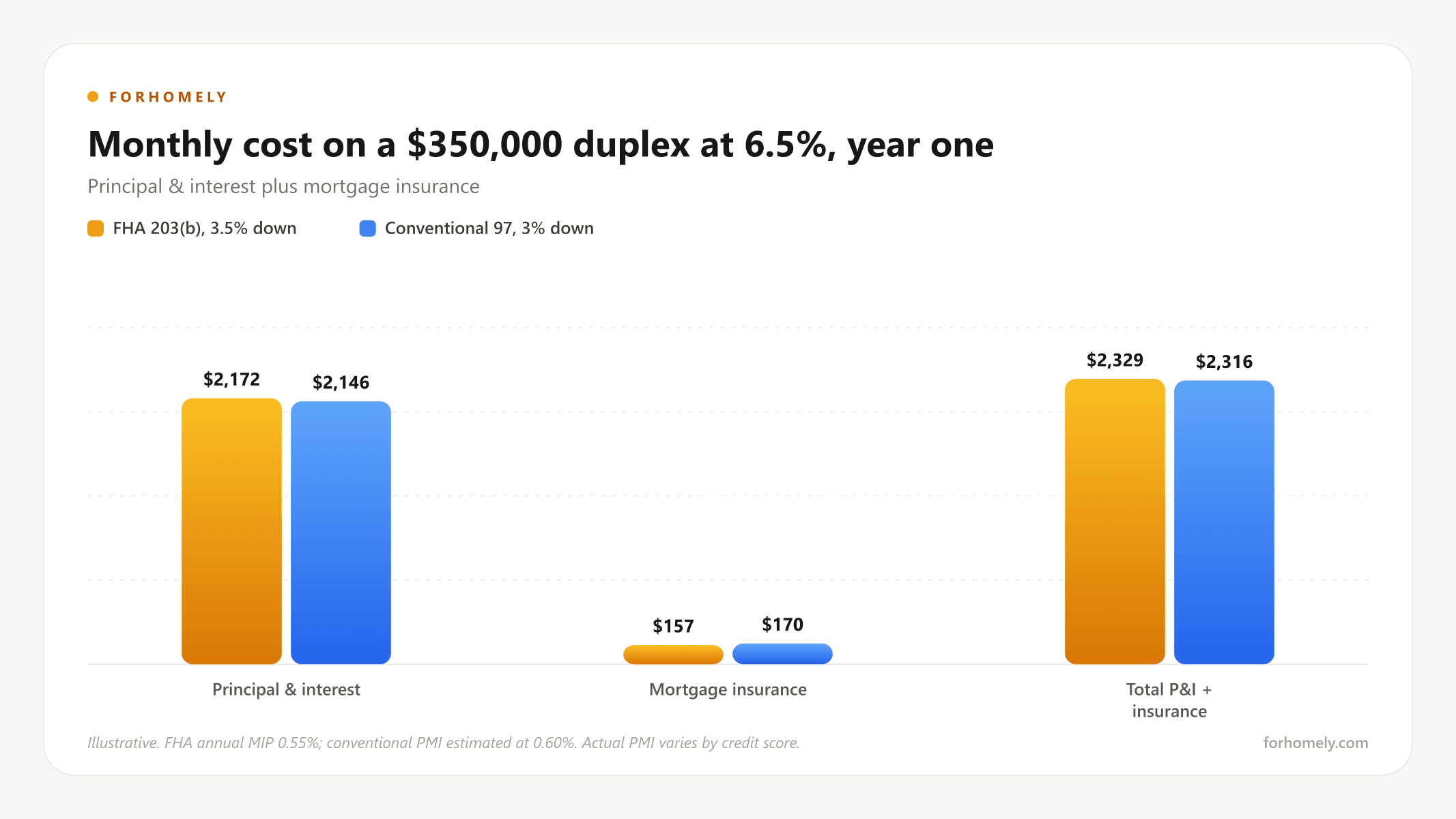
Assume a 30-year fixed rate of 6.5% and a $350,000 purchase price, and compare FHA at 3.5% down with a conventional loan at 3% down (the one-unit case, which makes the math cleanest; on a duplex, substitute 5% down and the conventional numbers improve slightly).
FHA 203(b), 3.5% down ($12,250):
- Base loan: $337,750
- UFMIP at 1.75%: $5,911, financed. Total loan: $343,661
- Principal and interest: about $2,172 per month
- Annual MIP at 0.55%: about $157 per month
- P&I plus MIP: about $2,329 per month
Conventional 97, 3% down ($10,500):
- Loan: $339,500
- Principal and interest: about $2,146 per month
- PMI at an estimated 0.60% per year: about $170 per month
- P&I plus PMI: about $2,316 per month
Year one is a wash: $13 a month apart. The divergence comes from what happens to the insurance.
Where the insurance goes over ten years
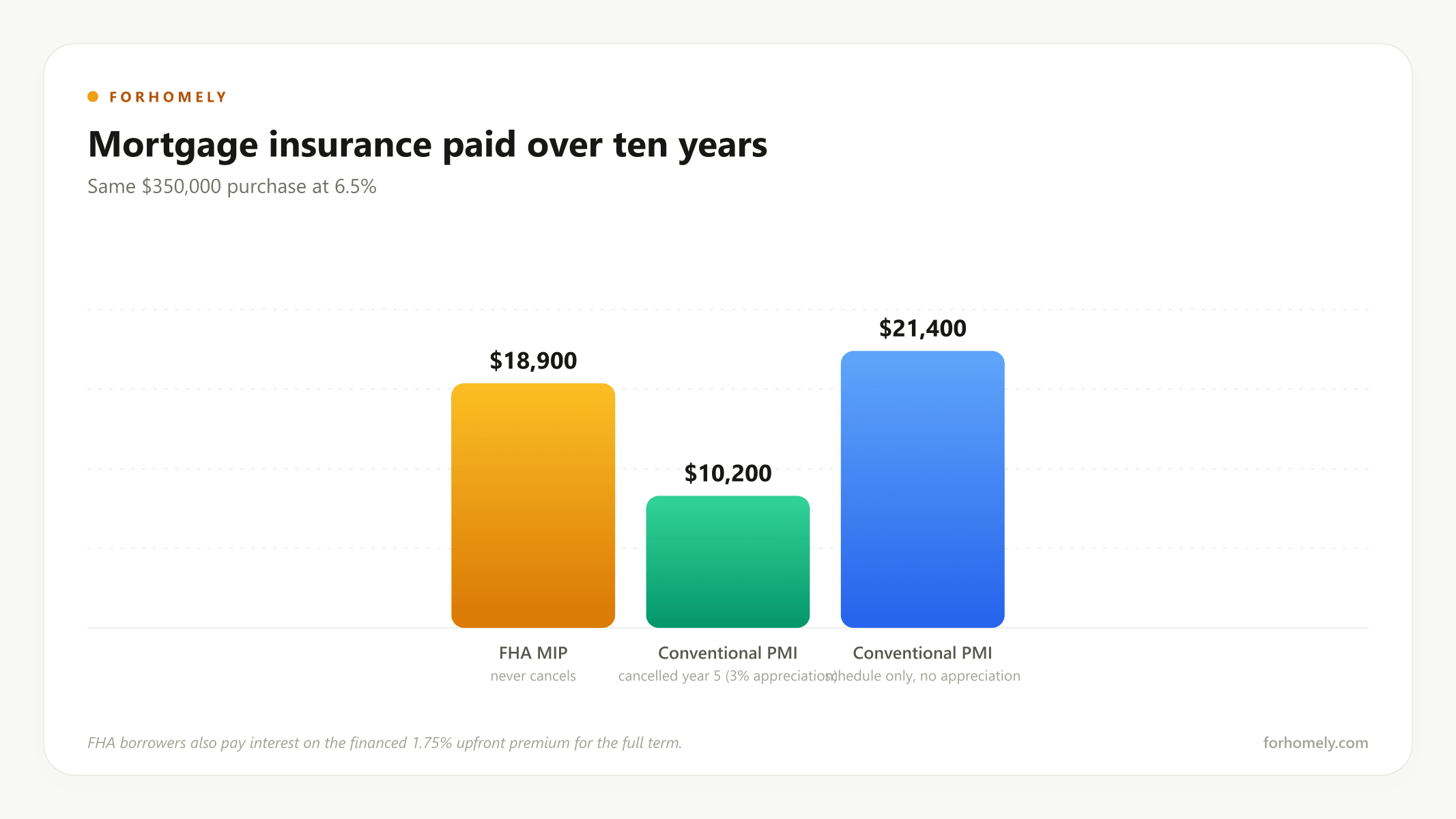
On the scheduled amortization alone, the conventional loan reaches 80% LTV (a $280,000 balance) a little after year ten. That is slow, because early payments are mostly interest. But Fannie Mae's rules also allow removal based on current value: with 3% annual appreciation, the property is worth about $406,000 by year five, 80% of that is $325,000, and the balance is roughly $319,000. The borrower can order an appraisal and request cancellation in year five.
- FHA: $157 a month for the full ten years, about $18,900, and it keeps going after year ten.
- Conventional, PMI cancelled in year five: roughly 60 payments of $170, about $10,200, then nothing.
- Conventional, no appreciation (schedule only): about 126 payments, roughly $21,400, then nothing.
Add the FHA borrower's financed UFMIP, on which they pay interest for the whole term, and the ten-year gap is typically $10,000 to $15,000 in favor of the conventional loan when values rise even modestly.
When FHA is still the right answer
The conventional advantage depends on qualifying for good PMI pricing and on equity building. FHA wins when those assumptions break:
- Credit score under 640. Conventional PMI at a 640 score can run 1% or more per year, which erases the cancellation advantage for years, and some lenders will not write conventional loans below 620 at all. FHA's 0.55% flat rate is cheaper.
- Debt-to-income above 45%. FHA's automated approvals routinely tolerate ratios conventional underwriting rejects, especially when rental income from the other units is part of the file.
- Buying a triplex or fourplex. Both programs now allow low down payments on 3-4 units, but FHA's underwriting of the rental income is more established and its 6% seller concession limit helps cover the higher closing costs on bigger buildings. The trade-off is the self-sufficiency test, which can fail in expensive markets.
- Thin reserves. FHA generally requires no reserves on 1-2 units and one month on 3-4 units; conventional multi-unit files often need six months.
When Conventional wins
- Score of 700 or better. PMI drops toward 0.3-0.5%, and it disappears.
- A rising market or a value-add plan. Forced appreciation from renovations or rent increases gets you to a cancellation appraisal faster.
- A long hold. The longer you keep the loan, the more the permanent MIP costs.
- No 1.75% upfront hit. Skipping the UFMIP keeps $5,000-$8,000 of equity in the building on day one.
Decision framework
- Score under 640, or DTI over 45%: FHA.
- Score 640-699 on a duplex: run both; FHA often wins on approval, conventional on ten-year cost. Choose conventional if you can comfortably qualify.
- Score 700+ on a 1-2 unit: Conventional, almost always.
- 3-4 units: FHA if the building passes the self-sufficiency test and you value the higher seller concession; conventional 5% down if your income carries the payment without leaning on rents.
Whichever you choose, model both on the same property in the First-Time Homebuyer Mortgage Calculator. It applies the UFMIP, the correct annual MIP tier, and the conventional PMI drop-off month automatically, so the lifetime cost difference is visible before you write an offer. For a deeper look at the insurance rules themselves, read FHA MIP vs. conventional PMI, and if closing costs are the constraint, see the real cost of closing.