FHA loans let you buy a 2-4 unit property with 3.5% down, one of the most powerful tools available to a first-time investor. But for three- and four-unit properties, HUD adds a hurdle that kills more deals than any other single rule: the self-sufficiency test. Understanding it before you write an offer saves you an appraisal fee, a wasted month, and a lot of frustration.
The rule
HUD Handbook 4000.1 requires that a 3-4 unit property financed with FHA be self-sufficient. Specifically, the net self-sufficiency rental income, defined as 75% of the appraiser's estimate of fair market rent for all units (or the actual rents, if lower), must be greater than or equal to the full monthly mortgage payment: principal, interest, taxes, insurance, mortgage insurance, and any association dues.
Three details trip up new buyers:
- The appraiser's number controls. The Form 1025 rent schedule sets the rent figure, not your lease, not the listing, and not your spreadsheet.
- The 25% haircut is fixed. HUD assumes 25% vacancy and collection loss regardless of how strong your market is.
- Every unit counts, including the one you will live in, because HUD is testing whether the building can carry itself, not whether you can.
The formula
The test passes when:
Appraised market rent (all units) × 0.75 ≥ Monthly PITIA
Equivalently, monthly rent must be at least 1.33 times the payment. That is the same idea as a 1.33 debt service coverage ratio, applied at the point of purchase.
Worked example 1: a $400,000 triplex that fails
FHA financing, 3.5% down, 30-year fixed at 6.75%, taxes of $4,200 a year, insurance of $2,640.
- Base loan: $386,000
- UFMIP at 1.75%: $6,755, financed. Total loan: $392,755
- Principal and interest: about $2,547 per month
- Annual MIP at 0.55%: about $180 per month
- Taxes $350, insurance $220
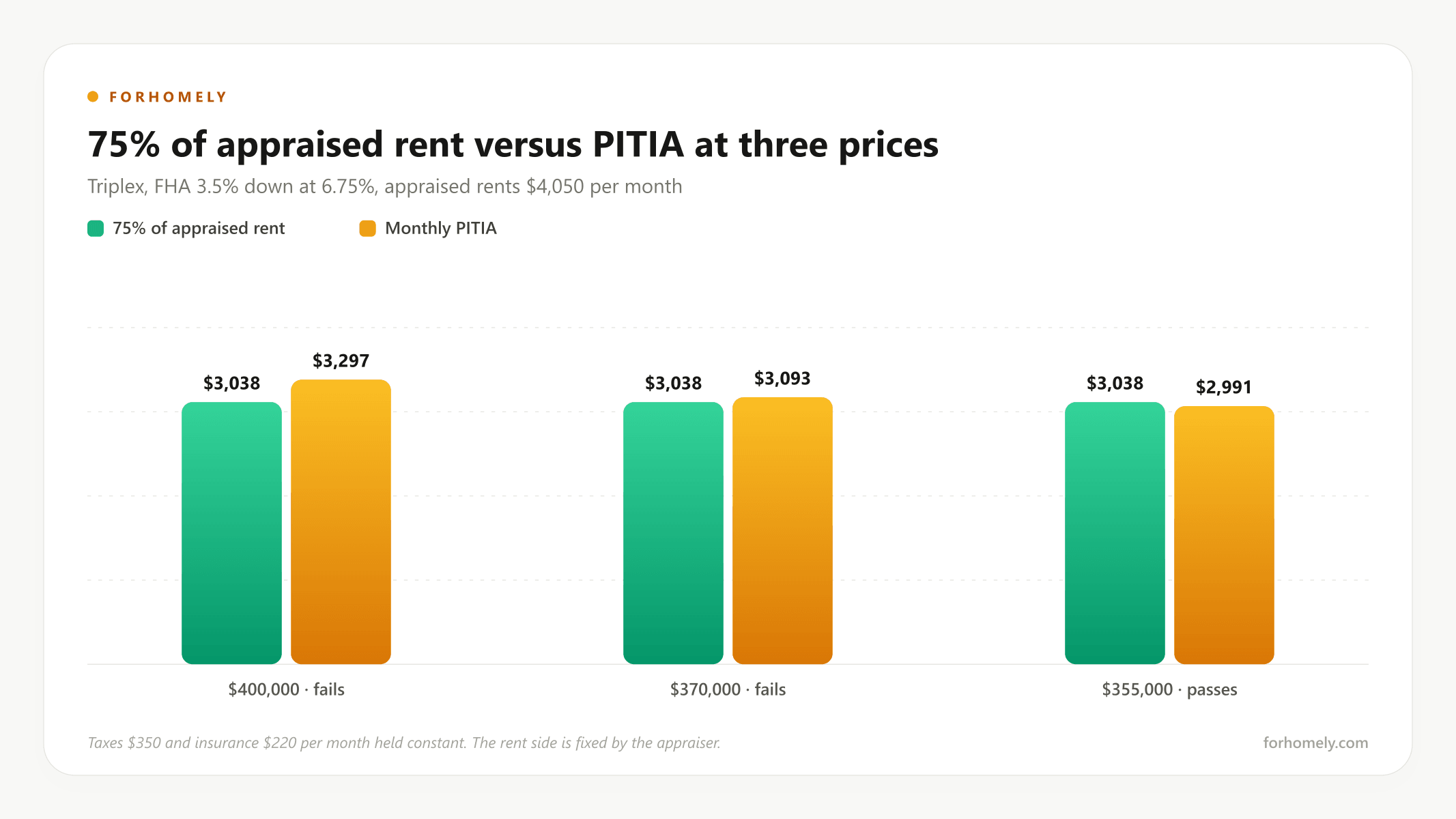
- Total PITIA: about $3,297 per month
The appraiser estimates market rents of $1,400, $1,350, and $1,300, a total of $4,050.
- Test: $4,050 × 0.75 = $3,037.50 versus a PITIA of $3,297
- Result: fail, by about $260 a month
Worked example 2: what it takes to pass
Renegotiating the price to $370,000 reduces the loan to $363,298 after UFMIP. P&I drops to about $2,356, MIP to $167, and with the same taxes and insurance the PITIA is about $3,093. Still a fail: $3,037.50 does not cover $3,093.
At $355,000, the loan is $348,570, P&I is about $2,261, MIP is $160, and PITIA is about $2,991. Now $3,037.50 covers it with $46 to spare. The deal passes.
That is a $45,000 price reduction, more than 11%, to move a $260 monthly shortfall. Which is the lesson: the self-sufficiency test is unforgiving, and it is far cheaper to screen for it before you make an offer than to discover it after the appraisal.
Why the test is really a price-to-rent screen
Rewriting the formula in terms of price makes the geography obvious. With 3.5% down at roughly 6.75% and typical taxes and insurance, the all-in PITIA on an FHA loan is about 0.85% of the purchase price per month. To cover that with 75% of rent, gross rent needs to be about 1.13% of the price per month.
- A $400,000 triplex needs about $4,500 of monthly market rent to pass.
- In a Midwest or Southeast market where triplexes rent for $4,500-$5,000, that passes comfortably.
- In a coastal metro where the same rent buys a $650,000 building, it fails by a mile.
Markets with high rent-to-price ratios pass easily. Expensive metros almost never do, which is why FHA fourplex purchases are common in Cleveland and rare in San Diego.
Five strategies to pass
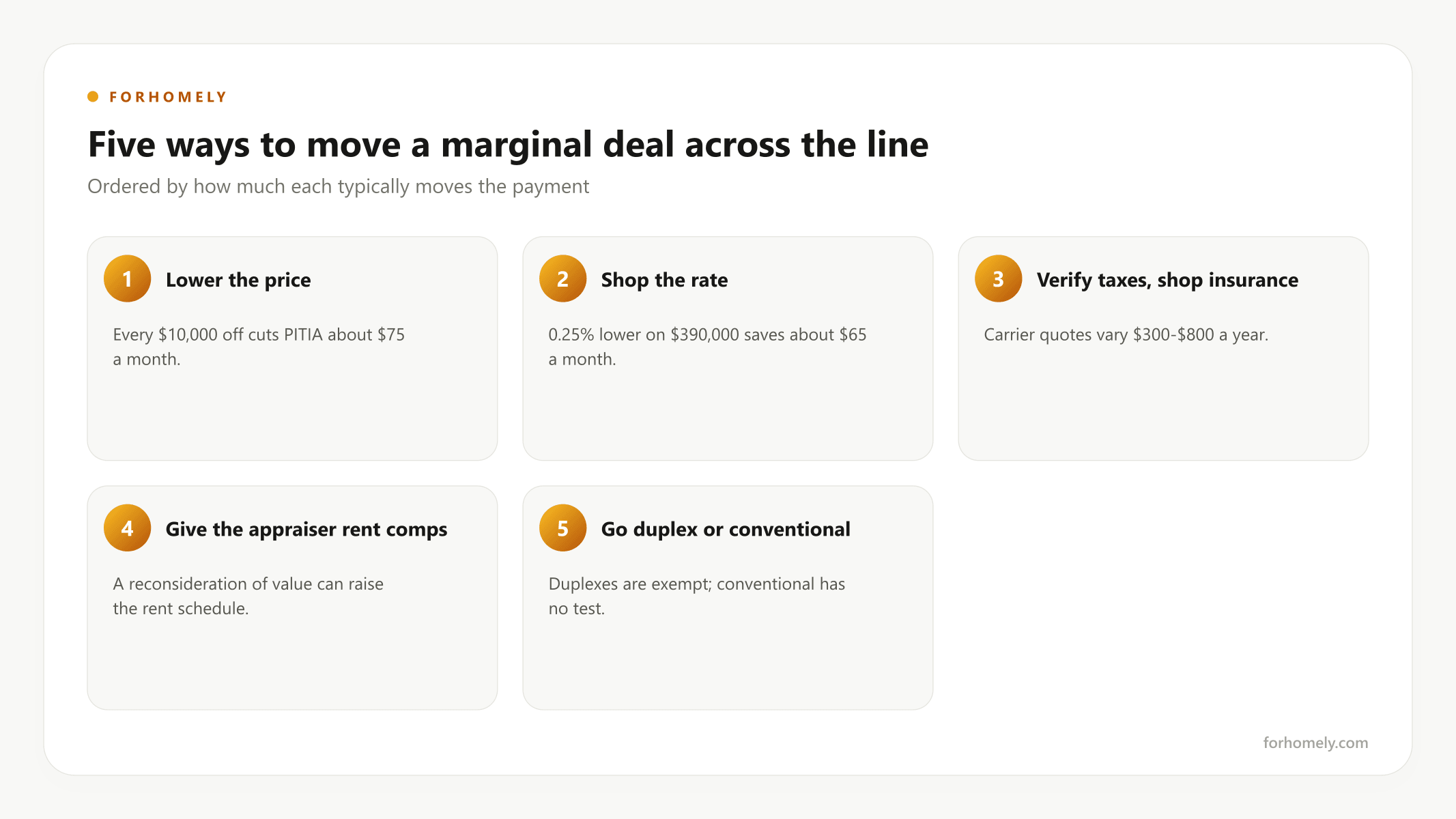
- Lower the price. Every $10,000 of price cuts PITIA by roughly $75 a month at current rates. Sellers of 3-4 unit buildings with few financed buyers often have room.
- Shop the rate hard. A 0.25% lower rate on a $390,000 loan saves about $65 a month. On a marginal deal that is the whole gap.
- Verify taxes and shop insurance. Lenders sometimes use a conservative tax estimate; the actual bill, or a reassessment estimate from the county, may be lower. Landlord insurance quotes vary by $300-$800 a year between carriers.
- Give the appraiser rent comparables. If the rent schedule looks low, your lender can submit recent leases on comparable units for a reconsideration of value. Appraisers can and do revise rent estimates when the evidence is better than what they found.
- Consider a duplex or a conventional loan. Duplexes are exempt. Fannie Mae now allows 5% down on owner-occupied 2-4 units, and conventional loans have no self-sufficiency test; they simply require your income (plus 75% of the rents) to carry the payment.
Why HUD created the test
FHA defaults on 3-4 unit properties historically clustered in buildings where the rents could not carry the payment. Owners lost a job, lost a tenant, and lost the building. HUD wants the property itself, not just the borrower's paycheck, to be able to support the loan. The rule is blunt, but the underlying logic is the same one every investor should apply anyway: if the building cannot pay for itself at 75% of market rent, it is a speculative purchase, whoever is financing it.
Check your deal before you offer
The First-Time Homebuyer Mortgage Calculator includes a built-in self-sufficiency flag: select FHA, choose 3 or 4 units, enter the total market rent, and it tells you instantly whether 75% of rents cover PITIA, before you spend $1,200 on an appraisal. For the qualifying side of the same rents, read how to use future rental income to qualify.