Mortgage insurance is the fee you pay to protect the lender when you make a small down payment. It exists in two very different forms, FHA MIP and conventional PMI, and confusing them costs first-time buyers thousands of dollars. This guide breaks down exactly how each one is calculated, when it can be removed, and how to model it before you choose a loan.
What FHA MIP is
Every FHA loan carries a Mortgage Insurance Premium with two components.
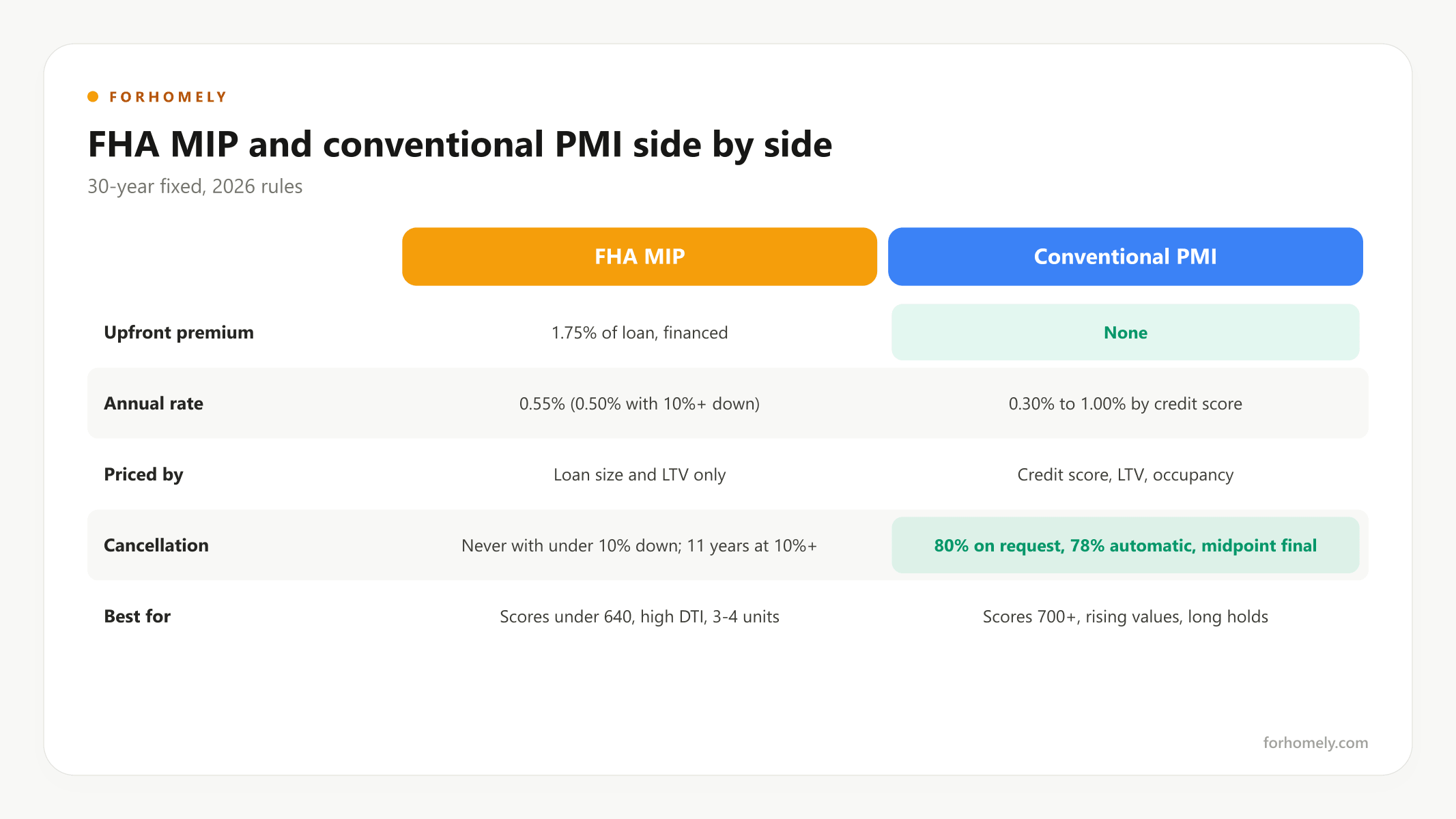
1. Upfront MIP (UFMIP). 1.75% of the base loan amount, charged at closing and almost always financed into the balance. On a $300,000 base loan, that is $5,250 of additional debt you pay interest on for the full term. It does not change with your credit score.
2. Annual MIP. A percentage of the average outstanding balance each year, divided into twelve monthly payments and collected with your mortgage payment. Since HUD's March 2023 reduction, the rates for 30-year loans are:
| Base loan amount | Down payment under 10% (LTV over 95%) | Down payment 10% or more (LTV 95% or under) |
|---|---|---|
| $726,200 or less | 0.55% | 0.50% |
| More than $726,200 | 0.75% | 0.70% |
Fifteen-year loans pay 0.15-0.40% depending on LTV.
How long FHA MIP lasts
- Less than 10% down: annual MIP is charged for the life of the loan. It never cancels automatically, and you cannot request removal.
- 10% or more down: annual MIP ends after 11 years.
- The only early exit is a refinance, usually into a conventional loan once you have 20% equity.
What conventional PMI is
Private Mortgage Insurance applies to conventional loans with less than 20% down. It is written by private insurers and, unlike FHA MIP, it is risk-priced: your rate depends on credit score, loan-to-value ratio, loan purpose, occupancy, and sometimes debt-to-income. Two borrowers with identical loans can pay very different premiums.
Typical annual PMI rates on a 30-year fixed with 5% down:
| Credit score | Approximate annual PMI rate |
|---|---|
| 760+ | 0.30-0.45% |
| 720-759 | 0.45-0.60% |
| 680-719 | 0.60-0.85% |
| 640-679 | 0.85-1.20% |
| 620-639 | 1.20%+ |
Rates are lower with 10-15% down and higher on 2-4 unit properties, cash-out refinances, and second homes. Get an actual quote; the table is only a planning range.
When PMI can be removed
The Homeowners Protection Act gives you three cancellation rights, and Fannie Mae's servicing rules add a fourth:
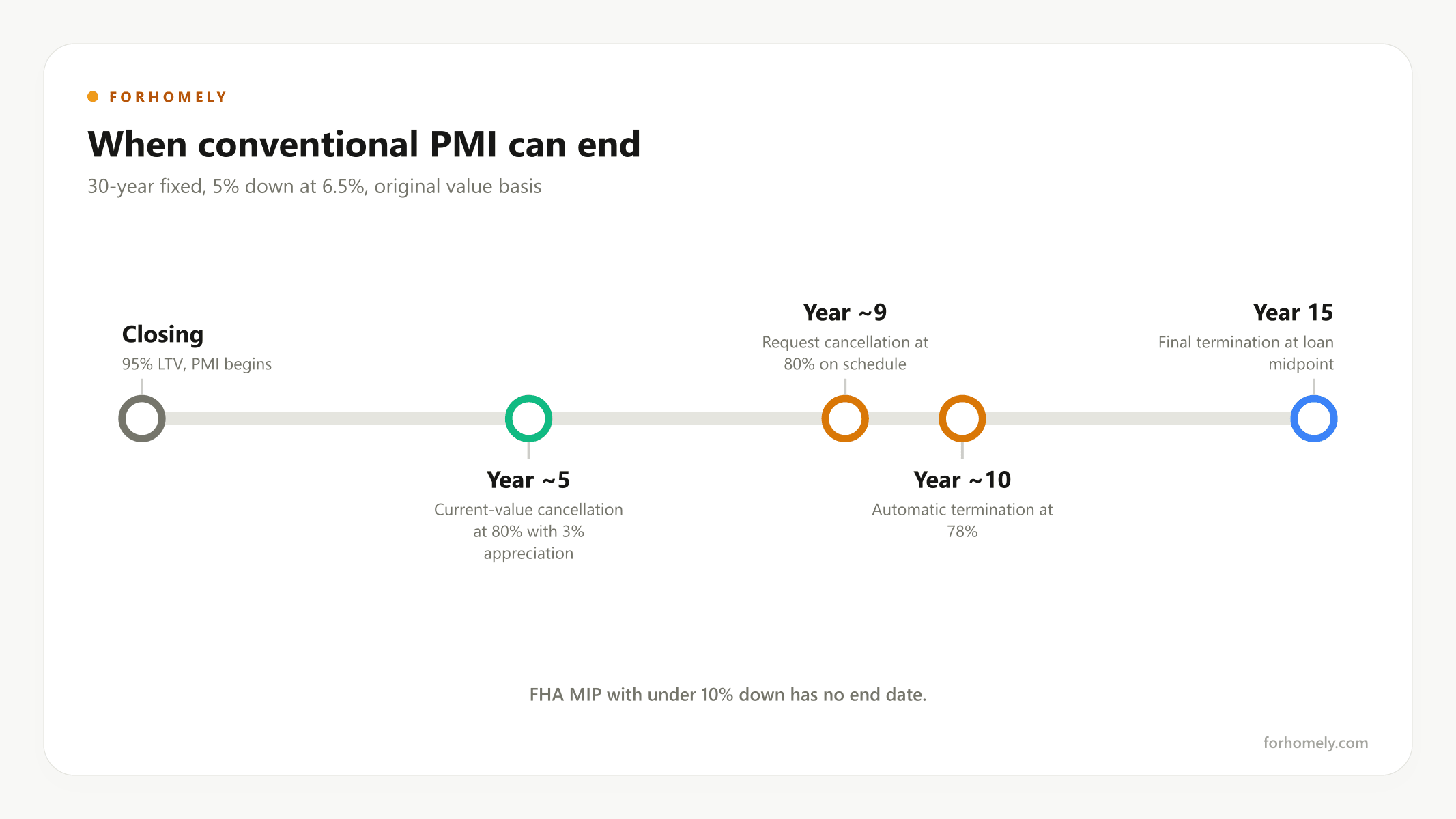
- Borrower-requested cancellation at 80% LTV. Once your balance is scheduled to reach 80% of the original value (the lower of price or appraisal at purchase), you can request removal in writing. You need a good payment history and no junior liens.
- Automatic termination at 78% LTV. The servicer must cancel PMI when the balance hits 78% of original value on the amortization schedule, if you are current.
- Final termination at the midpoint. PMI must end at the halfway point of the term (month 180 on a 30-year loan) regardless of balance, if you are current.
- Current-value cancellation. Fannie Mae allows cancellation based on a new appraisal when LTV is 75% or less after two to five years of seasoning, or 80% or less after five years. Substantial improvements can shorten the seasoning.
The math: a $300,000 loan
Compare an FHA borrower with 3.5% down against a conventional borrower with 5% down and a 700 credit score, both on a roughly $310,000 purchase at 6.5%.
| Item | FHA (3.5% down) | Conventional (5% down, 700 score) |
|---|---|---|
| Base loan | $299,150 | $294,500 |
| Upfront premium | $5,235 UFMIP, financed | $0 |
| Total loan | $304,385 | $294,500 |
| Annual insurance rate | 0.55% | About 0.55% |
| Monthly insurance | About $140 | About $135 |
| Removable? | No (life of loan) | Yes |
| Insurance paid in 10 years | About $16,500 | About $8,100 if cancelled in year five; about $16,800 on the schedule alone |
Even with a near-identical monthly rate, the conventional borrower pays about half as much over a decade when values rise enough to support a year-five cancellation, and pays nothing after that. The FHA borrower also pays interest on the $5,235 financed premium for 30 years, roughly $6,600 of additional interest.
Why the cancellation timeline matters more than the rate
On the schedule alone, a 95% LTV loan at 6.5% reaches 80% LTV around year nine. Early payments are mostly interest, so the balance falls slowly. Appreciation is what shortens the timeline: at 3% a year, a current-value cancellation becomes possible around year five. In a flat market, the conventional borrower still gets to 78% automatically around year ten; the FHA borrower never does.
When FHA MIP is still the better deal
- Credit scores under 640. Conventional PMI pricing becomes punitive below 660 and many lenders decline conventional loans below 620. FHA's flat 0.55% is often cheaper for the first several years, sometimes for the whole hold.
- High debt-to-income ratios. FHA tolerates ratios conventional underwriting rejects, which matters when rental income from the other units is doing the qualifying work.
- 3-4 unit purchases with strong rents. FHA's rental income treatment and 6% seller concession limit make bigger buildings easier to close, though the self-sufficiency test must pass.
The FHA-to-conventional refinance play
Many first-time buyers use FHA as a stepping stone: buy with 3.5% down now, build equity through paydown, appreciation, and improvements, then refinance into a conventional loan at 80% LTV to eliminate MIP. It works when values rise and rates are stable or falling. If values fall or rates spike, you can be stuck paying MIP indefinitely, which is why the decision should be made with a margin of safety, not a best case.
Common mistakes
- Comparing rates instead of total cost. FHA rates are often 0.125-0.25% lower. Permanent MIP usually costs more than that saves.
- Forgetting the financed UFMIP. It raises your balance, lowers your day-one equity, and delays the 80% LTV milestone if you later refinance.
- Waiting for automatic PMI termination. Requesting cancellation at 80%, or ordering an appraisal after appreciation, can end PMI years earlier.
- Assuming the 11-year rule applies. It only applies with 10% or more down on FHA. At 3.5% down, MIP is for life.
Model it before you decide
The First-Time Homebuyer Mortgage Calculator applies the correct UFMIP and annual MIP tier for FHA, estimates conventional PMI, and shows the exact month conventional PMI drops off on your amortization schedule. Compare both loan types on the same property before you write an offer, and read the full FHA vs. Conventional 97 comparison for the rest of the decision.