First-time buyers budget for the down payment and then get blindsided at the closing table. On a typical purchase, closing costs and prepaids run 2% to 5% of the price. On a $350,000 duplex, that is $7,000 to $17,500 due at or before closing, on top of the down payment. Multi-unit buyers tend to land near the top of the range because appraisals cost more and escrow deposits are larger.
This guide itemizes every bucket, walks through a full $350,000 duplex example, explains which fees the law prevents from rising, and lists the five levers that actually reduce cash to close.
The four buckets of cash to close
1. Lender fees
These compensate the lender for originating and underwriting the loan.
- Origination or underwriting fee: $1,000-$2,500, sometimes quoted as a percentage of the loan
- Application or processing fee: $0-$500
- Discount points (optional): 1% of the loan amount per point, paid to lower the rate
- Credit report, flood certification, tax service: $50-$150 combined
2. Third-party fees
Services required by the lender but performed by others.
- Appraisal: $500-$800 on a single-family; 2-4 unit appraisals include a rent schedule and comparable rent analysis and run $800-$1,500
- Title search and lender's title insurance: $700-$2,000 depending on state and price; an owner's policy is optional but recommended
- Settlement, escrow, or closing agent fee: $500-$1,500
- Recording fees and transfer taxes: $50-$250 for recording; transfer taxes vary from zero to more than 1% of the price by state and city
- Survey, pest inspection, HOA questionnaire (where applicable): $150-$600
3. Escrow deposits (prepaid items)
Lenders collect money up front to fund the escrow account that pays your taxes and insurance.
- First year of homeowners (landlord) insurance: paid at or before closing, typically $1,200-$2,500 on a duplex
- Property tax deposit: two to six months of taxes, depending on when the next bill is due
- Escrow cushion: up to two months of escrow payments, permitted by federal rule
4. Prepaid interest
Interest from your closing date through the end of that month, because your first full payment is due the first of the following month. Closing on the 28th means two or three days of interest; closing on the 2nd means nearly a full month.
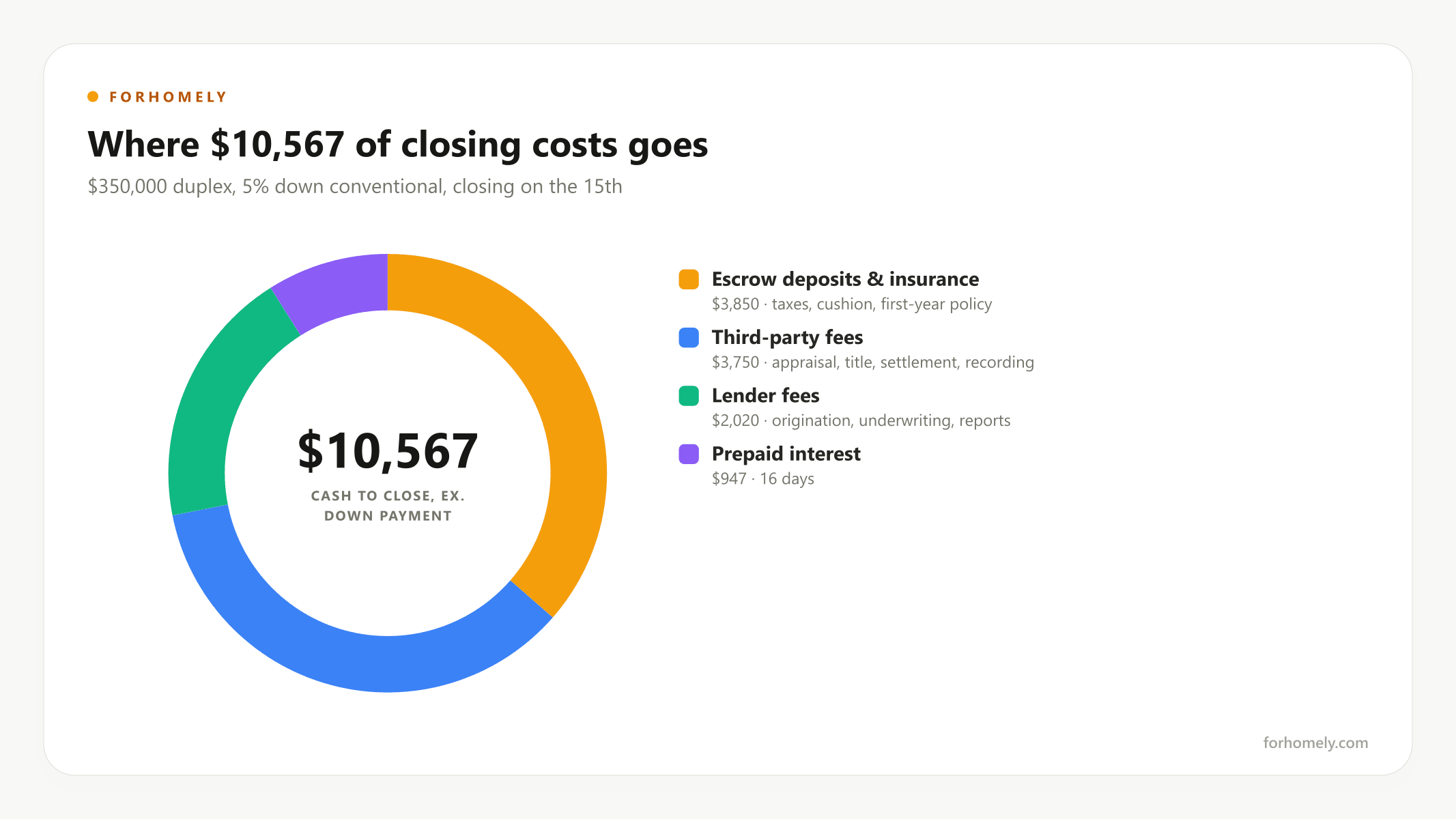
Worked example: $350,000 duplex, 5% down, conventional
Loan amount $332,500 at 6.5%, closing on the 15th, taxes of $3,500 a year, insurance of $1,800.
| Line item | Amount |
|---|---|
| Origination and underwriting | $1,895 |
| Credit report, flood, tax service | $125 |
| Appraisal (2-4 unit with rent schedule) | $1,100 |
| Title search and lender's title policy | $1,450 |
| Settlement fee | $950 |
| Recording and miscellaneous | $250 |
| Prepaid interest (16 days) | $947 |
| First-year insurance premium | $1,800 |
| Property tax escrow deposit (4 months) | $1,167 |
| Escrow cushion (2 months of taxes and insurance) | $883 |
| Total closing costs and prepaids | $10,567 |
That is about 3.0% of the price, and with a $17,500 down payment, cash to close is roughly $28,000. Transfer taxes, an owner's title policy, or a state with attorney closings would add to it.
The rules that protect you from fee creep
Under the federal TRID rules, your lender must give you a Loan Estimate within three business days of application and a Closing Disclosure at least three business days before closing. Fees fall into three tolerance categories:
- Zero tolerance: lender fees, transfer taxes, and fees for services you cannot shop for. These cannot increase at all from the Loan Estimate unless a valid changed circumstance occurs.
- 10% tolerance: recording fees and third-party services where you chose a provider from the lender's list. The total of this group can rise no more than 10%.
- No tolerance limit: prepaid interest, escrow deposits, insurance premiums, and services where you picked your own provider. These are estimates and can change.
Compare the Closing Disclosure to the Loan Estimate line by line. If a zero-tolerance fee went up, the lender owes you the difference.
Five ways to reduce cash to close
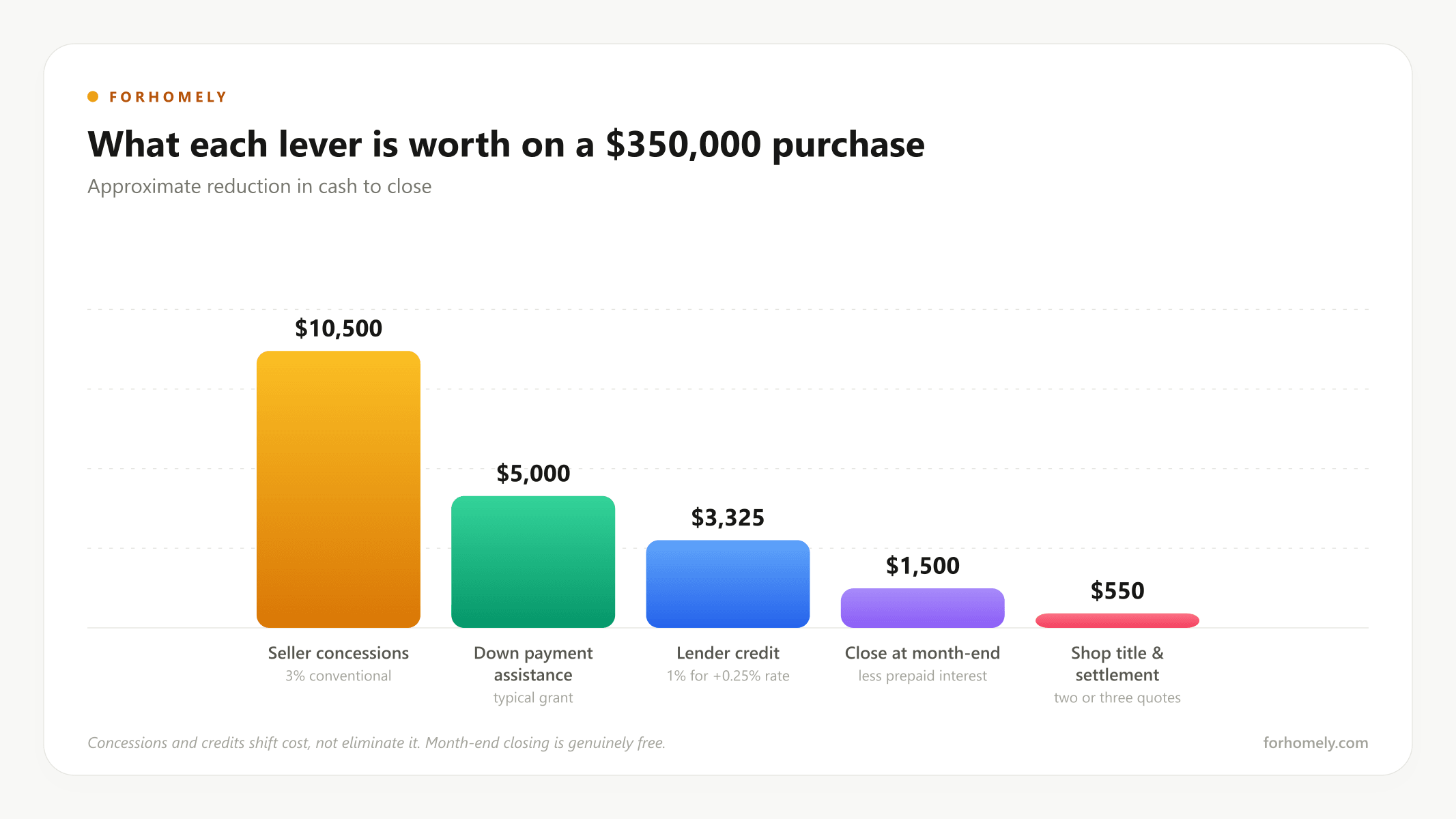
- Negotiate seller concessions. FHA and VA allow the seller to pay up to 6% of the price toward your closing costs and prepaids. Conventional allows 3% with less than 10% down and 6% with 10-25% down. In a balanced or slow market, write the concession into the offer; a $350,000 offer with $8,000 of concessions is often more attractive to a seller than a $342,000 clean offer, because it nets the same and closes.
- Take a lender credit. Accepting a rate 0.25% higher can generate a credit of 1% of the loan amount, about $3,300 here. It costs roughly $55 a month, which is worth it if you expect to refinance or sell within five or six years.
- Close at month-end. Moving from the 2nd to the 28th cuts prepaid interest by about $1,500 on this loan. It does not change what you pay in total, but it lowers cash due at closing.
- Shop title and settlement. These are not fixed prices. In most states, comparing two or three title agents saves $300-$800, and the lender's Loan Estimate lists which services you may shop for.
- Use down payment assistance. Many state housing finance agencies and city programs offer grants or forgivable second liens that cover closing costs for first-time buyers, and most can be combined with FHA or conventional 3-5% down programs on owner-occupied 2-4 units.
A warning about vague estimates and no-cost loans
A worksheet with a single "$2,000 total closing costs" line is not a Loan Estimate and is a red flag. Insist on the standard three-page Loan Estimate, which itemizes every fee and tells you which ones can change. "No-closing-cost" loans are real, but the costs are paid through a higher rate or a larger balance; know which one before you sign.
Plan your full cash to close
The First-Time Homebuyer Mortgage Calculator estimates upfront cash as your down payment plus 3% for closing costs and prepaids, a realistic planning number in most markets, so you can see the true minimum savings required before you start touring. If closing costs are the constraint, the guide to gift funds and co-borrowers covers the legitimate ways family can help.