
Two of the most common reasons first-time buyers are declined have nothing to do with the property: not enough cash, and a debt-to-income ratio that is a few points too high. Both have well-established fixes that lenders see every day. A documented gift solves the cash problem. A non-occupant co-borrower solves the income problem. Neither is a loophole; both are written into the FHA and Fannie Mae rulebooks, with paperwork and limits you need to know before you ask a relative for help.
Gift funds: the rules
A gift is money given to you with no expectation of repayment. Lenders accept it as a source of funds for the down payment, closing costs, and (with limits) reserves, as long as it is documented.
What FHA allows
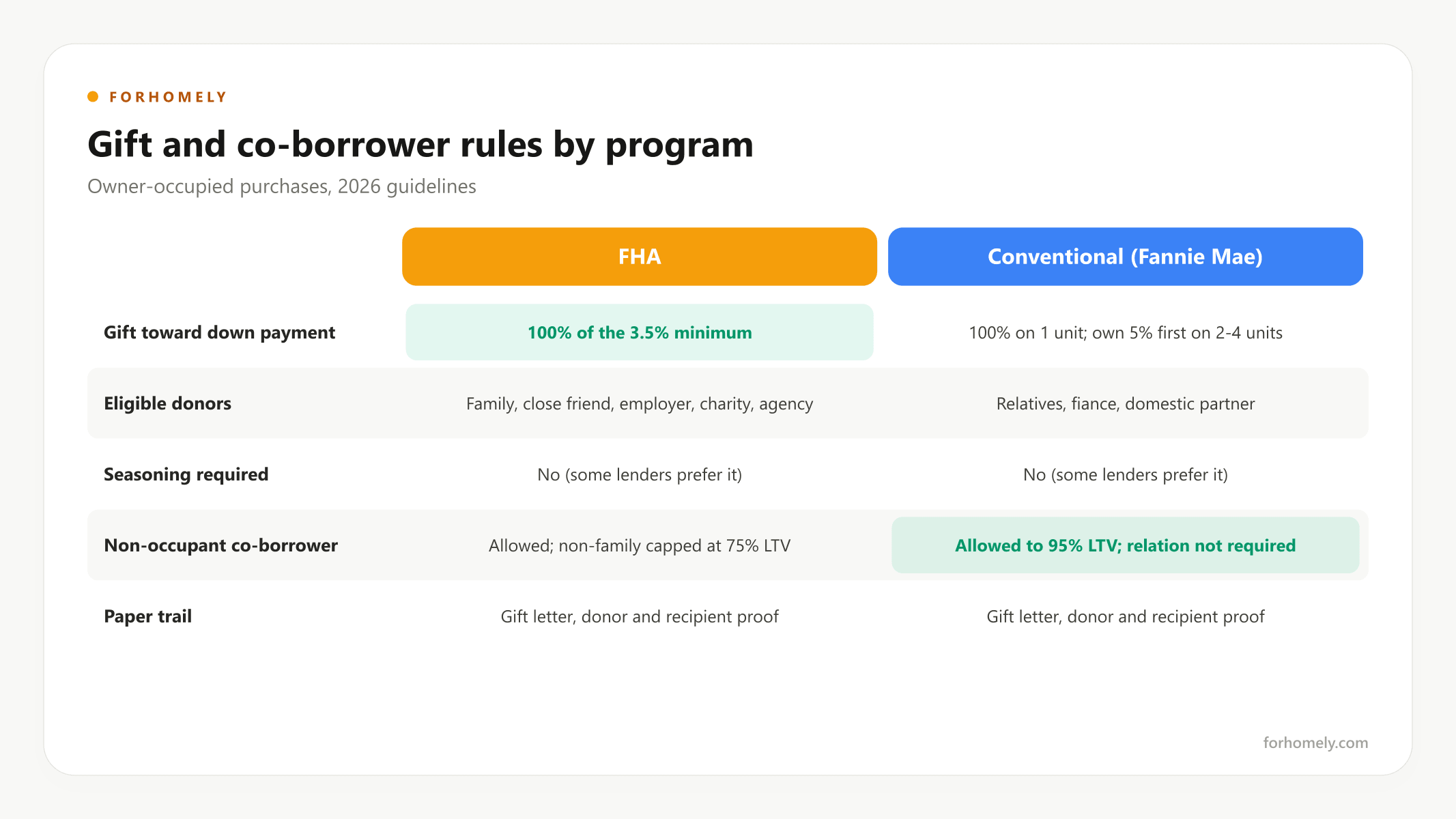
- The entire 3.5% minimum required investment can be a gift.
- Acceptable donors: a family member; a close friend with a clearly defined and documented interest in you; an employer or labor union; a charity; a government agency or public entity that provides homeownership assistance.
- Not acceptable: anyone with an interest in the transaction, including the seller, agent, builder, or their associates.
- Gifts may not be used to meet reserve requirements on manually underwritten loans.
What conventional (Fannie Mae) allows
- On a one-unit principal residence, gifts can fund 100% of the down payment and closing costs at any LTV.
- On a 2-4 unit principal residence with LTV above 80%, you must contribute 5% of the price from your own funds before gifts can be applied. A $380,000 duplex therefore needs $19,000 of your own money; gifts can cover the rest of the down payment and all closing costs.
- Acceptable donors are relatives by blood, marriage, adoption, or legal guardianship, plus a fiancé or domestic partner. Employers and charities fall under separate rules.
The paper trail lenders require
- A gift letter signed by the donor and you, stating the amount, the donor's relationship to you, the property address, and that no repayment is expected.
- Evidence the donor had the funds: usually the donor's bank statement showing the withdrawal, or a copy of the check or wire.
- Evidence you received them: your statement showing the deposit, or the wire confirmation if the gift goes directly to the closing agent.
There is no FHA or Fannie Mae requirement that gift money be "seasoned" in your account for 60 days. Some lenders prefer it because it simplifies the file. If a lender insists, either ask for the gift earlier or find a lender that follows the agency rule.
The tax side, briefly
A gift is not income to you and is not deductible by the donor. For the donor, the annual gift-tax exclusion is $19,000 per recipient in 2026. A gift under that amount requires no filing. Two parents can each give $19,000 to you and $19,000 to your spouse, $76,000 in total, with nothing to file. Above the exclusion, the donor files Form 709 and the excess counts against a lifetime exemption large enough that tax is rarely owed. This is general information; the donor should confirm with a tax professional.
Non-occupant co-borrowers: the rules
A co-borrower signs the mortgage note alongside you. Their income and their debts are added to the file, their credit is pulled, and they are fully liable for the loan. A non-occupant co-borrower does not live in the property and usually is not on the title.
FHA
- Non-occupant co-borrowers are permitted. Their income counts fully toward qualifying.
- If the co-borrower is not a family member, the maximum LTV drops to 75%, which defeats the purpose of a low-down-payment loan. Family members (parents, children, siblings, grandparents, in-laws, and similar) keep the full 96.5% LTV.
- The occupying borrower's DTI is not evaluated separately; the combined ratio is what matters.
Conventional
- Fannie Mae allows non-occupant borrowers on principal residences with LTV up to 95% (and higher under some programs). The borrowers' incomes and liabilities are combined.
- The non-occupant borrower does not need to be related.
- The occupying borrower must still have reasonable credit; the automated underwriting decision is made on the blended file.
A worked example
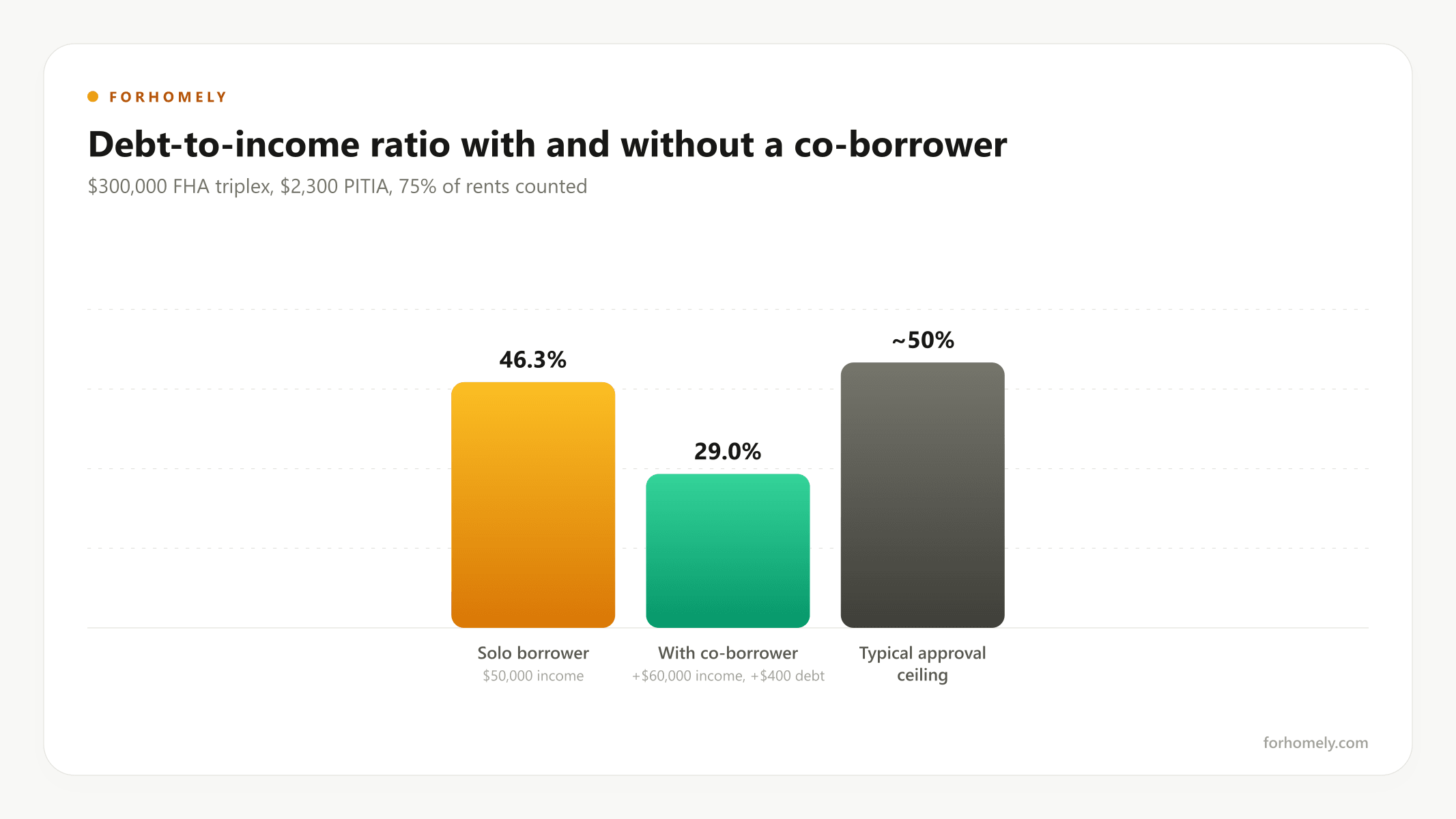
You earn $50,000 a year ($4,167 a month) and carry $500 of car and student loan payments. You want a $300,000 triplex with an FHA loan; the PITIA is about $2,300, and 75% of the two rental units' appraised rent adds $1,875 of income.
- Qualifying income: $4,167 + $1,875 = $6,042
- Debts: $500 + $2,300 = $2,800
- DTI: 46.3%. Workable, but tight, and one lender overlay away from a decline.
Add your parent as a non-occupant co-borrower at $60,000 a year ($5,000 a month) with a $400 car payment:
- Qualifying income: $6,042 + $5,000 = $11,042
- Debts: $2,800 + $400 = $3,200
- DTI: 29.0%. A comfortable approval with room to spare.
The obligations nobody mentions
- The co-borrower is fully liable. A missed payment hits their credit as hard as yours, and the loan counts in their DTI if they want to buy anything themselves.
- It is permanent until you refinance. Plan to refinance in your own name in 12-24 months, once rental history and income growth support it. Some servicers offer a release of liability; most do not.
- Put the agreement in writing. Who owns the property, who pays if a tenant leaves, and what happens on sale. A one-page agreement drafted by a real estate attorney costs a few hundred dollars and prevents a family dispute.
- The co-borrower's credit matters. A co-borrower with a 640 score can raise the rate for both of you; lenders price on the lowest middle score.
- Gifts can affect the donor's own plans. A parent giving $40,000 has $40,000 less in reserves for their own retirement or their own mortgage application.
The playbook
- Ask early. A gift that lands two weeks before closing creates a documentation scramble.
- Have the donor send a wire directly to the closing agent when possible; it produces the cleanest paper trail.
- Sign the gift letter on the lender's form, not a homemade one.
- If you need income rather than cash, ask about a co-borrower before you shop, and pull the co-borrower's credit at pre-approval, not at underwriting.
- Set a refinance target date and put it in the written agreement.
Run the numbers first. The First-Time Homebuyer Mortgage Calculator shows the cash needed to close and the net monthly cost after rent, so you know exactly how large a gift you need and whether a co-borrower is necessary at all. If cash to close is the problem rather than income, seller concessions and lender credits may close the gap without involving family.