One of the least understood advantages of buying a 2-4 unit property as an owner-occupant is that lenders count the rent from the other units toward your qualifying income. This is how buyers earning $60,000-$75,000 a year get approved for $400,000-$500,000 duplexes and triplexes, and it is completely legitimate when it is documented correctly.
This guide explains the three ways rental income helps you qualify, walks through a full debt-to-income example, and lists the paperwork lenders will ask for.
Three ways rental income helps
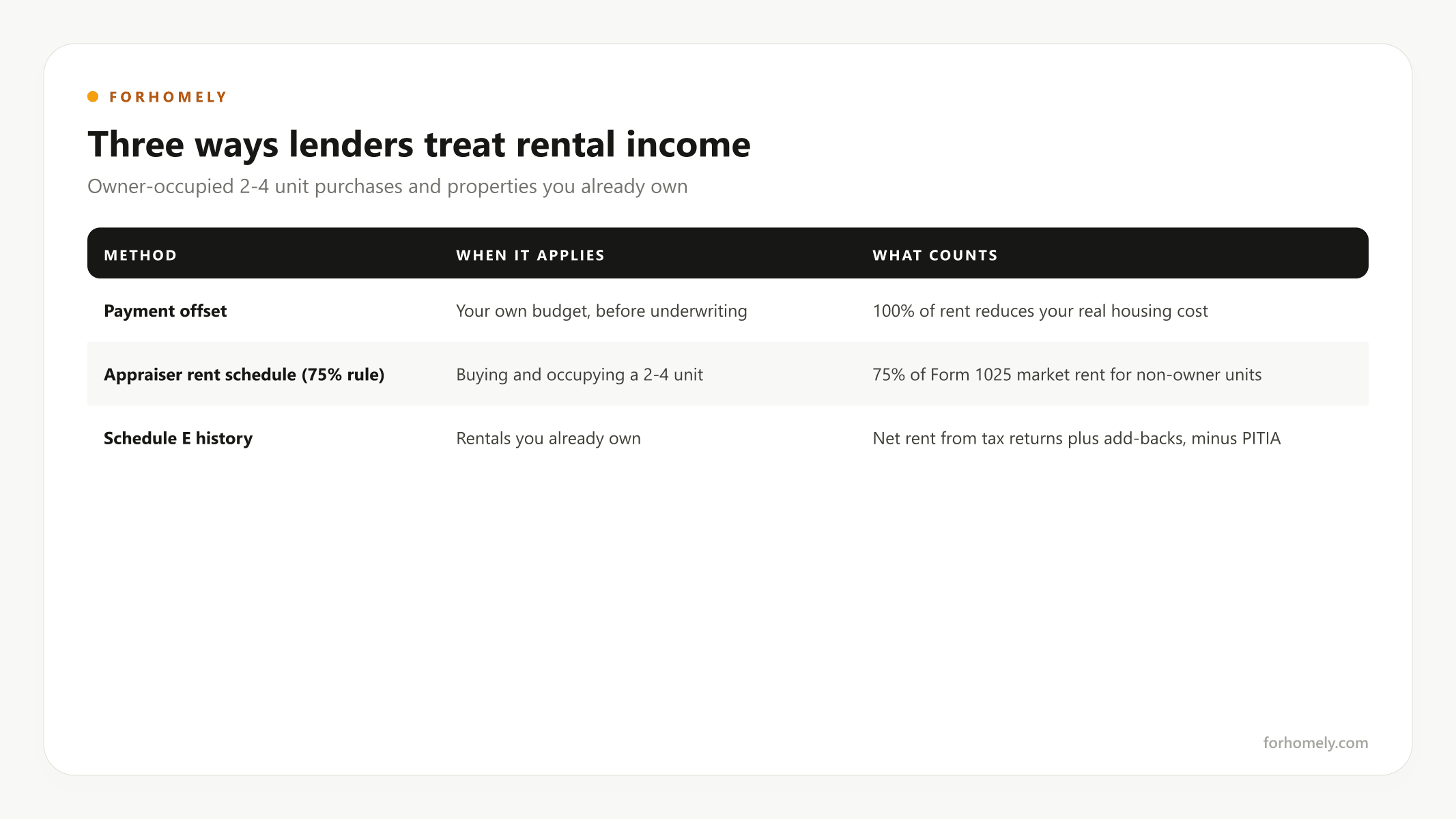
1. It offsets the payment in your real budget
Even before underwriting, choosing a multi-unit property lowers your effective housing cost. A $2,600 PITIA offset by $1,400 of rent behaves like a $1,200 payment in your monthly budget. That is the house-hacking premise, and the House Hacking Calculator models it over five years.
2. Appraiser-based rental income: the 75% rule
For a 2-4 unit property you are buying and occupying, both FHA and Fannie Mae let the lender use the appraiser's rent schedule (Form 1025 for 2-4 unit properties) to estimate market rent for the units you will not occupy. The allowable income is:
Appraiser market rent for non-owner units × 75%
The 25% deduction covers vacancy and maintenance. The result is added to your gross monthly income for the debt-to-income calculation, or, under some automated underwriting treatments, netted against the PITIA. Either way, it does the same job: it makes the payment fit.
On FHA 3-4 unit purchases, the same rent schedule also has to pass the separate self-sufficiency test.
3. Historical rental income for properties you already own
If you already own rentals, lenders want your Schedule E from the last one or two tax returns. They start with net rental income, add back depreciation, mortgage interest, taxes, insurance, and HOA dues (because those are already in your debts), then subtract the property's full PITIA to get a monthly net figure. New investors are often surprised that their actual collected rent counts for less than expected: the tax return, not the bank deposit, drives the number, and large repair write-offs reduce it.
Worked example: qualifying with a duplex
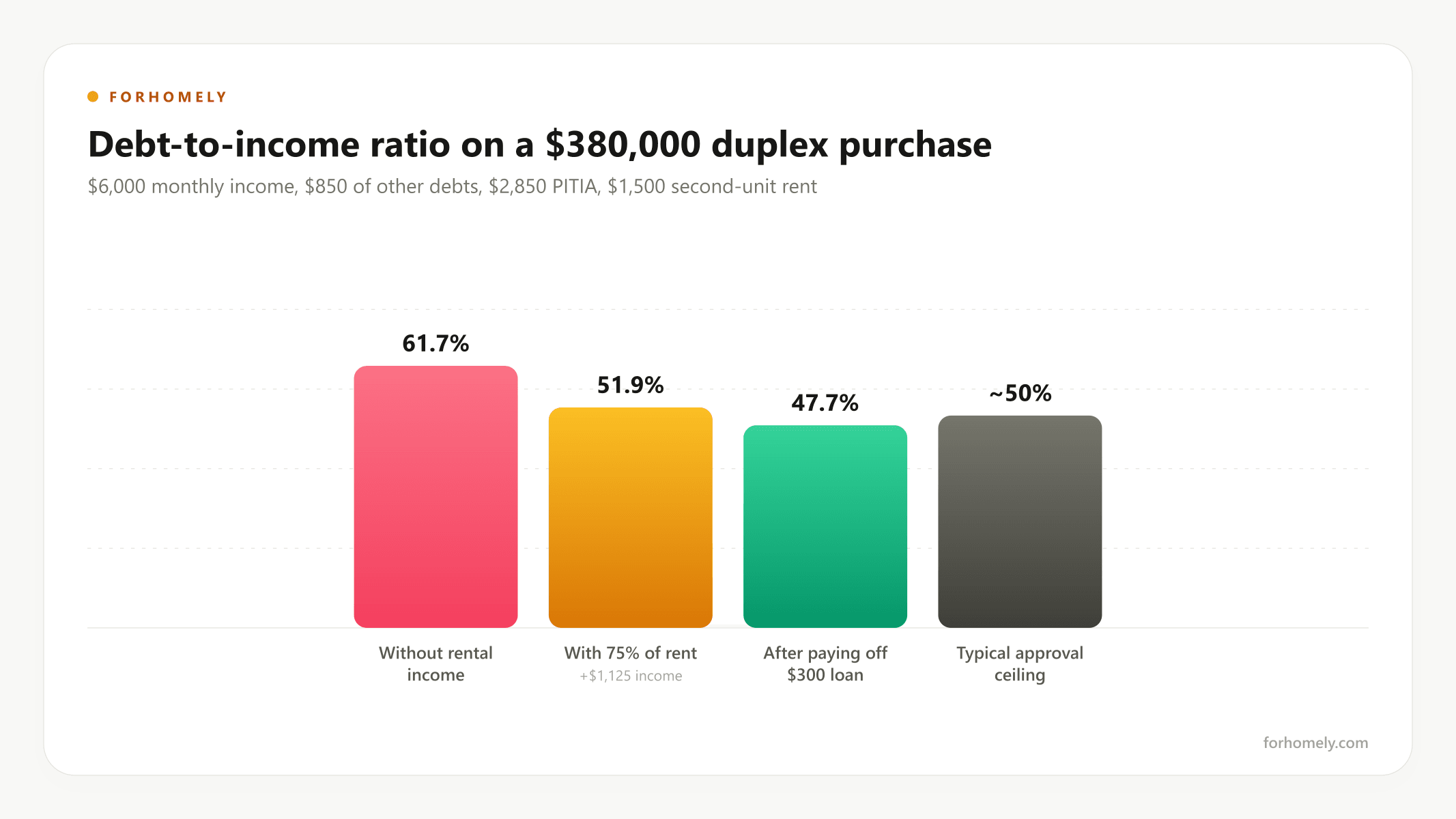
Borrower: $72,000 salary ($6,000 a month), a $550 car payment, and a $300 student loan payment.
Purchase: $380,000 duplex, conventional loan with 5% down at 6.75%, owner-occupied.
- PITIA (including PMI): about $2,850 a month
- Appraiser's market rent for unit 2: $1,500
- Allowable rental income: $1,500 × 0.75 = $1,125 a month
Without rental income:
- Total monthly debts: $550 + $300 + $2,850 = $3,700
- DTI: $3,700 ÷ $6,000 = 61.7%, a decline under any program
With rental income:
- Qualifying income: $6,000 + $1,125 = $7,125
- DTI: $3,700 ÷ $7,125 = 51.9%
That is still high. Conventional automated underwriting tops out around 50% and FHA can go slightly beyond it with compensating factors, so this file is on the edge. Two small moves finish it: paying off the $300 student loan (DTI falls to 47.7%) or buying a $360,000 building instead (PITIA drops about $150, DTI falls to about 49.8%). The point is that a single line item, $1,125 of paper income from a unit that may be vacant at closing, is the difference between a decline and an approval.
Documentation lenders require
- Appraisal with rent schedule. Form 1025 for 2-4 units. Your lender orders it; you pay for it. Make sure the lender orders the right form, because a standard 1004 appraisal without a rent schedule cannot support rental income.
- Existing leases, if units are tenanted. If a lease is below the appraiser's estimate, most lenders use the lower figure.
- Schedule E from your last one or two returns for any rental property you already own, plus current leases and mortgage statements for each.
- Reserves. Fannie Mae requires six months of PITIA on 2-4 unit principal residences in many cases; FHA requires one month on 3-4 units and none on 1-2 units (three months if manually underwritten). Verify your lender's rule early.
- Occupancy certification. You will sign a statement that you intend to occupy one unit within 60 days and for at least one year.
Common mistakes that kill multi-unit approvals
- Counting 100% of the rent. Budget with 75%. Your own spreadsheet should use the same haircut the lender will.
- Using your own rent projections. Only the appraiser's figure counts at purchase. If it comes in low, ask the lender to submit rent comparables for reconsideration.
- Ignoring the self-sufficiency test on FHA 3-4 unit deals. It is a separate, stricter hurdle.
- Undocumented cash rent on properties you already own. If it is not on Schedule E, it does not count, and you have a tax problem as well.
- Forgetting reserves. A buyer who spends every dollar on the down payment and closing costs will be short the six months of PITIA a conventional 2-4 unit loan may require.
Model your qualification scenario
Enter your expected rental offset in the First-Time Homebuyer Mortgage Calculator to see your net out-of-pocket monthly cost, the number your lender's DTI math is effectively solving for. Then read about DSCR loans to see how investor lending flips the logic entirely: there, the property's rent, not your income, is the only qualifying factor.