A DSCR loan (Debt Service Coverage Ratio loan) is an investor mortgage that qualifies the property instead of the person. No tax returns, no W-2s, no debt-to-income calculation. The lender asks one question: does the rent cover the payment? For self-employed investors, for anyone who has hit the conventional ten-property cap, and for buyers whose tax returns understate their real income, DSCR lending has become the dominant way to finance 1-4 unit rentals.
Quick definition: a DSCR loan is a business-purpose mortgage on a non-owner-occupied 1-4 unit property, approved on the ratio of gross monthly rent to the total monthly payment (PITIA). A ratio of 1.25 or higher qualifies for prime investor pricing and up to 80% loan-to-value with no personal income verification.
Investor insight from Toheeb Ekundayo, MBA: "DSCR loans are how a small portfolio scales past conventional debt-to-income caps. Aim for 1.25 or better before you apply. The extra cushion buys you prime pricing today and a margin for vacancy tomorrow."
How the ratio is calculated
DSCR = Gross Monthly Rent ÷ PITIA
PITIA is principal, interest, taxes, insurance, and association dues, plus mortgage insurance if the program has any (most DSCR loans do not).
Most residential DSCR lenders use 100% of gross rent from the lease or the appraiser's Form 1007 rent schedule, whichever is lower. A minority apply a 75-85% haircut for vacancy, which materially changes the math on the same building. Always confirm the convention before you compare quotes.
Example. Gross monthly rent of $2,400 against a PITIA of $1,900 is a DSCR of 1.26. The property covers its payment with a 26% cushion.
The approval tiers
| DSCR | Typical outcome |
|---|---|
| Below 1.00 | The property loses money each month. Most lenders decline; a few offer "no-ratio" programs at 65-70% LTV and materially higher rates. |
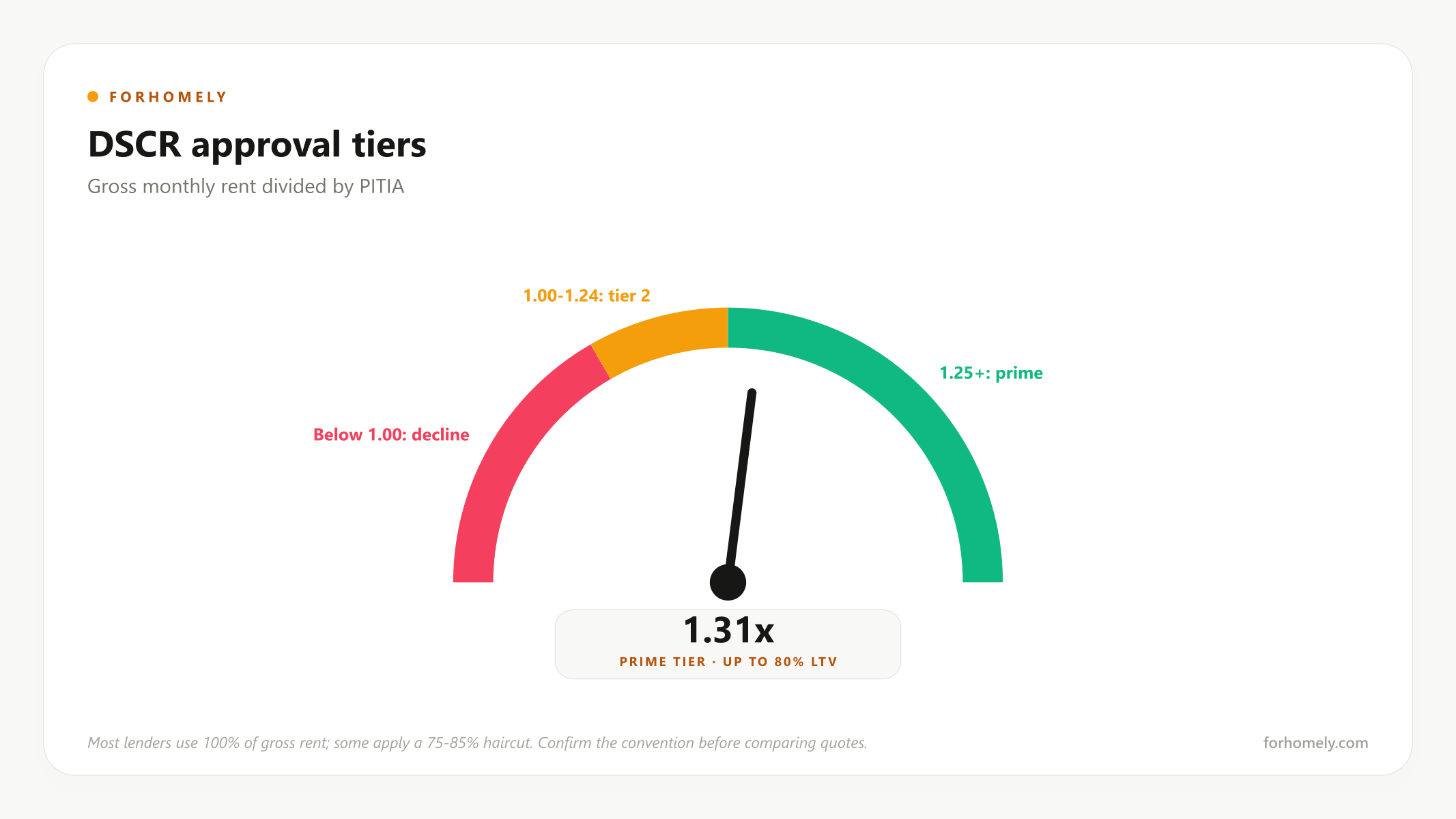
| 1.00 to 1.24 | Approvable at tier-2 pricing: a higher rate, LTV capped around 70-75%, and more reserves. |
| 1.25 and above | Prime investor pricing: best rates, LTV to 80%, standard reserves. |
| 1.50 and above | Some lenders offer rate discounts or waive reserves. |
The 1.25 threshold is the industry's line because it represents a 25% cushion over the payment, enough to absorb a month of vacancy or a repair without the loan going underwater.
Typical 2026 DSCR guidelines
Programs vary by lender, but the mainstream terms look like this:
- Down payment: 20-25% on purchases (maximum LTV 75-80%). Cash-out refinances are usually capped at 70-75%.
- Credit score: 620-640 minimum at most lenders; best pricing at 700+, and many programs step up LTV at 680 and 720.
- Reserves: three to six months of PITIA after closing; some programs waive reserves above a 1.50 ratio.
- Loan amounts: commonly $100,000 to $3 million; some lenders go lower or higher.
- Property types: 1-4 unit residential, warrantable condos, townhomes; a growing number of lenders finance 5-8 unit buildings on a DSCR basis.
- Occupancy: investment only. You cannot live in the property.
- Vesting: individual or LLC, usually with a personal guarantee.
- Income documentation: none. Expect a credit pull, bank statements to verify reserves, the lease or rent schedule, and an ID.
- Terms: 30-year fixed is standard; 40-year with a 10-year interest-only period, and 5/6 or 7/6 adjustable options are common.
- Prepayment penalties: common, typically a 3-year or 5-year step-down (for example 3-2-1: 3% of the balance in year one, 2% in year two, 1% in year three). Some states restrict or prohibit them, and most lenders will reduce or remove the penalty for a higher rate.
DSCR versus conventional investor loans
| Feature | DSCR loan | Conventional investor loan |
|---|---|---|
| Qualification | Property rent | Your income and debt-to-income ratio |
| Tax returns | No | Yes, two years |
| Maximum LTV | 75-80% | 75% on 1 unit, 75% on 2-4 units |
| Financed property limit | Set by each lender, usually generous | Ten financed properties, agency-wide |
| Vesting | Individual or LLC | Individual only |
| Rate | Roughly 0.75-1.5 points higher | Lower |
| Prepayment penalty | Usually | Never |
| Closing speed | Two to three weeks | Four to six weeks |
| Best for | Self-employed, scaling investors, LLC ownership | W-2 borrowers with low DTI and few properties |
Worked example: when DSCR beats conventional
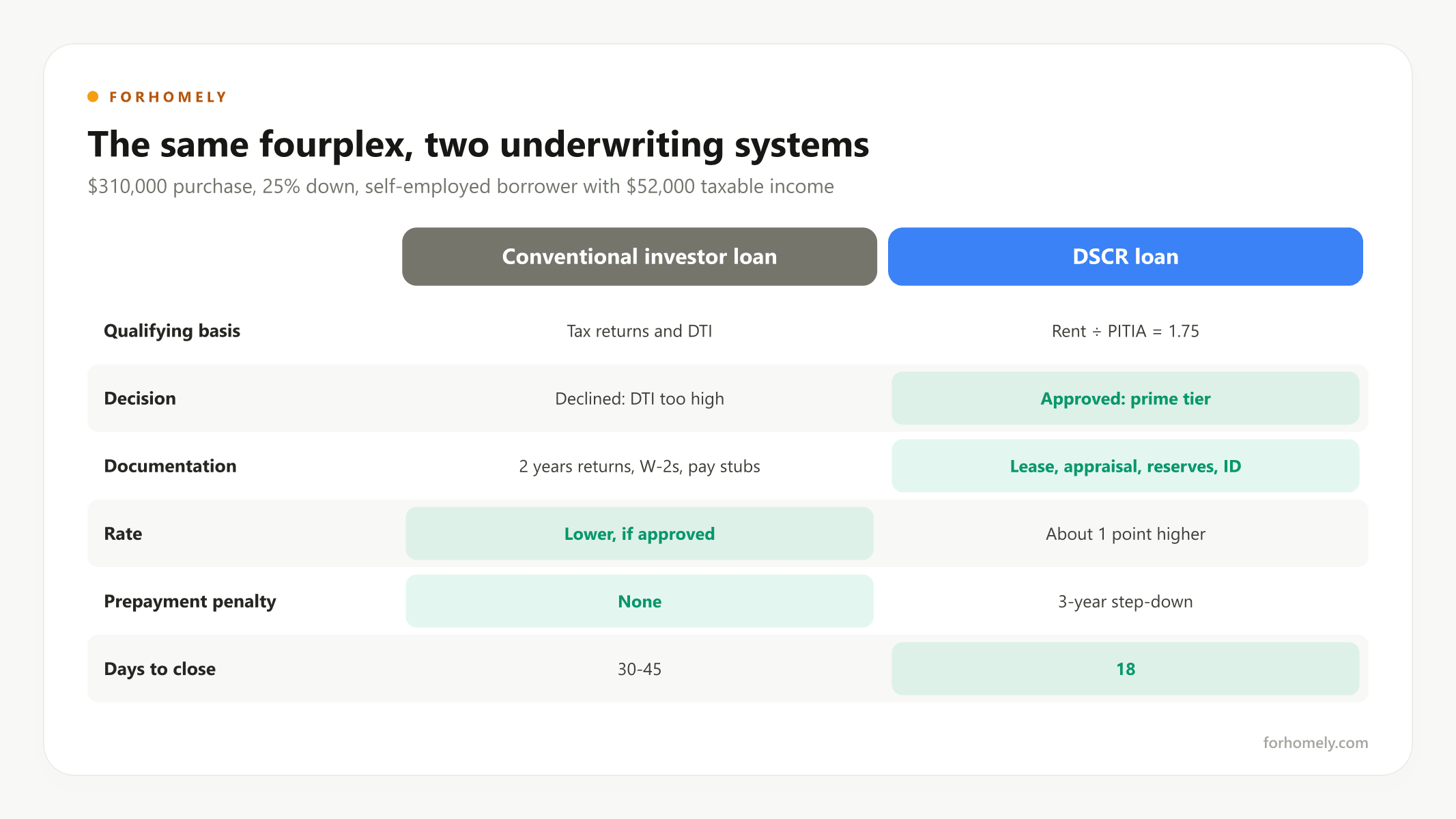
Maria is a freelance designer. Her tax returns show $52,000 of income after deductions, which is not enough debt-to-income capacity for a conventional loan on a $310,000 fourplex. But the fourplex grosses $3,900 a month:
- Loan at 75% LTV: $232,500 at 7.5%, principal and interest about $1,625
- Taxes $420, insurance $180
- PITIA: $2,225
- DSCR = $3,900 ÷ $2,225 = 1.75
Under conventional underwriting she is declined. Under DSCR she is a prime borrower with a strong cushion, and no one asks about her tax returns. She puts $77,500 down, holds three months of PITIA in reserves ($6,675), and closes in 18 days. This is exactly the scenario the product was built for.
The downsides to understand
- Higher rates and fees. You pay for the documentation convenience. On a $232,500 loan, one extra point of rate is about $150 a month.
- Prepayment penalties. A 5-year penalty on a property you sell in year two costs thousands. Negotiate the penalty period against the rate before you lock.
- Rent dependence. If the appraiser's rent schedule comes in low, your ratio drops and your pricing worsens mid-deal. Supply leases and rent comparables at application.
- No owner-occupancy. Use FHA or conventional for a house hack; the FHA vs. Conventional comparison covers those options.
- Not always the cheapest investor loan. If you have a banking relationship, a portfolio lender may beat DSCR pricing with hybrid underwriting.
How to prepare a DSCR application
- Run the ratio yourself first with the actual lease or a realistic market rent, using the full PITIA including HOA dues.
- Pull your credit and fix anything under 700 that can be fixed in 30 days.
- Hold reserves in a seasoned account; large recent deposits will be questioned even without income verification.
- Decide on vesting (personal name or LLC) before you apply, because changing it later restarts the file.
- Get two quotes and compare the rate, the LTV, and the prepayment terms together, not the rate alone.
Check your ratio first
Before you talk to a lender, run your deal through the DSCR Loan Calculator. It computes your ratio, shows your approval tier, and tells you the rent needed to reach 1.25, so you know your negotiating position before the lender quotes you. If the ratio is tight, the guide to cash-out refinancing versus a HELOC shows how a larger down payment funded from another property changes the math.