DSCR lending has become the dominant investor financing product in the country, and for good reason: it is fast, standardized, and it does not care about your tax returns. But it is not the only way to finance a rental, and it is often not the cheapest. The alternative most beginners never discover is portfolio lending: local banks and credit unions that hold loans in-house and underwrite you and the property together. On a typical 2-4 unit purchase, the difference can be $9,000 of interest over a decade.
What a portfolio loan is
A portfolio loan stays on the lender's balance sheet. It is not sold to Fannie Mae or Freddie Mac and not securitized. Because the lender is keeping the risk, it writes its own underwriting rules. No agency overlays. No PMI. No ten-financed-property cap. Underwriting is hybrid: the bank looks at your income and credit and at the property's rents, and it can weigh a strong file on one side against a weakness on the other.
The portfolio versus commercial mortgage guide covers what happens when you move up to five or more units. This guide compares portfolio lending with DSCR lending on the 1-4 unit properties where most investors start.
DSCR: property-only underwriting
A DSCR lender divides the rent by the payment. Above 1.25, prime pricing; between 1.00 and 1.24, tier-2; below 1.00, a decline or a no-ratio program. Your personal income is not evaluated. The DSCR loan guide covers the full 2026 guidelines.
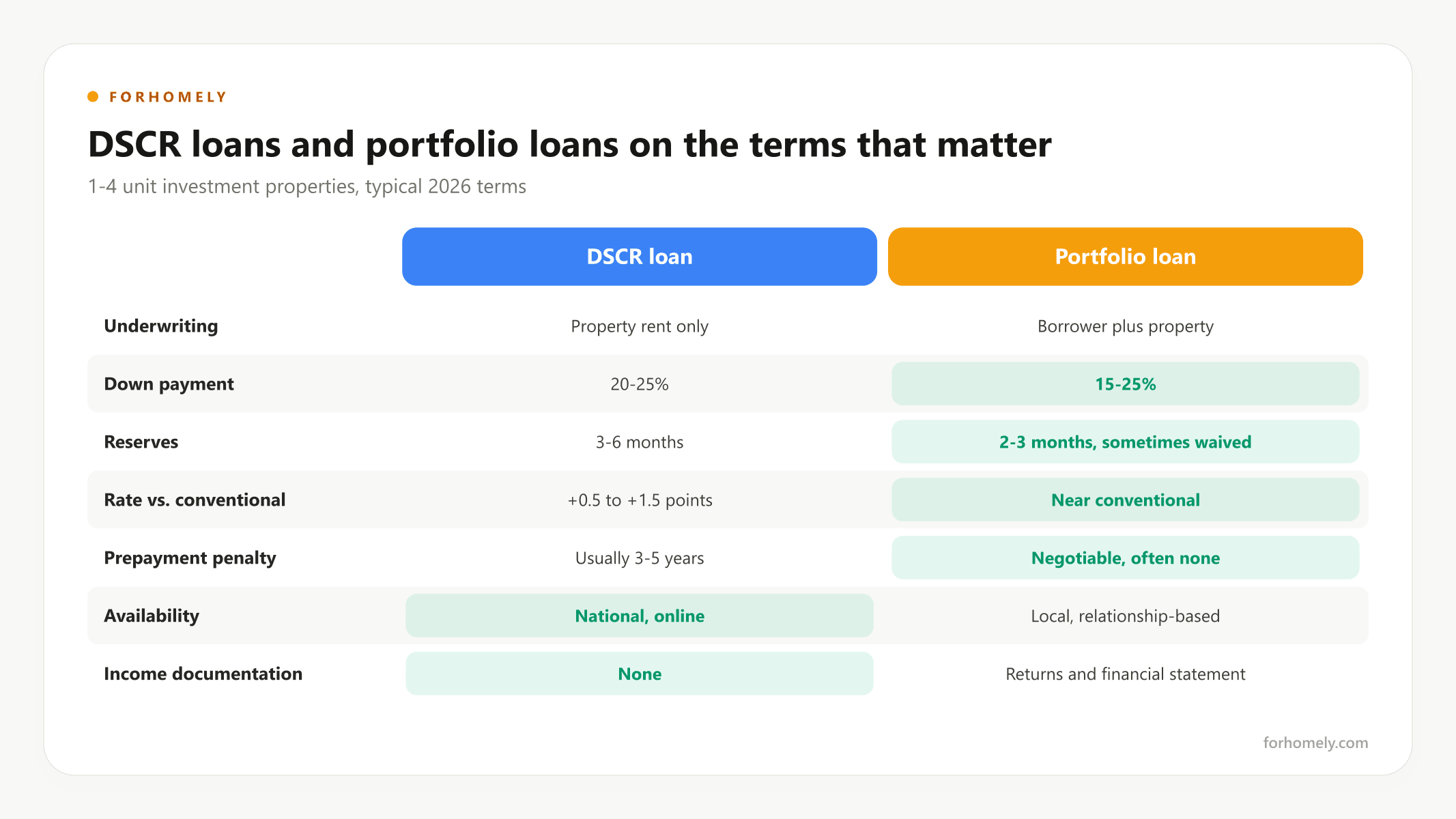
| DSCR loan | Typical terms |
|---|---|
| Down payment | 20-25% |
| Maximum LTV | 75-80% |
| Reserves | 3-6 months |
| Credit score | 620-660 minimum; 700+ for best pricing |
| Rate | Roughly 0.5-1.5 points above conventional investor rates |
| Prepayment penalty | Usually, 3-5 years |
| Vesting | Individual or LLC |
The edge: no income documentation, unlimited property count, national availability, mechanical approval.
The cost: you pay for the simplicity in rate, in fees, and in the prepayment penalty.
Portfolio: hybrid underwriting
| Portfolio loan | Typical terms |
|---|---|
| Down payment | 15-25% |
| Maximum LTV | 75-85%, bank-dependent |
| Reserves | Often 2-3 months, sometimes waived |
| Credit score | 660-680 minimum in practice |
| Rate | Near conventional investor rates, sometimes below DSCR by 0.5-1.0 point |
| Prepayment penalty | Negotiable, often none or one year |
| Vesting | Individual or LLC |
| Term structure | 5-10 year fixed with reset or balloon is common; some banks fix for 15-30 |
The edge: better pricing, lower fees, flexible terms, and a banker who can approve an unusual file.
The cost: you need a relationship, you may need to move deposits, and terms are less standardized, so you must read them carefully.
Worked example: a $250,000 triplex, 20% down
A W-2 borrower earning $65,000 buys a triplex renting $1,600, $1,400, and $1,300 ($4,300 a month) with $50,000 down. Both lenders approve; the terms differ.
| Factor | DSCR loan | Portfolio loan |
|---|---|---|
| Loan amount | $200,000 | $200,000 |
| Interest rate | 7.0% | 6.5% |
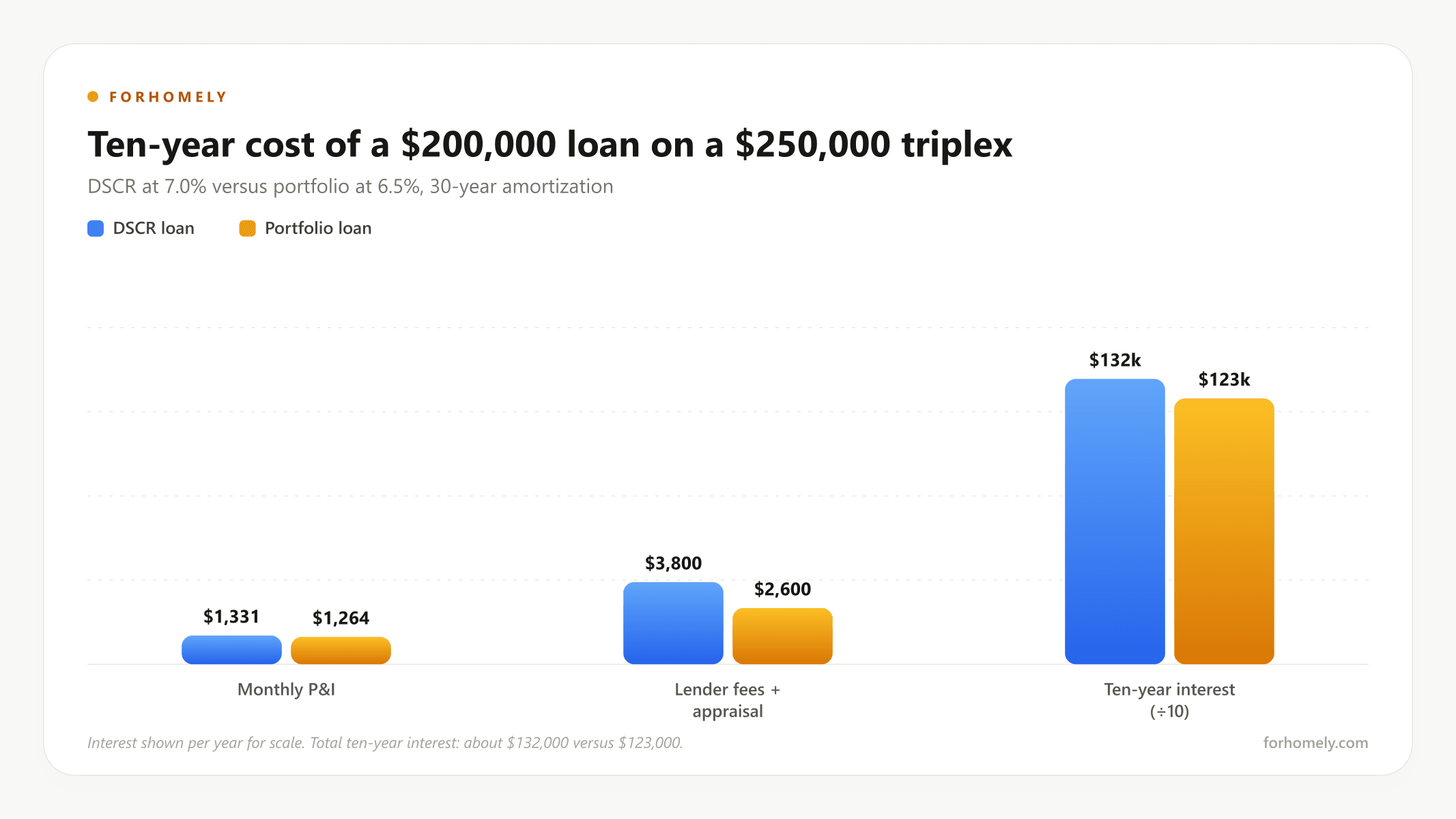
| Monthly P&I | $1,331 | $1,264 |
| Year-one interest | About $13,900 | About $12,900 |
| Ten-year interest | About $132,000 | About $123,000 |
| Lender fees and appraisal | About $3,800 | About $2,600 |
| Prepayment penalty | 3-2-1 step-down | None after year one |
| Time to close | About 21 days | About 30 days |
The portfolio loan saves about $69 a month, roughly $9,000 of interest over ten years, plus $1,200 in closing costs, and it leaves you free to refinance or sell without a penalty. The DSCR loan closed nine days faster and never asked about the borrower's income.
Now change one fact: the borrower is self-employed with $52,000 of income after deductions. The portfolio bank's hybrid underwriting may still approve on the strength of the rents and reserves, but many will not. The DSCR lender does not care. That is the whole trade.
When DSCR wins
- A thin ratio. Portfolio banks get nervous below 1.20; several DSCR programs work down to 1.00, and no-ratio programs exist at lower leverage.
- Marginal or complicated income. Self-employed, newly self-employed, heavy write-offs, or income that does not show on a tax return.
- Credit in the 620-660 range. DSCR lenders price it; many portfolio banks decline it.
- Out-of-state purchases. You have no banking relationship where the building is. DSCR lenders are national.
- Speed at volume. Closing your fourth property in 18 months on a tight timeline favors a standardized process.
- You are past ten financed properties and the bank's exposure limit is lower than the DSCR lender's.
When portfolio lending wins
- Good credit and verifiable income. If you qualify on both metrics, portfolio pricing usually beats DSCR by half a point or more.
- Long-term holds. You are buying to keep. Build the relationship, get the better rate, skip the prepayment penalty.
- Lower down payment. Some portfolio banks lend to 85% on strong files; DSCR tops out at 80%.
- Unusual properties or structures. A mixed-use building, a non-warrantable condo, a purchase through a partnership, or a renovation that needs an interest-only period.
- Local knowledge. A community bank that has lent on the same street for decades will often value a building more accurately than a national appraisal-management pipeline.
How to find and approach a portfolio lender
- Make a list: community banks, credit unions, and regional banks within an hour of the property. Ask each whether it holds investor mortgages in portfolio.
- Ask for the commercial or business banking side, not the residential mortgage desk, which usually sells to the agencies.
- Bring a package: two years of returns, a personal financial statement, the property's rent roll and expenses, and your reserves. Portfolio underwriting rewards preparation.
- Open the relationship early. A deposit account and a small line of credit six months before you need a mortgage make the mortgage conversation easier.
- Compare the package, not the rate: LTV, reserves, prepayment terms, the fixed period, and what happens at reset.
The strategic play
Get pre-approved with a DSCR lender and a portfolio lender before you start shopping. More often than not, the portfolio lender is cheaper and the DSCR lender is faster. Use the DSCR approval to write confident offers with short closings when speed matters, and use the portfolio approval when you can give the bank thirty days. Either way, run the property through the DSCR Loan Calculator first: both lenders are going to look at the same ratio, and you should see it before they do.