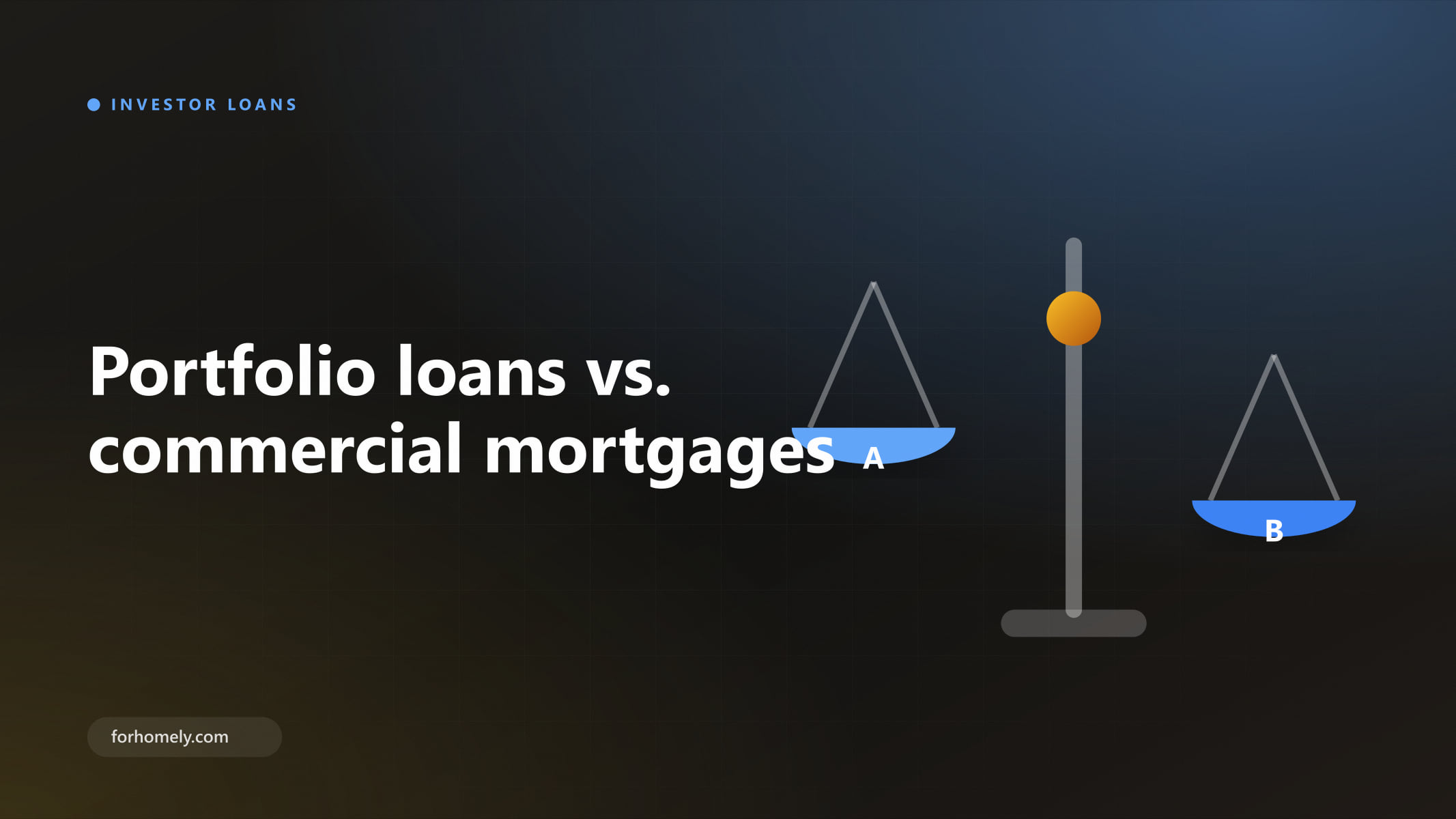
Once you move beyond conventional and FHA financing, two doors open: portfolio loans and commercial mortgages. They overlap, and the same community bank may offer both, but they serve different properties, different borrowers, and different strategies. Choosing the wrong one costs basis points at best and, with a badly timed balloon, the building at worst.
What a portfolio loan is
A portfolio loan is held on the lender's own balance sheet rather than sold to Fannie Mae or Freddie Mac. Because the lender keeps the risk, it does not have to conform to agency rules and can write its own:
- Sources: community banks, credit unions, and some regional banks.
- Underwriting: relationship-driven and hybrid. The bank looks at your income, your deposits, and your track record as well as the property's rent.
- Terms: negotiable. Interest-only periods during a renovation, blended rates, and flexible documentation are all possible.
- Property types: anything the bank is comfortable with, including 1-4 units, mixed-use, non-warrantable condos, and buildings with an unpermitted unit that agency lenders would reject.
- Rates: typically between conventional investor loans and hard money, often fixed for 5-10 years and sometimes for 15-30.
The portfolio lender guide covers how these loans compare with DSCR loans on 1-4 unit properties. This article focuses on the boundary between portfolio and commercial lending.
What a commercial mortgage is
Strictly, a commercial mortgage finances property used for commercial purposes, which in multifamily means five or more units. Banks also apply commercial logic to 2-4 unit and mixed-use buildings owned in an entity, often calling the product a "commercial-style" or "business" loan:
- Underwriting: primarily on net operating income and DSCR, secondarily on the sponsor's liquidity and experience.
- Structure: fixed for 5, 7, or 10 years, then a balloon or a rate reset; amortized over 25-30 years.
- Recourse: almost always a personal guarantee at this size.
- Pricing: a spread over a benchmark, typically SOFR for floating rates or the matching Treasury for fixed.
- Minimum DSCR: usually 1.20-1.25 on NOI (not gross rent), at a maximum LTV of 75-80%.
- Escrows and reserves: taxes and insurance are usually escrowed, and many lenders require a funded replacement reserve of $250-$350 per unit per year.
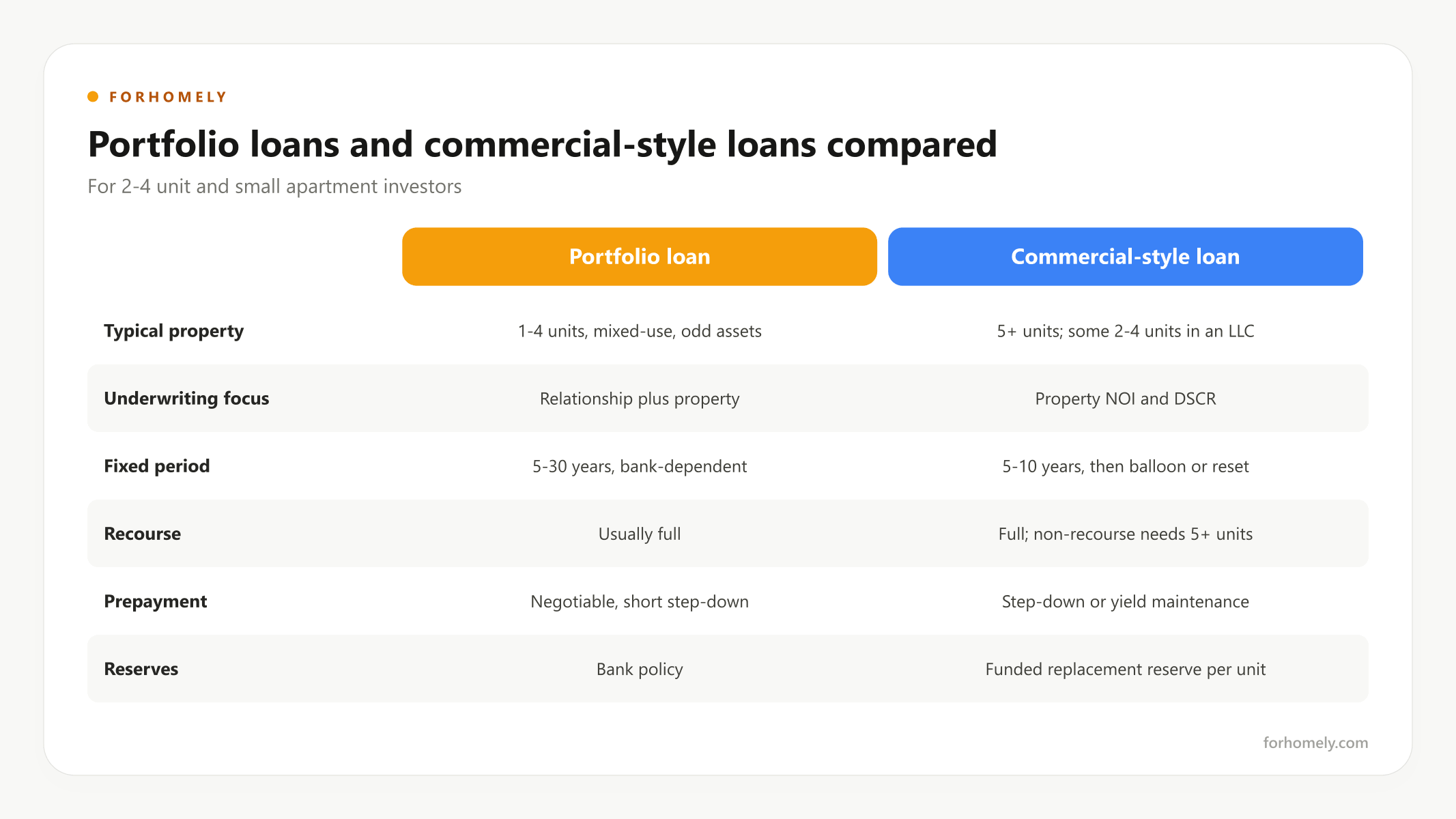
Side-by-side comparison
| Feature | Portfolio loan | Commercial-style loan |
|---|---|---|
| Typical property | 1-4 units, mixed-use, non-conforming assets | 5+ units; sometimes 2-4 units in an LLC |
| Underwriting focus | Borrower relationship plus property | Property NOI above all |
| Fixed period | 5-30 years, bank-dependent | 5-10 years, then balloon or reset |
| Amortization | 15-30 years | 25-30 years |
| Recourse | Usually full | Full at this size; non-recourse needs 5+ units and low leverage |
| Prepayment | Negotiable, often a short step-down | Step-down or yield maintenance |
| Reserves | Bank policy | Replacement reserve per unit, often escrowed |
| Speed | Three to six weeks | Four to eight weeks |
| Best for | Unusual properties, relationship borrowers, renovation periods | Cash-flowing buildings held long-term |
When a portfolio loan wins
- The property does not fit an agency box. A storefront with two apartments above, a non-warrantable condo, a triplex with an unpermitted fourth unit, or a building that needs work before it will appraise.
- You have an unusual income profile and a real banking relationship. A banker who knows your deposits and your track record can approve what an algorithm rejects.
- You want interest-only flexibility during a renovation, then a conversion to amortizing payments.
- You are over the ten-financed-property conventional cap and DSCR pricing is unattractive.
When a commercial-style loan wins
- The building's income is strong and verifiable. NOI-driven underwriting rewards a well-run building regardless of your personal debt-to-income ratio.
- You are buying five or more units, where commercial lending is the only option other than agency multifamily programs.
- You want maximum leverage on a strong deal. Some commercial lenders go to 80% LTV on 5+ units with a 1.35+ DSCR.
- You plan to hold long-term and can refinance before the balloon, or the lender offers extension options you have negotiated in advance.
The balloon risk, read this twice
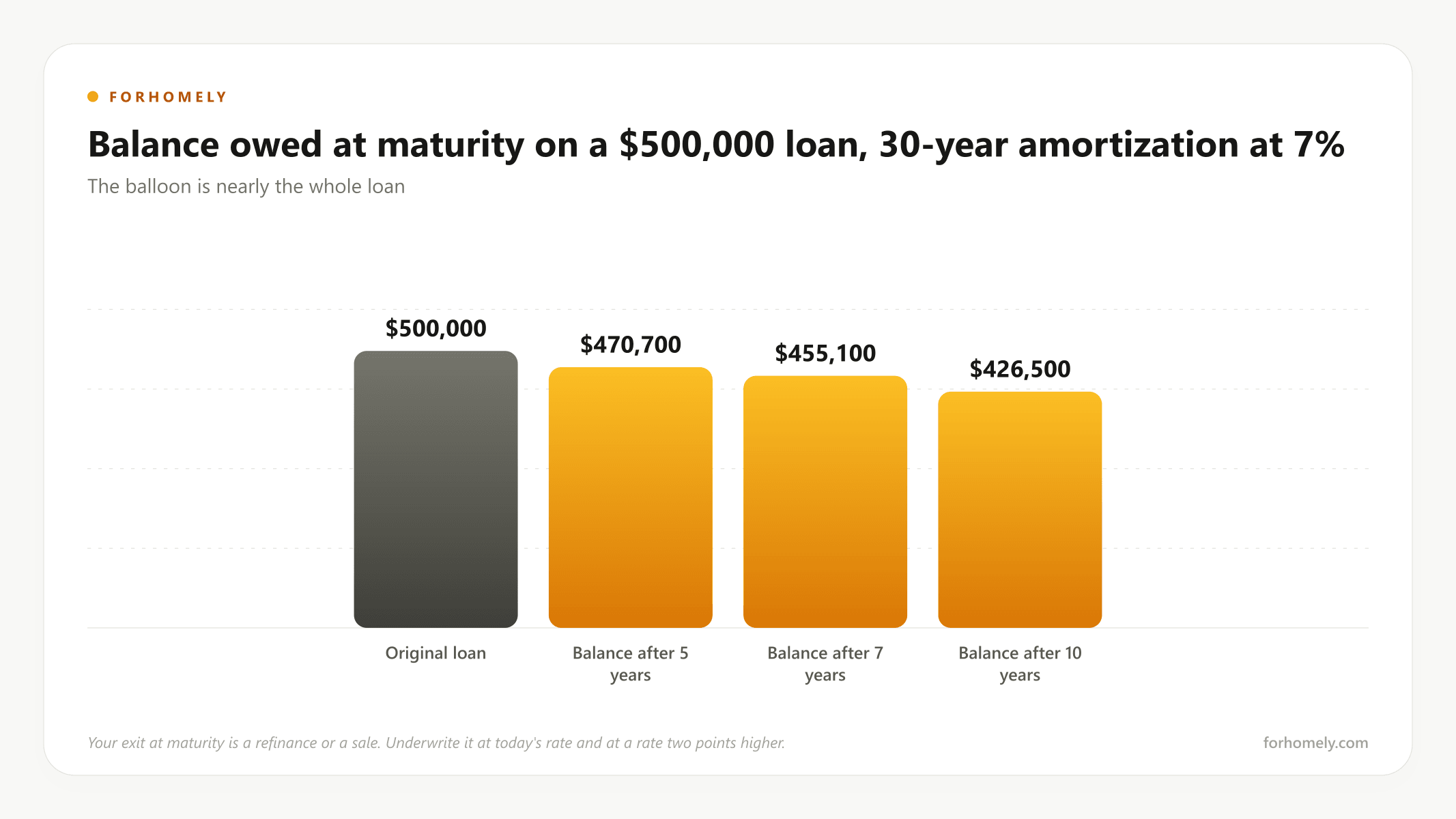
A 7-year fixed commercial loan amortized over 30 years still owes about 90% of the original balance at maturity. That is the balloon payment, and it is due in full. Your exit plan must exist before closing: refinance, sell, or pay down. Investors who bought in 2013-2016 with 7-year balloons hit the 2022-2023 rate reset with no plan and found that the same building, at a rate three points higher, no longer covered a refinance at the balance they owed.
Underwrite the exit two ways: at today's rate, and at a rate two points higher. If the building only refinances in the first case, the loan is a bet on rates, not on the property.
Recourse and what it really means
A recourse loan is backed by your personal guarantee. If the lender forecloses and the sale does not cover the balance, it can pursue your other assets for the deficiency, subject to state law. Nearly all loans under roughly $2 million are recourse. Non-recourse debt, where the lender is limited to the property, generally requires five or more units, a larger loan, lower leverage, and a sponsor with experience, and it always includes carve-outs (fraud, environmental damage, unauthorized transfers) that restore personal liability. An LLC does not convert a recourse loan into a non-recourse one; the guarantee follows you.
Questions to ask any portfolio or commercial lender
- Is this loan recourse or non-recourse, and what triggers the carve-outs?
- What is the prepayment structure: step-down, yield maintenance, or open after a period?
- What DSCR and LTV do you require for this property type, and is DSCR calculated on NOI or gross rent?
- What happens at maturity: extension options, reset terms, and refinance expectations?
- Do you escrow taxes and insurance, and do you require a funded replacement reserve?
- Will the loan be in my name or the entity's, and what deposits or relationship do you expect?
- What is the rate benchmark and the spread, and how often can a floating rate adjust?
Compare the whole financing picture
Whichever loan you consider, the property side of the underwriting is the same math a DSCR lender does. Run the proposed payment through the DSCR Loan Calculator to see how the building's rent covers it, and run the full income statement through the Multifamily Cash Flow Calculator to confirm the NOI a commercial lender will underwrite. If the deal only works at 80% leverage with a thin DSCR, no loan structure will fix it.