
Seller financing, also called owner financing or a seller carry, means the property seller acts as the bank. Instead of a buyer getting a mortgage from a lender, the seller carries a note: the buyer pays the seller principal and interest over time. It sounds unusual. It happens far more often than new investors expect, especially on older 2-4 unit buildings that conventional lenders dislike, and it can close deals that nothing else can.
This guide covers why sellers agree, how to structure the note so it protects you, the two structures to avoid, the federal rules that apply if you will live in the property, and a worked example from offer to payoff.
Why sellers carry paper
- Monthly income at a good rate. A retired owner who sells a fourplex outright gets a lump sum earning 3-4% in a savings account. Carrying a $300,000 note at 6.5% produces about $1,900 a month for years. For many long-time owners, that beats the alternatives.
- Tax deferral through installment-sale treatment. A seller who has owned the building for decades may face a large capital gain plus depreciation recapture. Under IRS installment-sale rules, most of the gain is recognized as payments arrive, spreading the tax over years instead of one bill. (Recapture of depreciation is generally recognized in the year of sale; the seller's CPA will model it.)
- A faster sale of a hard-to-finance property. A building with deferred maintenance, an odd layout, a mixed-use zoning, or an unpermitted unit attracts few financed buyers. The seller who carries paper widens the buyer pool and usually gets a higher price for it.
- Free-and-clear ownership. Sellers without a mortgage are the ideal carry candidates, because there is no underlying loan with a due-on-sale clause to worry about.
How a seller carry is structured
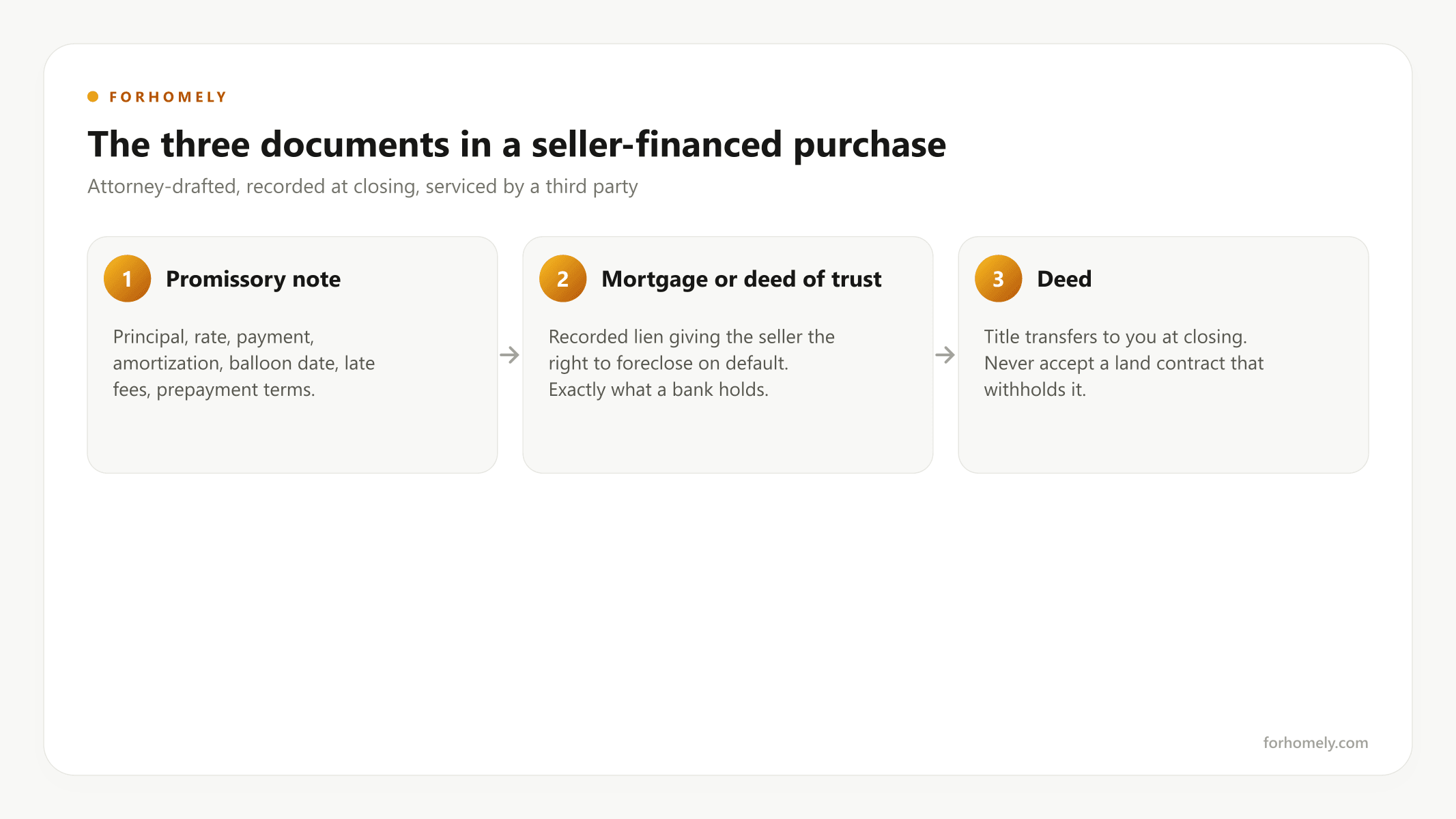
A properly structured carry has three documents:
- The promissory note: the loan agreement, stating the principal, rate, payment, amortization, maturity or balloon date, late fees, and prepayment terms.
- The mortgage or deed of trust: the security instrument, recorded against the property, giving the seller the right to foreclose if you default. This is exactly what a bank would hold.
- The deed: transferring title to you at closing. You own the building; the seller holds a lien.
A note servicing company should collect payments, track the balance, and issue year-end statements to both parties. It costs $20-$40 a month and prevents most disputes.
Typical terms
| Term | Common range | Notes |
|---|---|---|
| Down payment | 10-20% | Shows commitment; 10% is a credible floor |
| Interest rate | Near market, 6-8% | Fixed for the term |
| Amortization | 20-30 years | Keeps the payment manageable |
| Maturity (balloon) | 3-10 years | Five to seven is common |
| Prepayment | None or short penalty | Negotiate for none; you may want to refinance early |
| Late fee | 5% after 10-15 days | Standard |
| Due-on-sale | Usually included | You cannot resell subject to the note without consent |
Two structures to avoid
Land contracts (contracts for deed). The seller keeps the deed until you have paid in full; you hold only equitable rights. If the seller faces a foreclosure, a divorce, a lawsuit, or a tax lien, your interest can be impaired even though you have made every payment. Some states protect land-contract buyers reasonably well; many do not. Insist on the deed.
Wraparound notes on a mortgaged property. If the seller still has a mortgage, a "wrap" leaves it in place and your note wraps around it. Nearly every mortgage has a due-on-sale clause, enforceable under federal law, that lets the lender accelerate the full balance when the property is transferred. If the lender calls the loan, you must refinance immediately or lose the property. Wraps also depend on the seller continuing to pay the underlying loan with your money. If you must do a wrap, use an escrow servicer that pays the underlying lender directly, get title insurance, and understand that the risk never fully goes away.
Federal rules when you will live in the property
If you will occupy one unit, the seller is extending consumer credit and the Dodd-Frank ability-to-repay rules apply unless the seller fits an exclusion:
- One-property exclusion: a person, estate, or trust financing one property in any 12-month period. The rate must be fixed, or adjustable only after five years with caps; negative amortization is prohibited; a balloon is permitted.
- Three-property exclusion: a seller financing up to three properties in 12 months. No balloon is allowed, the rate rules are the same, and the seller must make a good-faith determination that you can repay.
For a pure investment purchase where you will not live there, these rules do not apply. Either way, a real estate attorney should draft the documents; $800-$1,500 is cheap insurance on a six-figure note.
Worked example: a $280,000 duplex
A 71-year-old owner has held a duplex for 24 years, owns it free and clear, and wants out of management without a large tax bill. You propose:
- Price: $280,000
- Down payment: $28,000 (10%)
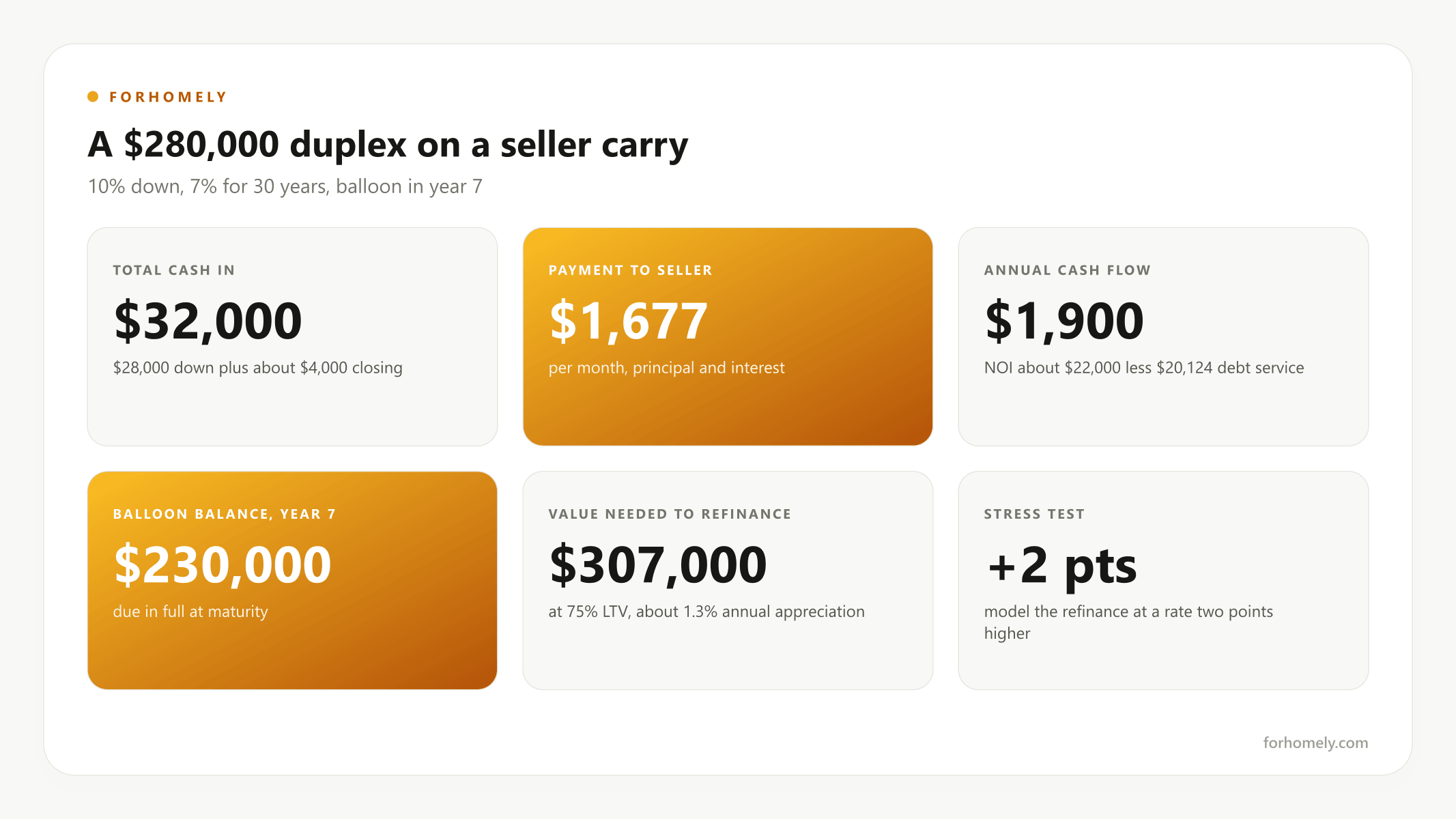
- Seller carries: $252,000 at 7%, amortized over 30 years, balloon in year 7
- Payment to seller: about $1,677 a month
- Your closing costs: roughly $4,000 (attorney, title policy, recording, servicing setup); no lender fees, no appraisal required (get one anyway for $600)
The units rent for $1,450 and $1,400. After taxes, insurance, utilities, and reserves, the building's NOI is about $22,000 a year. Annual debt service is $20,124, so cash flow is thin at about $1,900 a year, but you bought a duplex with $32,000 total cash, no bank, and a seven-year runway to raise rents and refinance.
The balloon in year 7: the balance is about $230,000. To refinance at 75% LTV, the duplex needs to appraise at about $307,000, a 1.3% annual appreciation rate, and the rents need to cover the new payment at whatever rate prevails. Model that exit now, at today's rate and at a rate two points higher. If it only works in the first case, negotiate a ten-year balloon or a lower price.
Negotiating the carry
- Find the right sellers: free-and-clear owners, long-term landlords, inherited properties, and listings with long market times.
- Lead with their benefit: the income stream and the installment-sale tax treatment, not your need for financing.
- Offer a credible down payment of 10-15% and a fair rate.
- Ask for no prepayment penalty and a balloon long enough to survive a bad refinance market, seven years or more.
- Paper everything: attorney-drafted note and mortgage, recorded at closing, title insurance, and a servicing company from day one.
- Get the seller's payoff terms in writing, including what happens if they die or want to sell the note.
Underwrite it like any other deal
A seller carry changes the financing, not the building. Run rents, expenses, NOI, and the note payment through the Multifamily Cash Flow Calculator before you sign, and check the balloon exit with the DSCR Loan Calculator to confirm a refinance will be viable at maturity. If the seller is tax-motivated, the 1031 exchange guide explains the alternative they may be weighing against your offer.