A 1031 exchange, named for Section 1031 of the Internal Revenue Code, lets you sell a rental property, reinvest the proceeds in another investment property, and defer both capital gains tax and depreciation recapture. For small multifamily investors it is the standard engine for trading up: selling a $340,000 duplex and rolling everything into a $560,000 fourplex without writing a five-figure check to the IRS. The rules are mechanical and unforgiving, which is exactly why they work when you follow them.
Educational content, not tax or legal advice. Every exchange needs a CPA and a qualified intermediary.
What qualifies
Both the property you sell (the relinquished property) and the property you buy (the replacement) must be held for productive use in a trade or business or for investment. A duplex you have rented for three years qualifies. Your primary residence does not; that is the Section 121 exclusion instead. A house hack is split: the rented units can be exchanged, the unit you lived in cannot.
Like-kind is broad for real estate. Any U.S. real property held for investment can be exchanged for any other, so a duplex can become a fourplex, a small apartment building, a commercial condo, or land. Foreign property, personal residences, and property held primarily for sale (flips) are out.
The two clocks
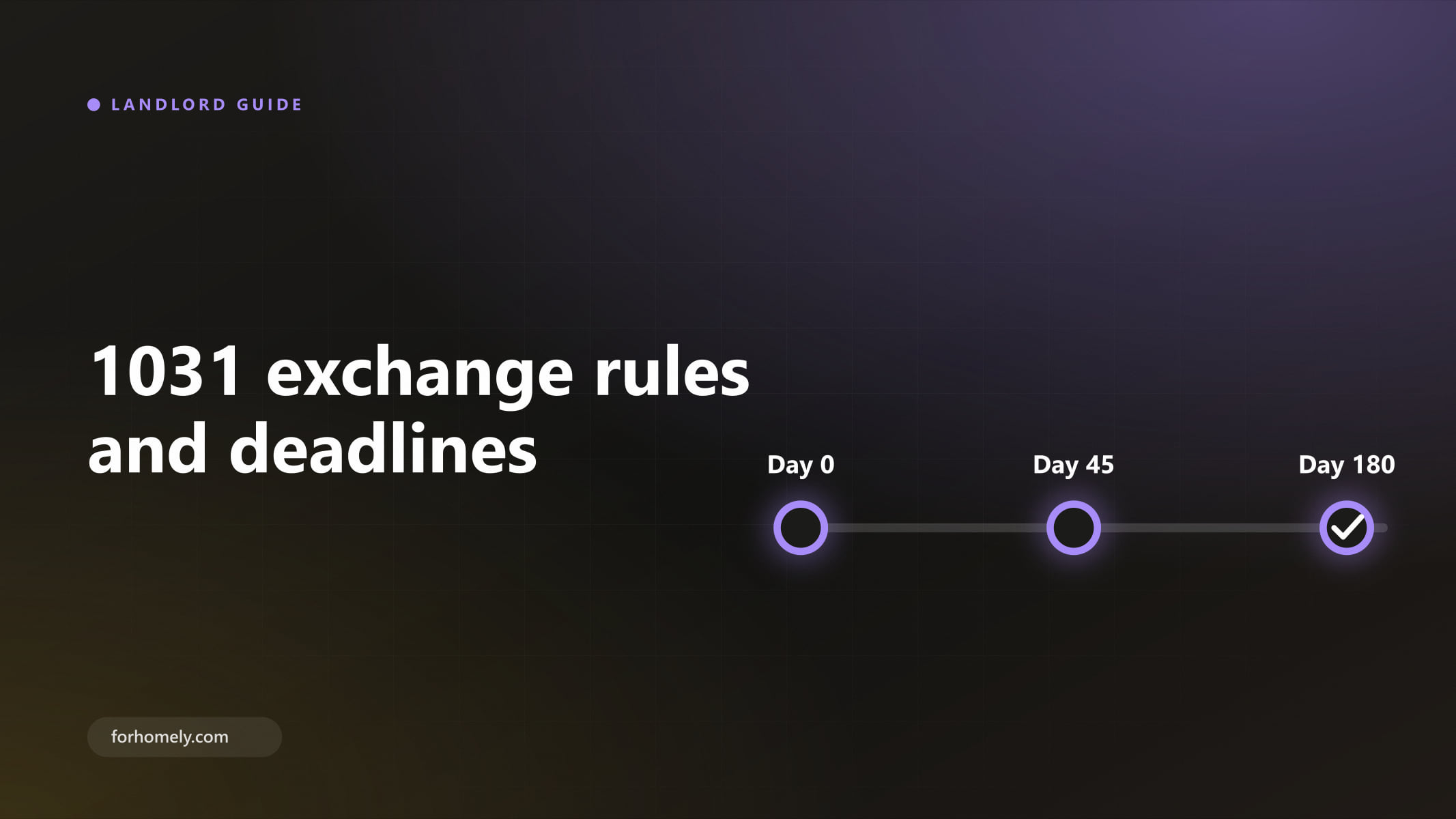
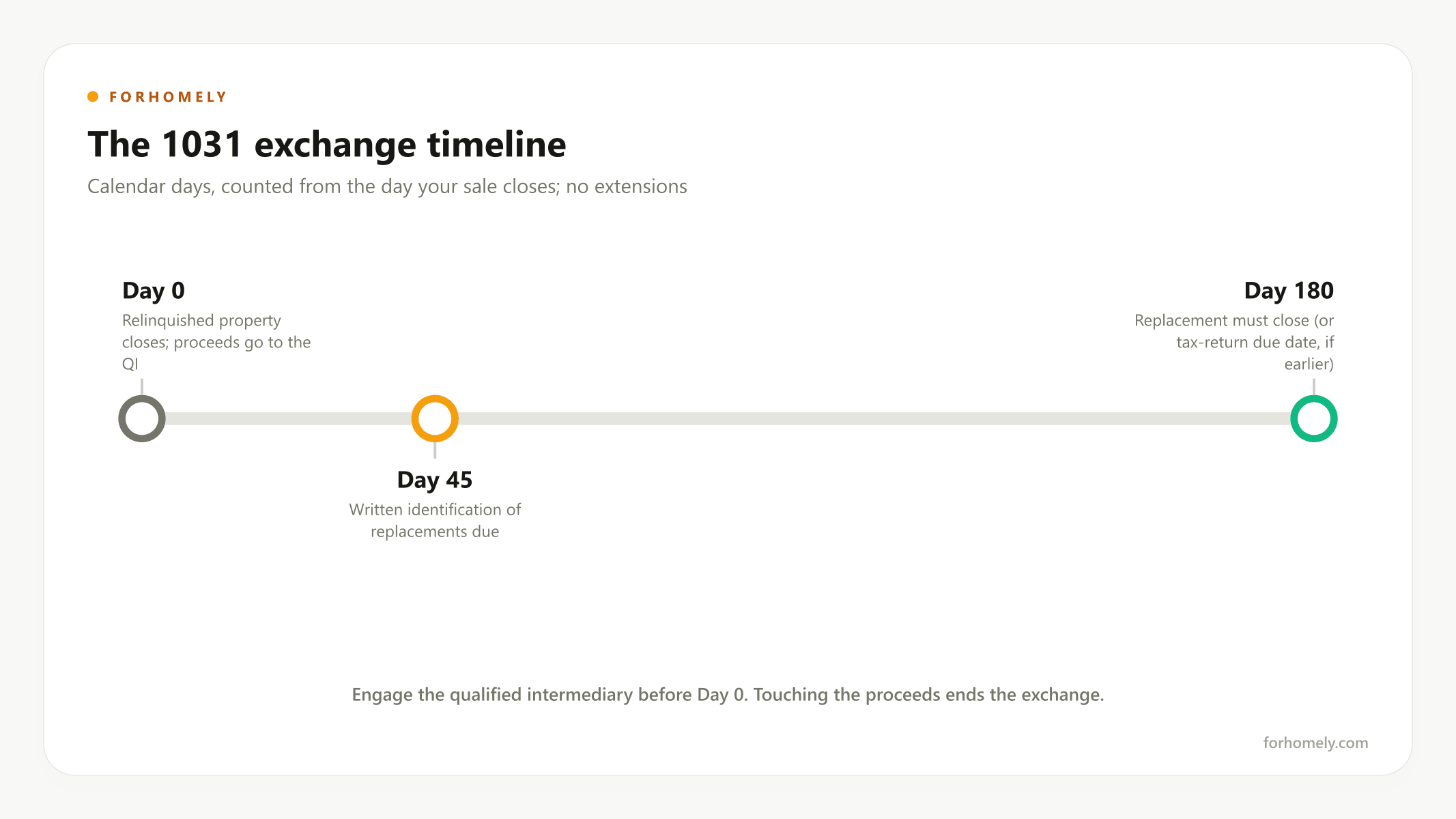
- 45-day identification period. From the day your sale closes, you have 45 calendar days to identify replacement property in writing to your intermediary.
- 180-day exchange period. You must close on the replacement within 180 calendar days of your sale, or by the due date of your tax return (including extensions) for the year of sale, whichever is earlier.
Weekends and holidays count. There are no extensions except in federally declared disaster areas. Miss either deadline by a day and the exchange fails; the entire gain becomes taxable in the year of sale.
The identification rules
You may identify replacements under any one of these tests:
- Three-property rule. Identify up to three properties, regardless of value. The most common choice.
- 200% rule. Identify any number of properties as long as their combined value does not exceed 200% of the relinquished property's sale price.
- 95% rule. Identify any number of properties, but you must close on at least 95% of the total identified value. Rarely used.
Identification must be unambiguous: a signed, dated written notice to the intermediary with the address or legal description of each property. You can revoke and re-identify within the 45 days; after that, the list is frozen.
The qualified intermediary
You cannot touch the money. From the moment your sale closes, the proceeds must go directly to a qualified intermediary (QI), an independent party that holds the funds and acquires the replacement on your behalf. The intermediary cannot be your attorney, CPA, agent, or anyone who has acted for you in the past two years. Engage the QI before your sale closes; once the money hits your account, no exchange is possible.
Choose a QI that is bonded and insured, holds funds in segregated accounts, and has been in business through at least one downturn. Intermediary failures have cost investors their entire proceeds.
Worked example: duplex to fourplex
The sale
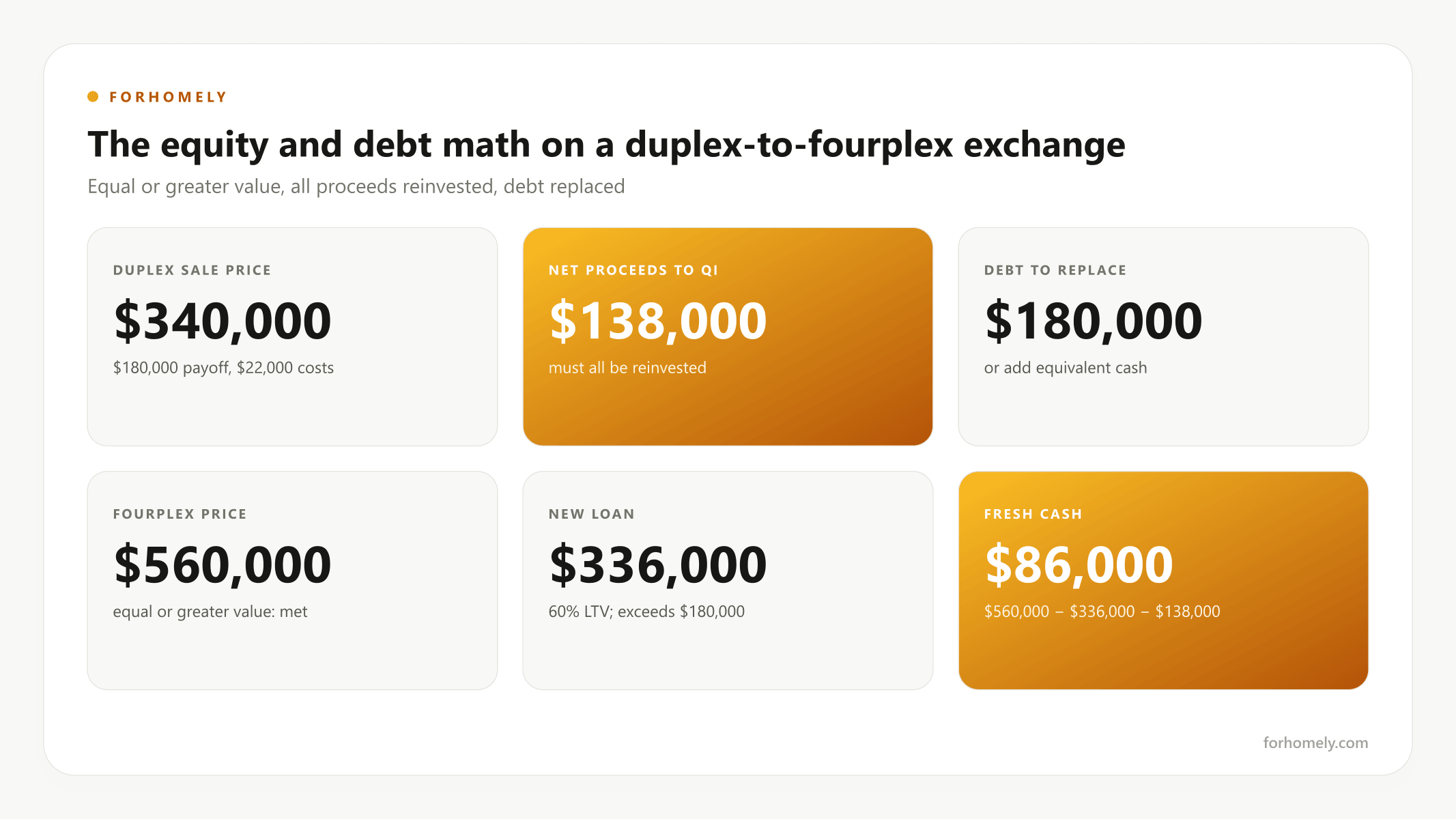
- Duplex sells for $340,000; mortgage payoff $180,000; selling costs $22,000
- Net proceeds to the QI: $138,000
- Adjusted basis after depreciation: $190,000. Gain plus recapture: about $150,000, deferred if the exchange completes
The replacement
- Fourplex purchase price: $560,000
- Identified within 45 days under the three-property rule
- Closed within 180 days
To fully defer the tax, you must:
- Buy property of equal or greater value than what you sold ($340,000 or more).
- Reinvest all net proceeds ($138,000).
- Replace the debt you paid off ($180,000 or more of new mortgage), or make up the difference with additional cash.
New loan of $336,000 (60% LTV) + $138,000 from the QI + $86,000 of fresh cash = $560,000. All three tests are met. The entire $150,000 of gain and recapture is deferred, and the fourplex's basis is the duplex's adjusted basis plus the additional cash and debt, so depreciation continues on a larger building.
Boot: the taxable leakage
Anything of value you receive that is not like-kind real estate is boot, and it is taxable in the year of the exchange, to the extent of your gain:
- Cash boot: proceeds left over at the QI and paid to you after closing.
- Mortgage boot (debt relief): replacing a $180,000 loan with a $120,000 loan is $60,000 of debt relief, taxable unless offset with additional cash.
- Non-qualifying property received: furniture, equipment, or a vehicle thrown into the deal.
- Seller financing you provide to your buyer is generally boot unless structured through the intermediary.
Partial exchanges are allowed; you simply pay tax on the boot and defer the rest.
Common failure modes
- Missing the 45-day deadline while "still looking." Identify something valid, even if you plan to swap it out within the window.
- Touching the proceeds. A brief deposit into your own account, or a closing agent who wires to you by mistake, ends the exchange.
- Buying down and pocketing the difference without realizing it is boot.
- Related-party purchases. Buying the replacement from a relative or an entity you control is subject to a two-year holding rule and can disqualify the exchange.
- Engaging the QI too late. The exchange agreement must be in place before the relinquished property closes.
- Forgetting the state. Some states tax the deferred gain when you finally sell, wherever the replacement sits.
- Reverse or improvement exchanges without an experienced QI. Legal, but they require an accommodation titleholder and precise sequencing.
The strategy for small investors
The classic ladder: house hack a duplex, exchange into a fourplex, exchange into an 8-12 unit building, deferring tax at each step and resetting the depreciation clock on a larger basis each time. Combine it with cost segregation on the replacement and the early-year deductions compound. Hold long enough and the basis steps up at death, and the deferred gain is never taxed at all.
Underwrite the replacement before you sell
Before listing your duplex, model the fourplex you are targeting in the Multifamily Cash Flow Calculator and verify the new loan covers with the DSCR Loan Calculator. The 180-day clock is the worst possible time to discover the replacement does not cash flow, and the exchange rules do not care that you would rather have kept looking.