Utilities are one of the largest controllable expenses in small multifamily, and one of the few you can legally shift to tenants. On a master-metered fourplex, owner-paid water, sewer, trash, and heat can consume 15-25% of gross rent. The two dominant fixes are submetering and RUBS (ratio utility billing). Choosing correctly depends on your building's plumbing, your state's rules, and your tolerance for administrative work, and getting the legal side wrong can cost more than the utilities did.
Investor insight from Toheeb Ekundayo, MBA: "Master-metered utilities quietly erode 15-25% of gross rent if you leave them alone. Whenever the plumbing allows, submeter. Where it does not, a legally compliant RUBS program with a written addendum raises NOI immediately and raises the building's value the day you sell."
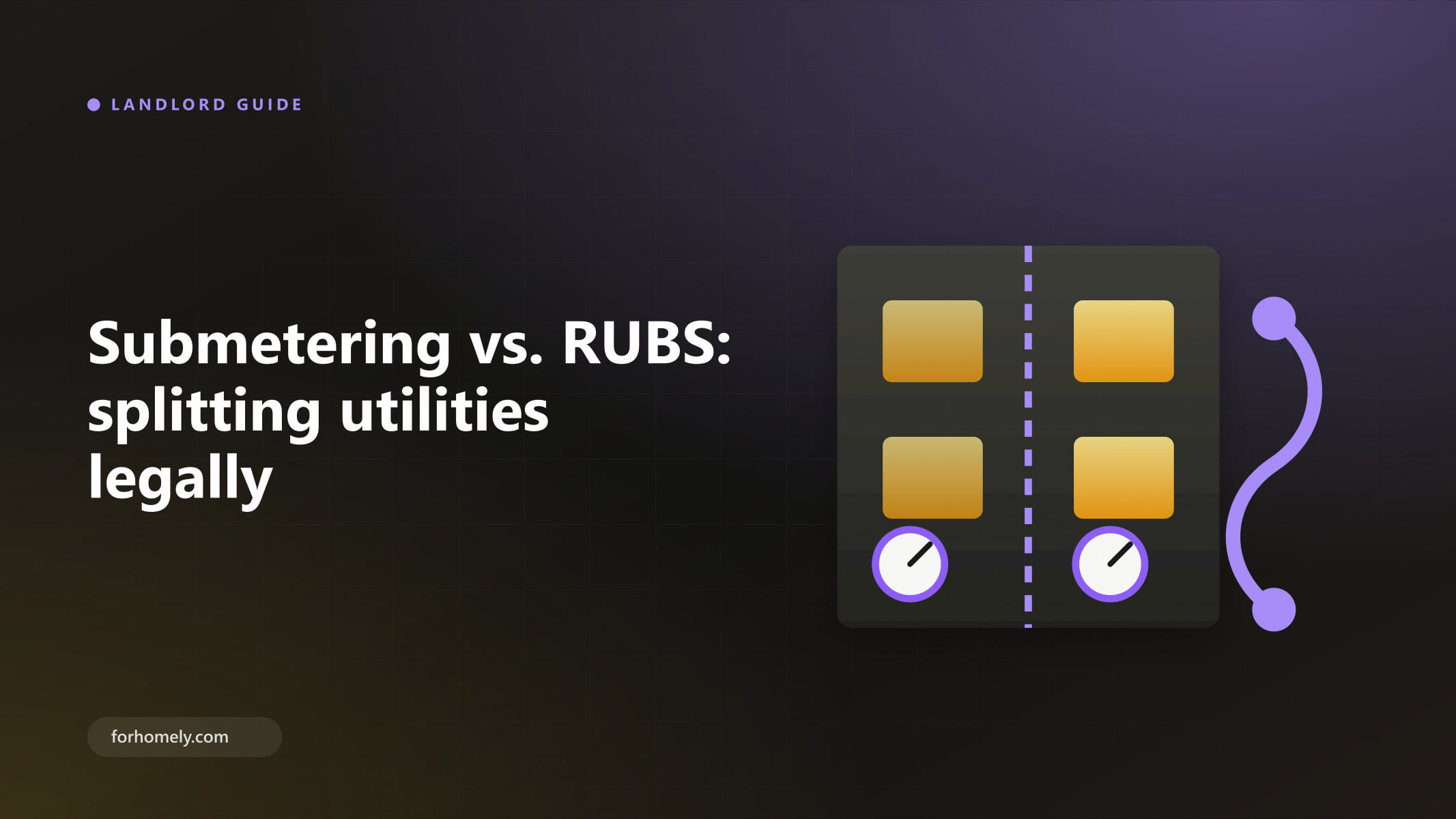
Method 1: submetering
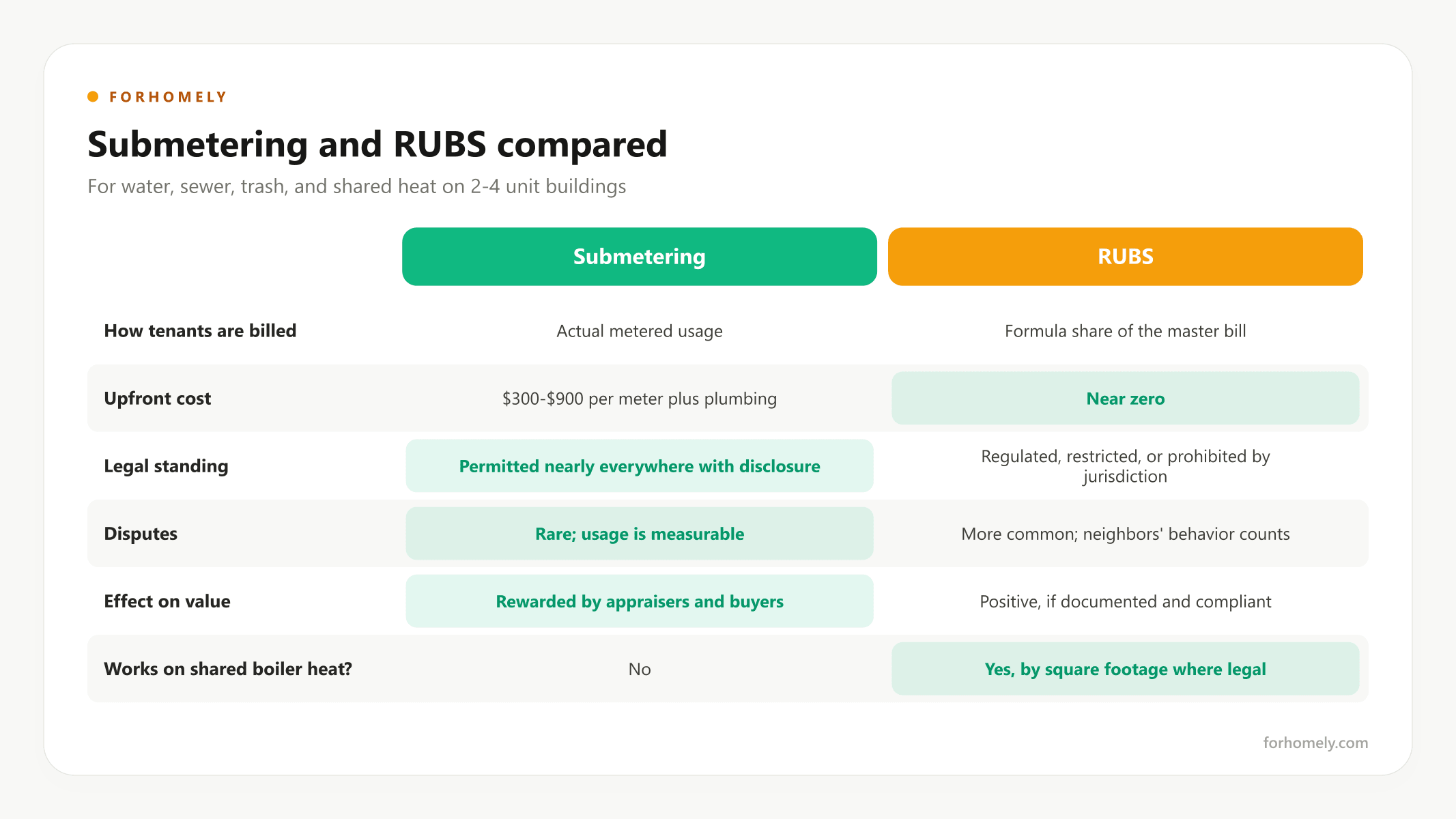
Each unit gets its own meter measuring actual consumption; tenants pay for what they use, either directly to the utility or to you at cost.
How it works.
- Electric and gas are usually already separately metered by the utility on 2-4 unit buildings. Tenants open their own accounts; you pay only for common areas.
- Water and sewer are the expensive ones. Retrofit submeters cost $300-$900 per unit for the meter and $1,000-$3,000 per unit for plumbing on buildings with shared supply lines. Newer buildings with separate risers are far cheaper.
- Heat on a single-boiler building cannot be practically submetered; the options are converting to per-unit systems (a capital project) or RUBS.
Advantages. Usage-based billing is uncontestable and it discourages waste; tenants who pay for water use less of it. It is compliant in nearly every state with proper disclosure. And it adds appraisable value, because separately metered buildings carry a lower and more predictable expense load.
Disadvantages. The upfront cost, and, in some states, a requirement that submetered water be billed through a registered third-party billing company with specific disclosures rather than directly by the owner.
Method 2: RUBS
No new meters. You allocate the building's actual utility bill among units using a disclosed formula.
Common allocation formulas:
- By occupant count. Each unit pays in proportion to the number of residents. Fair for water and trash; requires tracking occupancy.
- By square footage. Larger units pay more. Simple; less tied to actual water use.
- By fixture count. Bathrooms and kitchens as a proxy for usage.
- Equal split. The same amount per unit. Simplest and least defensible.
- Blended. For example, 50% by occupants and 50% by square footage, which many regulated programs require.
Example. A fourplex's water and sewer bill is $240 a month. Units house 1, 2, 2, and 3 people, eight in total. By occupant count, the allocation is $30, $60, $60, and $90.
Advantages. Near-zero upfront cost, and it works on buildings where the plumbing makes submetering impractical.
Disadvantages. Tenants pay for their neighbors' behavior, disputes are more common, and the regulation is heavier and more variable.
The legal landscape
Utility billing to tenants is regulated at the state, and sometimes city, level. The rules below are common patterns; verify your jurisdiction before you change a single lease.
- Confirm RUBS is permitted at all. Some states regulate it in detail (Texas, through its Public Utility Commission), some cities restrict water RUBS, and some jurisdictions require third-party billing. Where it is prohibited, submetering or including utilities in rent are the only options.
- A written lease addendum is mandatory everywhere. The billing method, the allocation formula, the fees, and the tenant's right to see the master bill must be disclosed in writing before the tenancy or at renewal.
- Cost recovery only. In nearly every jurisdiction you may bill the actual utility cost and, at most, a small disclosed administrative fee. Billing $260 on a $240 bill as profit is illegal.
- Timing. Changes take effect at lease renewal with the notice period your state requires for lease changes, typically 30-60 days.
- Late fees on utility charges are often capped separately from rent late fees, and in some states a utility balance cannot be grounds for eviction.
- Shutoff is never your tool. Terminating a tenant's utilities for non-payment is a self-help eviction in every state and carries serious penalties.
A one-hour consultation with a local landlord-tenant attorney to review the addendum is cheap insurance against a dispute with every tenant in the building at once.
The hybrid approach most small landlords should use
For a typical 2-4 unit building:
- Electric and gas: separate utility meters (usually already in place). Tenants pay the utility directly.
- Water, sewer, and trash: submeter water if the plumbing allows; if not, RUBS by occupant count (or the blend your state requires) with a written addendum and cost-only billing.
- Heat on a shared boiler: RUBS by square footage where legal, or a heat allowance built into rent with a plan to convert systems at the next replacement.
- Internet: either include it in rent or contract a bulk provider and bill cost-only.
The NOI and value impact
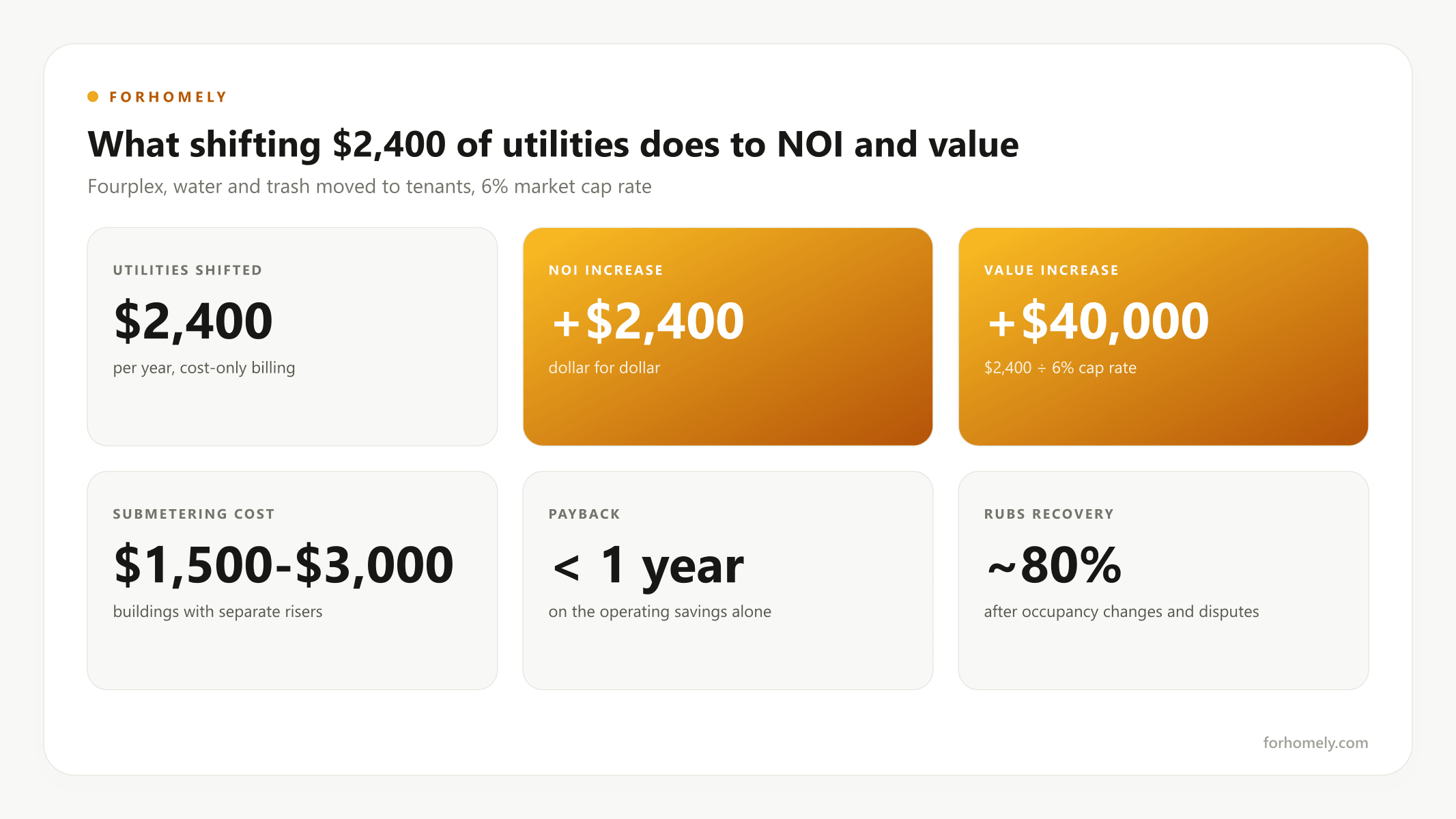
Shifting $2,400 a year of water and trash from owner to tenants raises NOI by $2,400. At a 6% cap rate, that is $40,000 of added property value from a $1,500-$3,000 submetering investment on a building with straightforward plumbing, one of the highest-return capital projects available to a small multifamily owner. Even a RUBS program that recovers 80% of the bill after occupancy fluctuations adds $32,000 of value for the cost of an attorney review.
Two honest caveats. First, tenants price total housing cost; in a soft rental market you may need to hold rent flat for a cycle when you add utility billing, which delays the gain. Second, a building marketed as "utilities included" attracts a different tenant pool than one marketed "tenant pays water," and turnover during the transition is real. Plan it at natural lease expirations.
Implementation checklist
- Pull twelve months of every utility bill you pay and total them by service.
- Get a plumber's assessment of what can be submetered and at what cost.
- Confirm state and local rules for each method; decide submeter, RUBS, or hybrid per service.
- Have an attorney draft or review the utility addendum with the formula, the disclosures, and the fee schedule.
- Roll it out at lease renewals with proper notice, attaching the actual master bill to each tenant's statement.
- Bill monthly, cost-only, through software that keeps twelve months of records; buyers and appraisers will ask for them.
- Model the NOI change in the Multifamily Cash Flow Calculator by moving the utility cost out of your expense column, and see what it does to cap rate and cash-on-cash.
Reimbursed utilities are rental income and the utility bills remain deductible expenses; the Schedule E guide shows where each goes.