Depreciation is the rental property owner's most valuable tax deduction: a paper loss on a real, cash-flowing asset. It is also the one most new landlords calculate wrong, usually by depreciating the purchase price instead of the building, or by starting on the wrong date. Here is the correct method, step by step, with the IRS table you actually need.
This guide is educational, not tax advice. Confirm your situation with a CPA who works with rental owners.
The core rule
Residential rental property, including 1-4 unit buildings, is depreciated straight-line over 27.5 years under the Modified Accelerated Cost Recovery System (MACRS), using the mid-month convention: the IRS treats every property as placed in service at the midpoint of the month you placed it in service, so the first year is always a partial year and the schedule runs into a 29th calendar year.
The annual rate for a full year is 1 ÷ 27.5 = 3.636% of the depreciable basis.
Step 1: establish depreciable basis
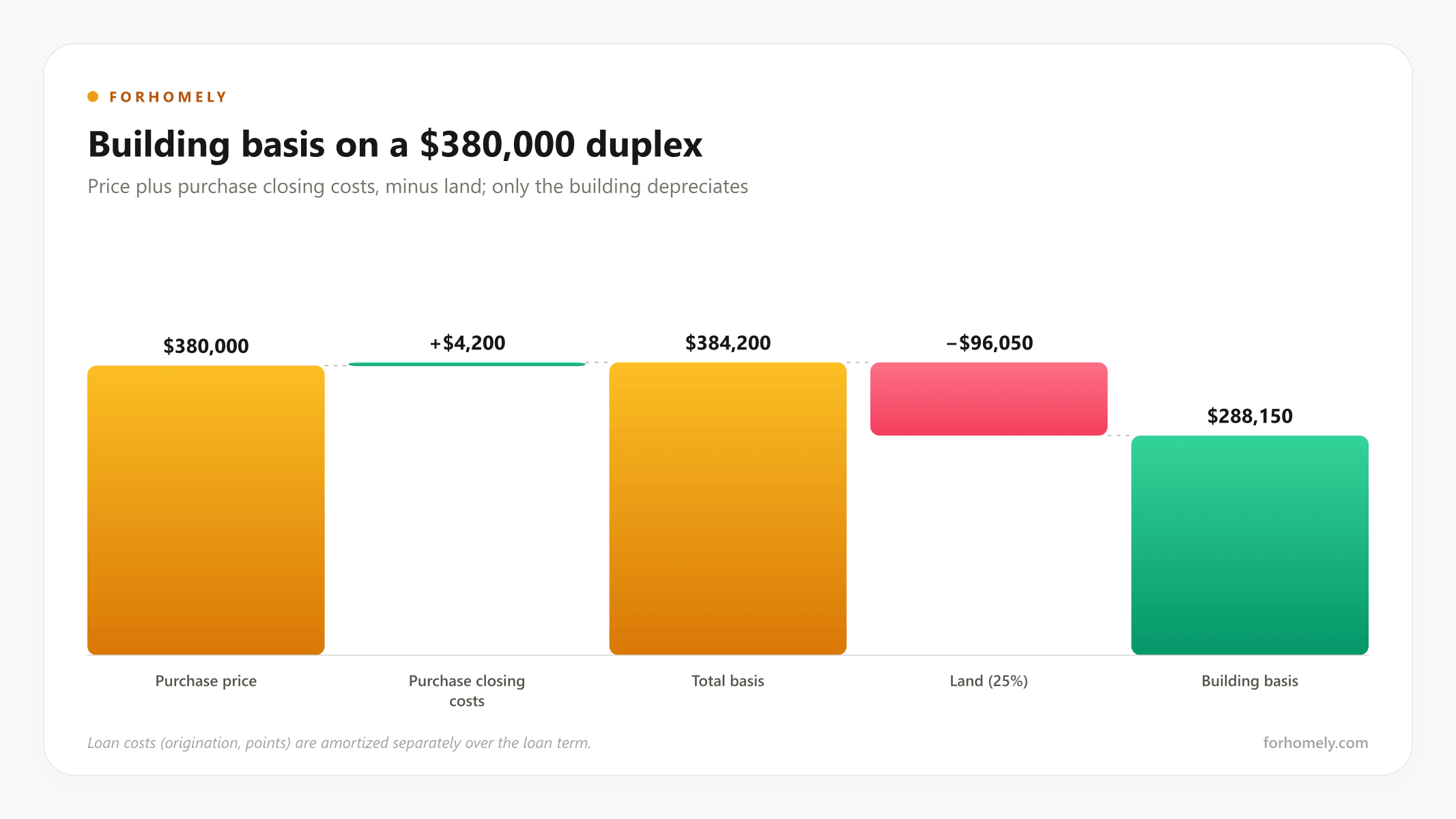
Depreciable basis = purchase price + purchase closing costs − land value
- Included in basis: title fees, legal fees, recording fees, survey, transfer taxes, and other costs of acquiring the property.
- Not included: loan costs such as origination fees and points. Those are amortized separately over the loan's term.
- Land is never depreciated. You must allocate the total basis between land and building, using the county assessor's ratio, an appraisal allocation, or a cost segregation study.
Step 2: apply the mid-month convention
The IRS publishes the first-year percentage for each placed-in-service month (Publication 946, Table A-6). Use the table rather than estimating:
| Month placed in service | First-year percentage |
|---|---|
| January | 3.485% |
| February | 3.182% |
| March | 2.879% |
| April | 2.576% |
| May | 2.273% |
| June | 1.970% |
| July | 1.667% |
| August | 1.364% |
| September | 1.061% |
| October | 0.758% |
| November | 0.455% |
| December | 0.152% |
Years 2 through 27 use 3.636%; the final partial year picks up the remainder.
Worked example: a $380,000 duplex
- Purchase price: $380,000
- Purchase closing costs (title, legal, recording, transfer tax): $4,200
- Assessor's allocation: land 25%, building 75%
- Placed in service (ready to rent): May 15
Calculation:
- Total basis: $380,000 + $4,200 = $384,200
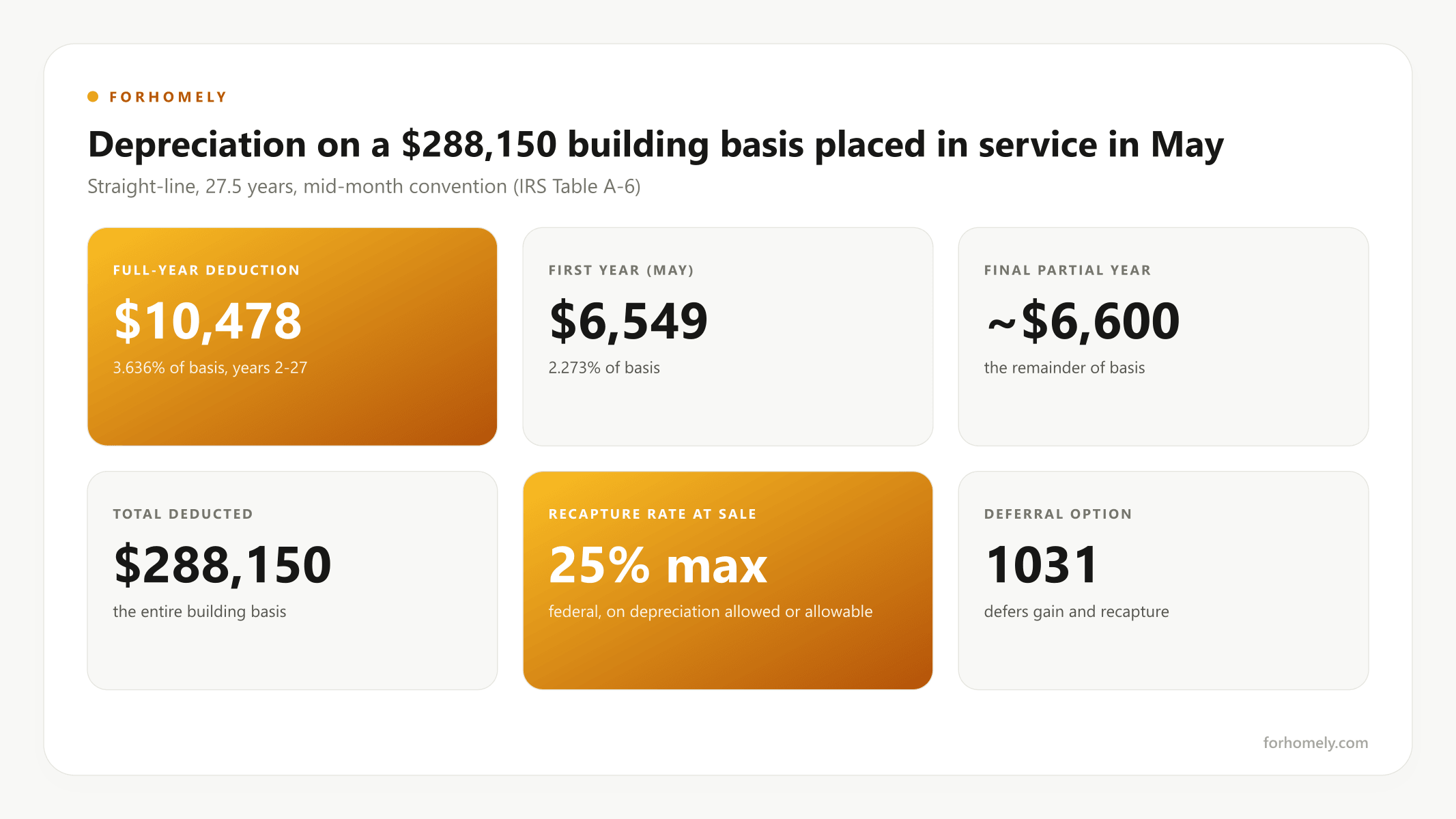
- Building basis: $384,200 × 0.75 = $288,150
- Full-year depreciation: $288,150 × 3.636% = $10,478
- First year (May): $288,150 × 2.273% = $6,549
- Years 2-27: $10,478 each
- Final year: the remaining balance, about $6,600
Over the full schedule you deduct the entire $288,150 building basis, while the property may have appreciated the whole time.
What else depreciates, separately
- Capital improvements: a $14,000 roof installed in year three is depreciated over its own 27.5 years from the month it is placed in service. See the repairs versus improvements guide.
- Appliances, carpet, and furniture in rental units: 5-year property.
- Land improvements such as fences, paving, and landscaping: 15-year property.
- Loan costs: amortized over the loan term; unamortized costs are deducted when you refinance or pay off the loan.
- Bonus depreciation: for qualifying property with a recovery period of 20 years or less (the 5-, 7-, and 15-year items above), 100% bonus depreciation is available for property acquired and placed in service after January 19, 2025 under the 2025 tax legislation. The building itself does not qualify. The cost segregation guide explains how to identify those components.
The cash-flow effect
Suppose your duplex produces $6,000 a year of true cash flow after all expenses and debt service. With $10,478 of depreciation, plus the deductible interest already in that cash-flow figure, your taxable rental income can be negative even though you banked $6,000. That loss offsets other passive income, and up to $25,000 of rental loss can offset ordinary income if you actively participate and your modified adjusted gross income is under $100,000, phasing out completely at $150,000. Losses you cannot use are suspended and carried forward, not lost.
Depreciation recapture: the other side
When you sell, the IRS taxes the depreciation you took (or could have taken) as unrecaptured Section 1250 gain at a maximum 25% federal rate, plus state tax, regardless of your ordinary bracket. Two points matter:
- Recapture applies to depreciation allowed or allowable. Skipping depreciation does not avoid recapture; it just wastes the deduction. Take it every year.
- A 1031 exchange defers both the capital gain and the recapture. Dying with the property steps up the basis for your heirs and eliminates both, which is why long-term holders talk about "swap until you drop."
Common mistakes
- Depreciating the full purchase price, including land.
- Forgetting to add purchase closing costs to basis, or adding loan costs to it.
- Starting depreciation at closing instead of when the unit is ready and available for rent.
- Never taking depreciation, then owing recapture anyway.
- Lumping a new roof into the original building schedule instead of starting a new 27.5-year schedule.
- Depreciating the owner-occupied unit of a house hack.
Track it properly
Keep a fixed-asset schedule listing every depreciable item, its basis, its placed-in-service date, and its method. Bookkeeping platforms built for rental owners, covered in the software comparison, automate most of this and produce the Form 4562 figures your preparer needs. And run the property's real cash flow in the Multifamily Cash Flow Calculator first, because depreciation makes a good building better on paper and does nothing for a bad one.