A cost segregation study takes your building's purchase price and splits it into components that depreciate faster than 27.5 years: carpet, appliances, cabinetry, land improvements, and the electrical and plumbing that serve specific equipment rather than the building as a whole. The result is bigger deductions in the first years instead of the last ones, and with bonus depreciation back at 100% for recent acquisitions, potentially a five-figure paper loss in year one on an ordinary fourplex.
Educational content, not tax advice. Have a CPA model the benefit before you commission a study.
The default versus the reclassified picture
Default: 100% of building basis depreciates straight-line over 27.5 years.
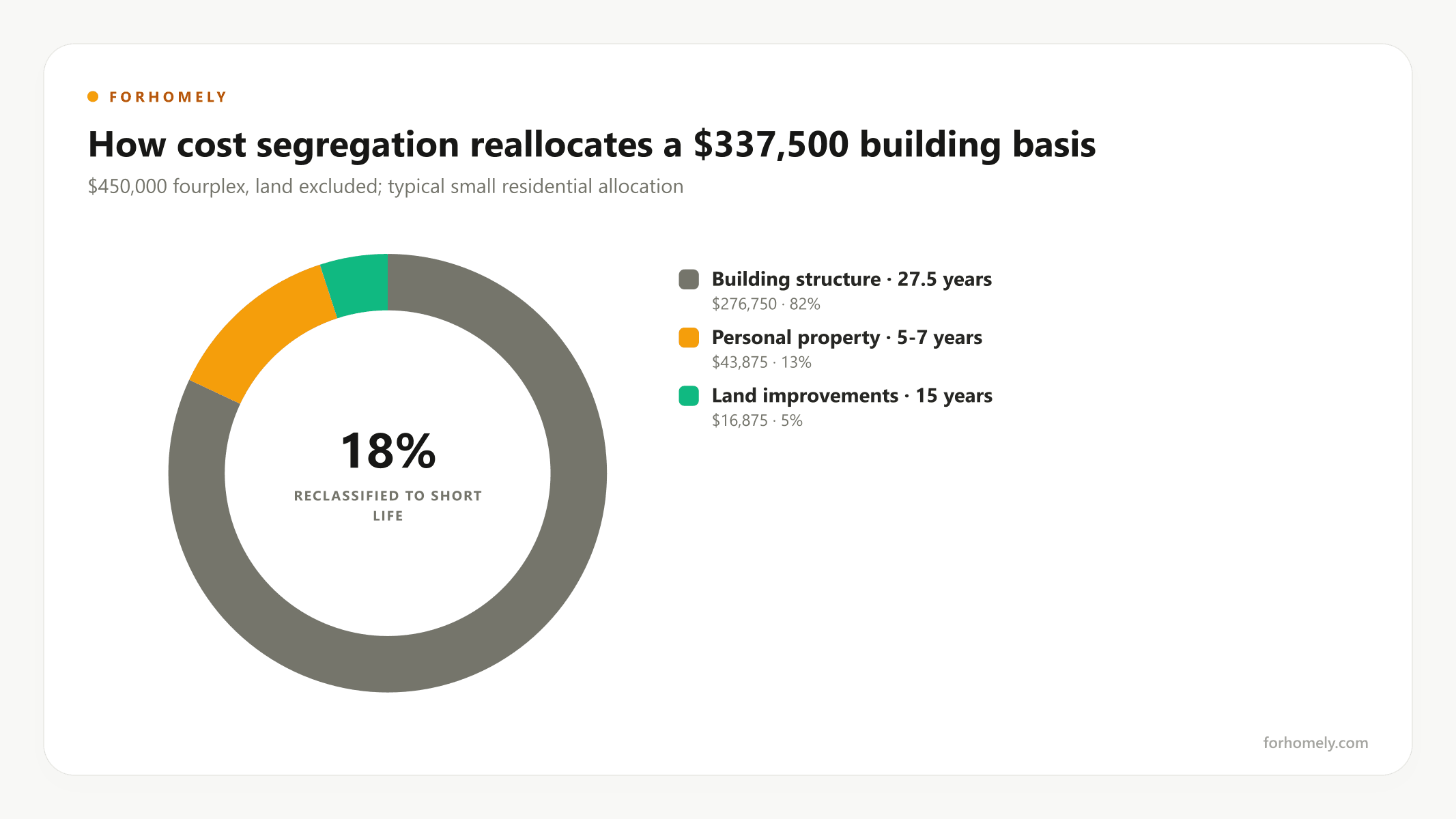
After cost segregation, typical allocation for a small residential building:
| Category | Recovery period | Typical share of basis | Examples |
|---|---|---|---|
| Building structure | 27.5 years | 75-85% | Walls, roof, foundation, general HVAC, plumbing, electrical |
| Land improvements | 15 years | 3-8% | Fencing, paving, sidewalks, landscaping, site lighting |
| Personal property | 5-7 years | 8-20% | Appliances, carpet, window treatments, cabinetry, dedicated HVAC serving a unit, some electrical serving equipment |
Land itself is excluded before the allocation begins.
The bonus depreciation multiplier
Cost segregation's power comes from combining reclassification with bonus depreciation, which allows immediate expensing of property with a recovery period of 20 years or less. Under the 2025 tax legislation, 100% bonus depreciation applies to qualifying property acquired and placed in service after January 19, 2025, on a permanent basis. Property acquired earlier is subject to the phase-down that was in effect at the time (for example, 60% for 2024 acquisitions).
Worked example: a $450,000 fourplex acquired in 2026
- Land allocation 25%: building basis $337,500
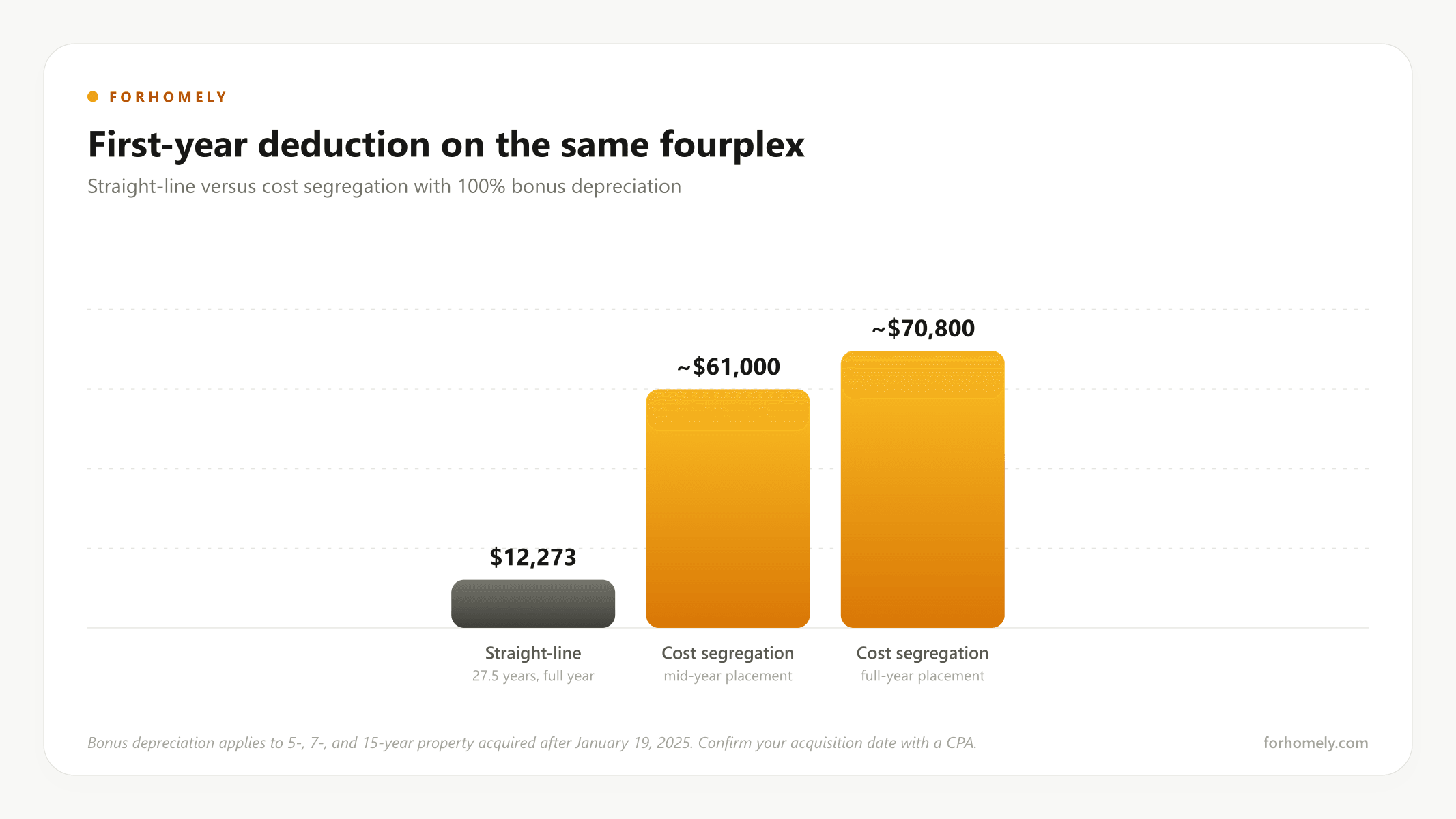
- Straight-line full-year depreciation: $337,500 × 3.636% = $12,273
With a study that reclassifies 18% of basis:
- 5- and 15-year property: $337,500 × 18% = $60,750, deducted in full in year one under 100% bonus depreciation
- Remaining 27.5-year basis: $276,750 × 3.636% = $10,063
- First-year deduction: about $70,800 (or about $61,000 if the mid-month convention and a mid-year placement trim the building portion)
That is roughly five to six times the straight-line deduction. At a 32% marginal rate, the incremental $58,000 of deduction is worth about $18,600 of tax in year one, if you can use it.
What a study costs and when it pays
- Full engineering-based study: $3,000-$7,000 for a small multifamily property, depending on the firm and whether a site visit is required.
- Model-based reports for simple residential properties: often $500-$1,500, with less documentation and correspondingly less audit protection.
- Break-even: the incremental first-year deduction × your marginal rate should comfortably exceed the fee, and you must be able to use the loss. At a 24% rate, a $4,000 study needs roughly $17,000 of accelerated deduction to pay for itself once; most buildings with $250,000 or more of basis clear that easily.
- Cheaper alternatives for small deals: the de minimis and small-taxpayer safe harbors capture much of the benefit on improvements you make yourself, for free.
Who should do it
Good candidates:
- Building basis of $250,000 or more
- A marginal tax bracket of 24% or higher, with passive income or an active-participation allowance to absorb the loss
- Properties with heavy personal-property content: furnished units, extensive appliances, recent finishes
- A hold long enough to benefit before sale, or an exit plan through a 1031 exchange
- Real estate professionals, for whom the loss is not limited
Poor candidates:
- Low-basis buildings where the fee approaches the benefit
- Owners above the $150,000 passive-loss phase-out who are not real estate professionals and have no passive income; the deduction is suspended, not lost, but the time value shrinks
- Short-term flips, where recapture wipes the benefit within a year or two
- Anyone who needs the cash flow and cannot afford the fee this year
The recapture trade-off
Accelerated depreciation means accelerated recapture exposure at sale. Depreciation on 5-, 7-, and 15-year property is recaptured as ordinary income (Section 1245), not at the 25% Section 1250 cap that applies to the building, so a short hold can leave you worse off after tax than straight-line would have. Cost segregation is a timing strategy: it moves deductions forward and the bill comes due on exit, unless you defer through a 1031 exchange or hold until the basis steps up at death. Model the sale, not just the purchase.
The process
- Your CPA models the projected benefit and confirms you can use the loss.
- An engineering firm reviews the appraisal, blueprints or measurements, photos, and often a site visit, and allocates basis by component with supporting detail.
- You receive a report; the IRS Audit Techniques Guide describes what a defensible one contains.
- For a property already in service, your CPA files Form 3115 and claims the catch-up depreciation in the current year, no amended returns needed.
- The new schedules go on Form 4562 and flow to Schedule E.
Run the numbers first
Model the building's cash flow in the Multifamily Cash Flow Calculator, have your CPA quantify the acceleration against your actual tax situation, and decide with the exit in view. Then read the depreciation guide so the base schedule the study modifies is right in the first place.