Every dollar of work on a rental is either a repair (deductible this year) or a capital improvement (depreciated over years). Classify correctly and you accelerate deductions legitimately; classify wrong and you either overpay taxes now or invite an audit later. The IRS tangible property regulations draw the line, and three safe harbors exist precisely so small landlords can be aggressive within it.
Educational content, not tax advice. Confirm elections with a CPA.
The IRS test: betterment, restoration, adaptation
Under the tangible property regulations, an expenditure must be capitalized if it does any of the following to the building or a major building system (structure, HVAC, plumbing, electrical, fire protection, security, elevators, gas):
- Betterment: fixes a material defect that existed when you bought it, materially enlarges the property, or materially increases its capacity, productivity, strength, or quality.
- Restoration: replaces a major component or substantial structural part, rebuilds the property to like-new condition after deterioration, or returns it to service after it had fallen out of use.
- Adaptation: converts the property to a new or different use.
If none of the three applies, the cost is a currently deductible repair.
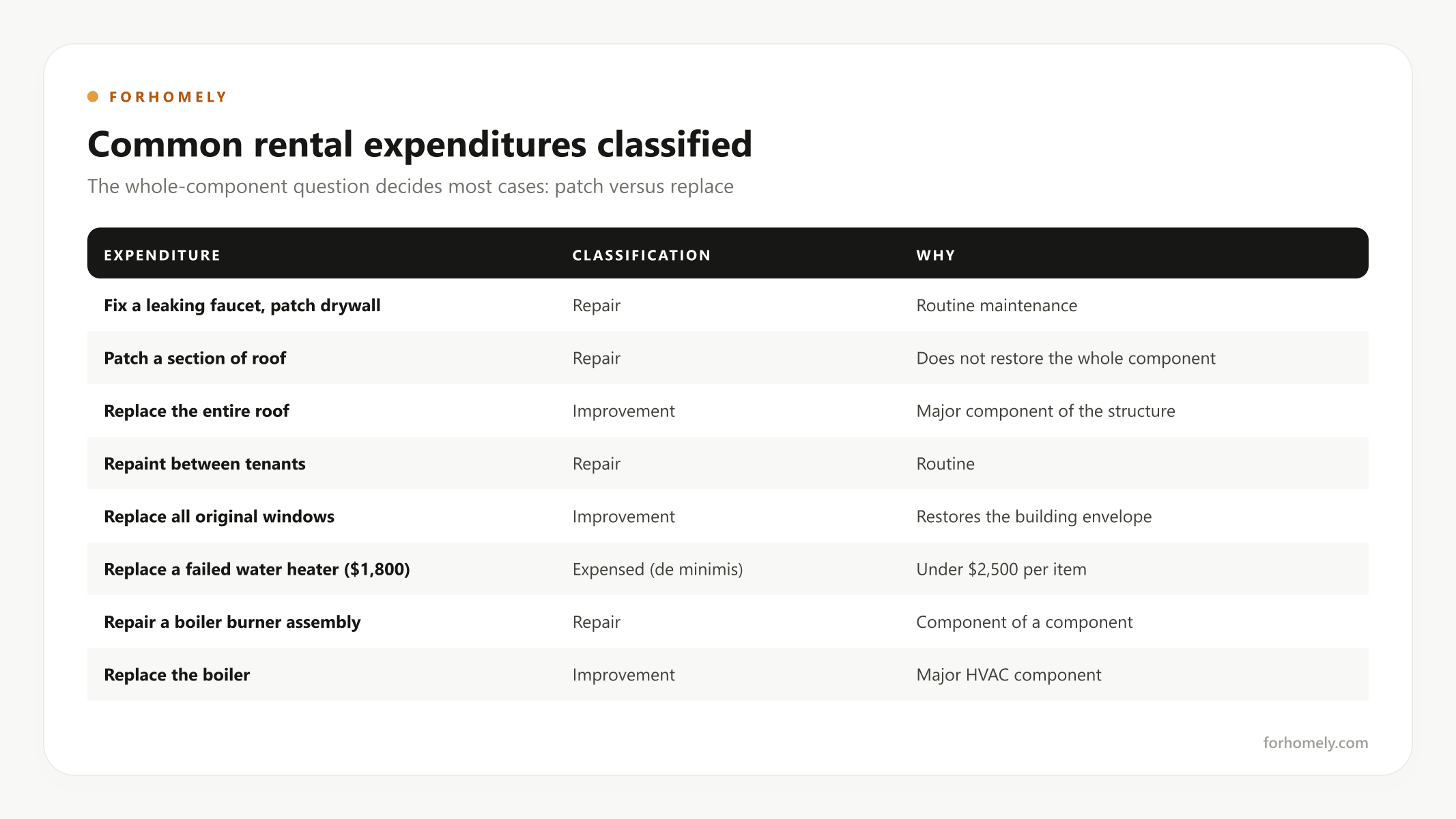
Common expenditures, classified
| Expenditure | Classification | Why |
|---|---|---|
| Fix a leaking faucet, patch drywall | Repair | Routine maintenance |
| Patch a section of roof | Repair | Does not restore the whole component |
| Replace the entire roof | Improvement | Replaces a major component of the structure |
| Repaint a unit between tenants | Repair | Routine |
| Repaint plus reconfigure walls into an extra bedroom | Improvement | Betterment and adaptation |
| Replace one broken window | Repair | Routine |
| Replace all original windows | Improvement | Restores a substantial part of the building envelope |
| Replace a failed water heater ($1,800) | Improvement by definition, expensed under de minimis | Under $2,500 per item |
| Repair a boiler's burner assembly | Repair | Component of a component |
| Replace the boiler | Improvement | Major component of the HVAC system |
| Annual HVAC service | Repair | Routine maintenance safe harbor |
| Add a fence or paving | Improvement | Land improvement, 15-year property |
| New appliances for a unit | Improvement, often expensed under de minimis | 5-year property; each under $2,500 |
The three safe harbors
1. De minimis safe harbor
Items costing $2,500 or less per item or per invoice can be expensed immediately, even if they would otherwise be capital, if you have a written capitalization policy in place at the start of the year stating that threshold, and you apply it consistently on your books. Taxpayers with audited financial statements have a $5,000 threshold. A $2,300 water heater, a $1,900 refrigerator, and a $2,400 flooring job in one unit can each be fully deducted this year.
2. Safe harbor for small taxpayers
For a building with an unadjusted basis of $1 million or less, owned by a taxpayer with average annual gross receipts of $10 million or less, you can elect to expense all repairs, maintenance, and improvements up to the lesser of $10,000 or 2% of the building's unadjusted basis in a year. On a $288,150 building, that is $5,763. If total spending on the building exceeds the limit, the safe harbor does not apply to any of it for that year, so plan large projects across tax years where practical.
3. Routine maintenance safe harbor
Recurring activities you reasonably expect to perform more than once during the property's class life (10 years for buildings, for this purpose), such as HVAC servicing, repainting, resurfacing, and replacing worn parts, are deductible even when substantial, as long as they keep the property in ordinary operating condition rather than better it.
The first two are annual elections made on your return; the third applies by definition. A CPA who works with rental owners pays for themselves here.
Why classification matters financially
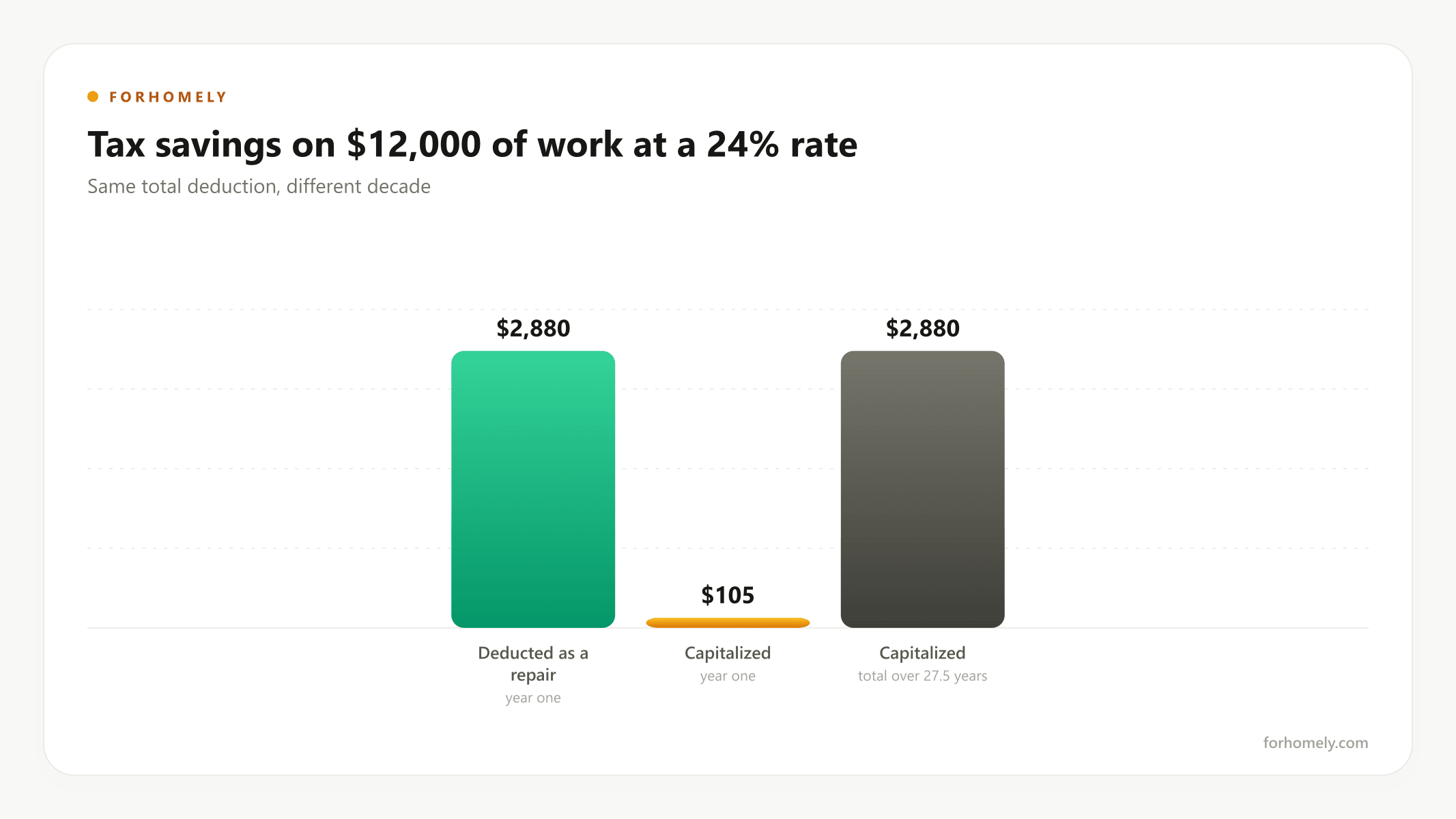
Example: $12,000 of work on a duplex, at a 24% marginal rate.
- As a repair: a $12,000 deduction this year, saving about $2,880 now.
- As an improvement: $12,000 ÷ 27.5 = $436 a year, saving about $105 a year for 27.5 years.
The total deduction is identical; the cash-flow difference is enormous, and the time value of $2,775 today versus a trickle over three decades is real money. That asymmetry is why the IRS scrutinizes aggressive repair classification, and why the safe harbors exist: they let small landlords take the fast deduction legally, within limits.
Documentation that protects you
- Separate invoices for each distinct project. A single $15,000 invoice bundling a roof and six small repairs forfeits the de minimis election on the repairs. Ask contractors to itemize or bill separately.
- Before-and-after photos for anything over a few hundred dollars.
- A written capitalization policy, one page, dated before the tax year starts, stating your $2,500 threshold. Keep it with your tax records.
- Consistency. Classify similar work the same way every year, and book it the same way in your accounting software.
- A fixed-asset schedule for everything capitalized, with placed-in-service dates, so each improvement gets its own depreciation schedule.
The interaction with depreciation and reserves
Capitalized improvements start their own 27.5-year (or 5- or 15-year) schedule when placed in service; they do not join the original building schedule. Qualifying 5-, 7-, and 15-year items may also be eligible for 100% bonus depreciation under current law, which is where a cost segregation study earns its fee on larger buildings. And your operating budget should carry routine repairs while your CapEx reserve carries the improvements; the Multifamily Cash Flow Calculator models both lines separately so NOI reflects reality, whatever the tax treatment.