Operating expenses keep a property running. Capital expenditures keep a property alive. Roofs, boilers, sewer lines, and electrical panels do not appear in any month's budget; they arrive as $8,000-$25,000 surprises. On buildings built before 1980, the difference between a cash-flowing duplex and a money pit is almost always the quality of the CapEx reserve planning, and it is the line most sellers leave off the pro forma entirely.
CapEx versus repairs: the line
- Repair (operating expense): restores an item to working order. Fix a leaking faucet, patch drywall, replace a broken pane, service the boiler. Deductible this year.
- Capital expenditure: replaces or substantially improves an asset with a useful life beyond one year. New roof, new boiler, all new windows, a sewer lateral. Depreciated over time; see the repairs versus improvements guide for the tax rules.
The operating budget carries repairs. The CapEx reserve carries replacements. Both belong in the NOI you underwrite.
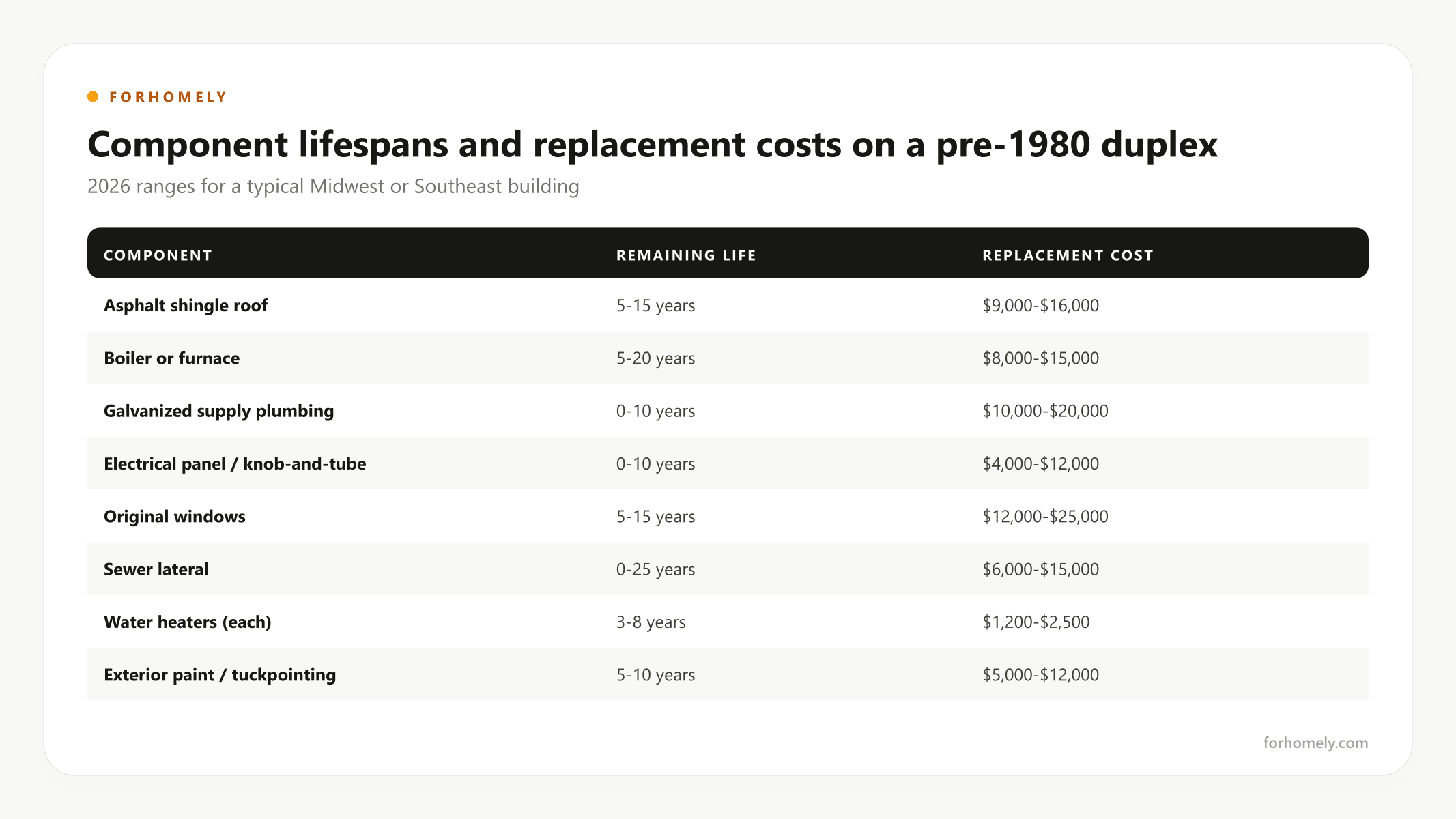
Component lifespans in pre-1980 buildings
| Component | Typical total life | Remaining life on a 1920s-1970s building | Replacement cost, duplex |
|---|---|---|---|
| Asphalt shingle roof | 20-30 years | 5-15 years if replaced once | $9,000-$16,000 |
| Boiler or furnace | 20-30 years | 5-20 years | $8,000-$15,000 |
| Galvanized supply plumbing | 40-60 years | 0-10 years, often past end of life | $10,000-$20,000 to repipe |
| Electrical panel, knob-and-tube | 40-70 years | 0-10 years | $4,000-$12,000 |
| Original wood windows | 30-50 years | 5-15 years | $12,000-$25,000 |
| Sewer lateral (clay or cast iron) | 50-100 years | 0-25 years | $6,000-$15,000 |
| Water heater (each) | 8-12 years | 3-8 years | $1,200-$2,500 |
| Exterior paint or tuckpointing | 10-15 years | 5-10 years | $5,000-$12,000 |
| Kitchen and bath (each unit) | 20-30 years | Varies | $8,000-$20,000 |
Costs are 2026 ranges for a typical Midwest or Southeast duplex; add 30-60% in high-cost metros.
Three budgeting methods
Method 1: percentage of gross income (simple)
Reserve 8-12% of gross scheduled income for buildings over forty years old, 5-8% for newer stock. A duplex grossing $38,400 reserves $3,000-$4,600 a year. Easy to apply, blind to the building's actual components.
Method 2: per unit per year (quick)
Reserve $250-$400 per unit per year for pre-1980 buildings ($500-$800 for a duplex, $1,000-$1,600 for a fourplex). Better than nothing; ignores component age and regional cost.
Method 3: component-based reserve study (accurate)
List each major component, its remaining life, and its replacement cost, then fund the annual equivalent. This is how institutional owners and HUD-financed properties do it, and it takes about an hour with an inspection report in hand.
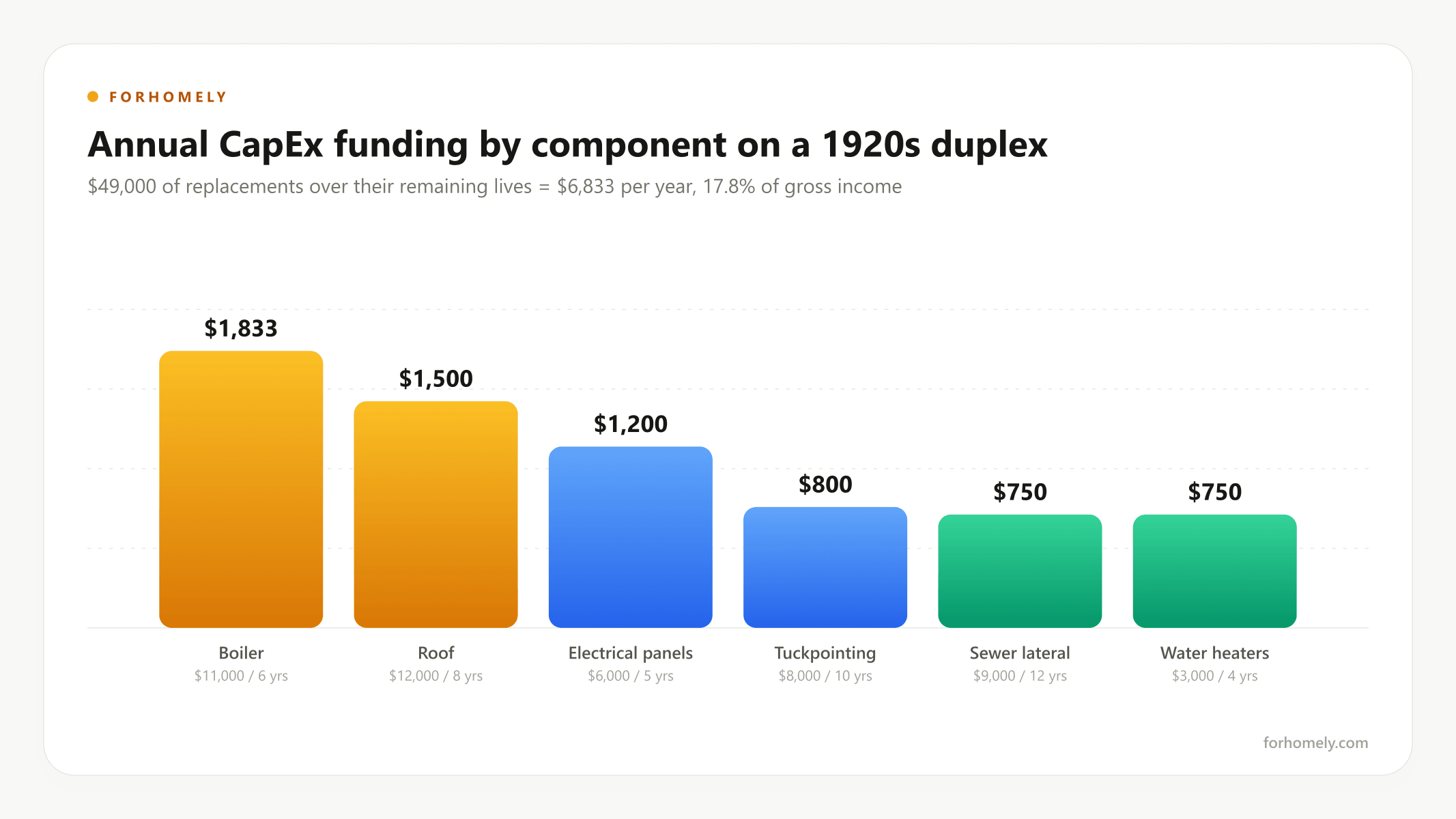
Worked example: a 1920s duplex, $38,400 of gross income
| Component | Replacement cost | Remaining life | Annual funding |
|---|---|---|---|
| Roof | $12,000 | 8 years | $1,500 |
| Boiler | $11,000 | 6 years | $1,833 |
| Sewer lateral | $9,000 | 12 years | $750 |
| Electrical panel upgrades (2) | $6,000 | 5 years | $1,200 |
| Water heaters (2) | $3,000 | 4 years | $750 |
| Exterior tuckpointing | $8,000 | 10 years | $800 |
| Total | $49,000 | $6,833 per year |
That is 17.8% of gross income, nearly double the 8-12% rule of thumb, and it is the honest number for this building. This is precisely why "1% rule" buildings with original mechanicals underperform: the CapEx load eats the margin the rent-to-price ratio promised.
What the reserve does to the deal
Run the duplex both ways in the Multifamily Cash Flow Calculator:
- With an 8% reserve ($3,072): NOI about $17,164, a 3.8% cap rate at $450,000.
- With the component-based reserve ($6,833): NOI about $13,400, a 3.0% cap rate.
At a 6% market cap rate, the difference in supportable value is roughly $63,000. Either the price comes down, or the seller credits the failing components at closing, or you accept that you are buying a building that will consume its own cash flow for the first decade.
The pre-offer CapEx inspection checklist
Before you buy any pre-1980 2-4 unit property, get answers on:
- Roof age and condition. Permit records or the seller disclosure; look for layered shingles, curling, and active leaks in the top-floor ceilings.
- Heating system age. Serial numbers date most boilers and furnaces; a technician's service tag often shows the last five years of visits.
- Electrical service. Panel amperage (60-amp service is a replacement), brand (some panels are known fire hazards), and any knob-and-tube or aluminum branch wiring.
- Plumbing material. Galvanized supply lines are near end of life; look under sinks and at the main.
- Sewer scope. A $200-$300 camera inspection can reveal a $12,000 lateral problem. On buildings with clay or cast iron laterals and mature trees, always scope.
- Foundation and masonry. Step cracks, bowing, efflorescence, and failed tuckpointing.
- Windows. Original single-pane windows drive both the CapEx line and the utility bills.
- Water heaters. Age from the serial number; more than ten years old is a near-term replacement.
Every item found is a price reduction, a seller credit, or a line in your reserve plan. Ideally all three are discussed before the inspection contingency expires.
Funding and holding the reserve
- Open the account at closing with a lump sum sized to the nearest likely failure, then automate the monthly contribution from rent.
- Keep it in a high-yield savings or money market account, liquid and separate from operating funds. One account per property keeps multi-property accounting clean.
- Refill after every use. A reserve that pays for a boiler and is never rebuilt is not a reserve; it is a one-time discount.
- Revisit annually. Components age, costs rise, and the study should be updated with each inspection or major repair.
Model it properly
The Multifamily Cash Flow Calculator includes a dedicated CapEx reserve input, so your NOI, cash flow, and cash-on-cash return reflect the true cost of owning an older building, not the version on the seller's pro forma. When the reserve is funded and the roof still needs replacing, the repairs versus improvements guide explains how the spending is treated on your taxes.