Real estate investing has two rules of thumb that have survived for decades: the 1% rule and the 50% rule. Both are screening tools designed to separate mediocre deals from promising ones in seconds. Neither is a substitute for actual analysis, and both are misused constantly, usually by treating a filter as a price. This guide explains what each rule measures, how to use them together, and exactly where they fail.
The 1% rule: a price-to-rent screen
The rule: monthly rent should be at least 1% of the purchase price.
- $200,000 property → needs $2,000 a month of total rent.
- A duplex renting $1,100 and $1,000 on a $210,000 price is $2,100 ÷ $210,000 = 1.0%. Passes.
- The same duplex at $300,000 is 0.7%. Fails.
What the 1% rule is good for
- Speed. Sorting forty listings into "maybe" and "no" in ten minutes.
- Market selection. It is really a rent-to-price ratio. Midwest and Southeast markets often hit 1% or more; coastal California rarely exceeds 0.5%.
- Screening for cash flow potential rather than appreciation-only plays. A 1% property in a normal-expense market usually produces a cap rate in the 6-7% range.
Where the 1% rule fails
- It ignores expenses entirely. A 1% property with $30,000 of deferred roof and foundation work is a worse deal than a 0.8% property in move-in condition.
- It punishes good markets. A 0.6% duplex in a city with 5% annual appreciation and strong rent growth can outperform a 1.1% property in a declining town.
- Master-metered buildings with owner-paid utilities can pass at 1% and still lose money every month.
- Class C and rougher neighborhoods hit 1.2-1.5% precisely because of eviction risk, turnover, and CapEx. The rule can lead beginners straight into the worst buildings on the market.
The 50% rule: an expense assumption
The rule: operating expenses (everything except the mortgage) consume about 50% of gross income.
- Gross scheduled income $38,400 → assume about $19,200 of expenses.
- NOI ≈ $19,200 before debt service.
What the 50% rule is good for
- Back-of-envelope NOI when a seller's pro forma is obviously fantasy.
- Sanity-checking underwritten expenses. A listing claiming $8,000 of expenses on $38,000 of income (21%) is either deferring maintenance or omitting lines.
- Quick DSCR estimates before you pull real tax and insurance quotes.
Where the 50% rule fails
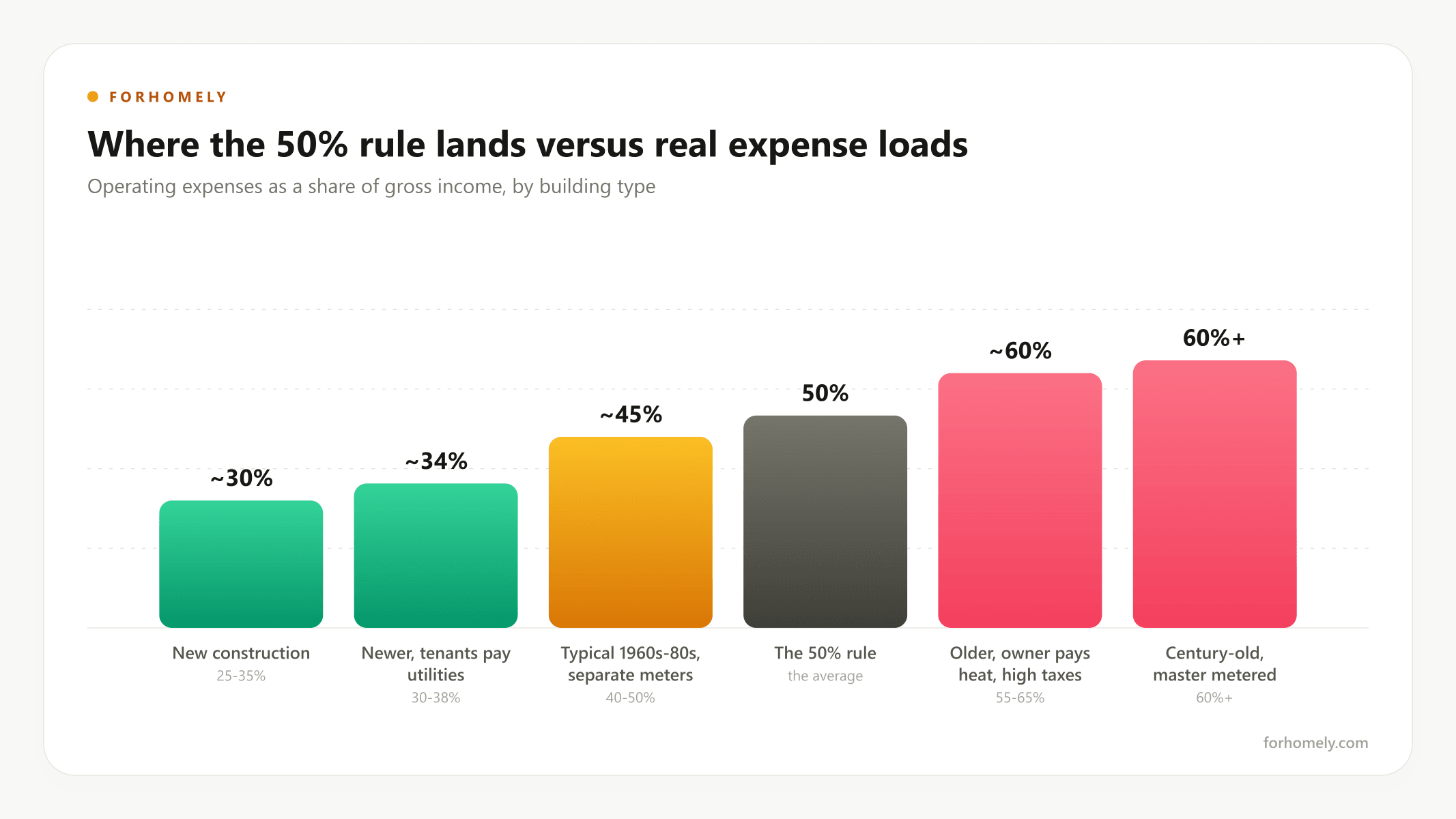
| Situation | Actual expense load |
|---|---|
| Tenants pay own utilities, low taxes, newer building | 30-38% |
| Typical 1960s-1980s building, separate meters | 40-50% |
| Owner pays heat and water, high taxes, older roof | 55-65% |
| New construction duplex | 25-35% |
| Century-old fourplex, master metered, high-tax state | 60%+ |
The 50% rule is an average across a huge distribution. Using it on a specific building is like planning a wardrobe around the national average temperature.
Using both rules together, the right way
- Screen with 1%. Does the price-to-rent ratio justify a second look at all? Below 0.8% in a normal market, keep scrolling; above 1.2%, ask why.
- Stress-test with 50%. At 50% expenses, does the property still cover debt service with a margin? If it fails at 50%, it will fail at 55%.
- Underwrite with real numbers. Actual taxes from the county (post-sale), an insurance quote, twelve months of utility bills from the seller, and a real CapEx reserve. The rent roll and T-12 guide lists what to request.
A screening flow
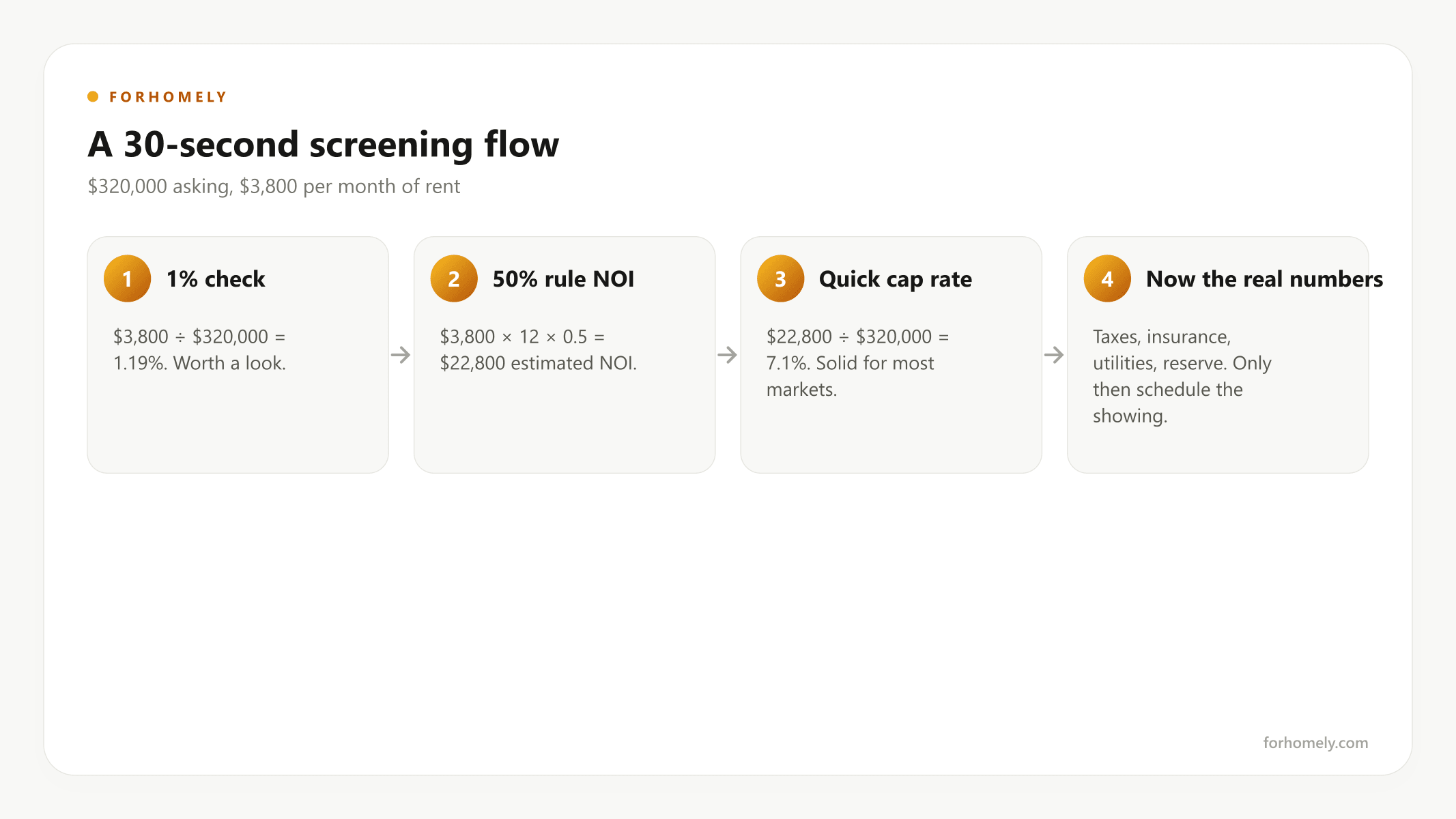
- Listing: $320,000 asking, $3,800 a month of rent.
- 1% check: $3,800 ÷ $320,000 = 1.19%. Worth a look.
- 50% rule: $3,800 × 12 × 0.5 = $22,800 of estimated NOI.
- Quick cap rate: $22,800 ÷ $320,000 = 7.1%. Solid for most markets.
- Now schedule the showing and pull the real numbers.
Total time: about thirty seconds, and you have avoided wasting an afternoon on a building at 0.6%.
Worked example: where the rules disagree with reality
A $300,000 fourplex grosses $3,000 a month, exactly 1%. It passes.
- 50% rule NOI: $18,000 a year.
- Real numbers, version A (master metered, high taxes): taxes $7,200, insurance $2,600, owner-paid water and trash $3,600, maintenance $2,400, reserves $2,400, management $2,880. Total $21,080 → NOI $14,920, a 5.0% cap rate. The rule was optimistic by 17%.
- Real numbers, version B (separate meters, a $2,000 tax abatement): taxes $5,200, insurance $2,600, utilities $600, maintenance $2,400, reserves $2,400, management $2,880. Total $16,080 → NOI $19,920, a 6.6% cap rate. The rule was pessimistic by 11%.
Same price, same rent, same 1% ratio, and the two versions differ by $5,000 of NOI, which at a 6.5% cap rate is a $77,000 difference in what the building is worth. The rules got both buildings to the table. Only real numbers get you to the closing table with the right price.
Three habits that make the rules useful instead of dangerous
- Calibrate the 1% threshold to your market. Look at the last twenty 2-4 unit sales and compute rent-to-price for each. Your local "1%" might be 0.7% or 1.3%.
- Replace 50% with a building-type estimate. Newer and separately metered: 35-40%. Older and master metered: 55-60%. Then verify.
- Never write an offer from a rule. Offers come from NOI, cap rate, and cash flow at your financing, all of which the Multifamily Cash Flow Calculator produces from real inputs in under a minute.
Once a deal passes both screens, calculate its NOI properly and compare cap rate against cash-on-cash at your actual loan terms before you decide.