Sophisticated sellers of small multifamily properties present two documents to serious buyers: the rent roll and the T-12 (trailing twelve months of income and expenses). Reading them critically is a core investing skill, because a seller's numbers are marketing documents until you verify them, and the gap between the pro forma and reality routinely changes an offer by six figures.
This guide walks through both documents in the order you will receive them, lists the five adjustments that reveal true NOI, and ends with the exact document list to request.
Part 1: the rent roll
A rent roll lists every unit, its tenant, lease terms, and rent. A good one includes unit number, bedrooms and baths, square footage, tenant name, lease start and end dates, current rent, deposit held, and any concessions or arrears.
Step-by-step audit
- Check every rent against the lease. Request copies of all leases. The roll says $1,450; the lease says $1,350? The lease wins. Month-to-month tenants with no lease should be documented with deposit records and bank statements.
- Identify below-market leases. A unit at $950 in a $1,300 market is a liability with a countdown clock, but it is also forced appreciation waiting to happen at turnover. Price the gap into your offer and your first-year plan.
- Look at lease expirations. Four leases expiring in the same month is a vacancy cliff; staggered expirations are healthier. Expirations also tell you when you can move rents to market.
- Verify deposits. Security deposits are the tenants' money and transfer at closing. Confirm the exact amounts, whether they are held in a separate account, and your state's rules for the transfer.
- Watch for related-party tenants. "My cousin pays $600" is not market rent, and it ends the day you close, along with the cousin.
- Cross-check against the T-12. If the roll shows $4,000 a month but the T-12 collected an average of $3,400, someone is late, in arrears, or the roll is aspirational.
Part 2: the T-12 operating statement
The T-12 shows twelve months of actual income and expenses. It is the closest thing to the building's medical record, and like a medical record, it reflects the patient's habits: a seller who self-manages books no management fee, a seller who defers maintenance books very little repair expense, and a seller who bought decades ago pays taxes on an assessment that will not survive your purchase.
Line-by-line verification
| T-12 line | How to verify | Red flag |
|---|---|---|
| Rental income | Sum of leases × 12; compare with deposits | Income spikes in the most recent months |
| Vacancy | Compare with the roll's gaps and turnover | Under 3% claimed on an older building |
| Property taxes | Call the assessor; ask for the post-sale estimate | Assessed value far below the asking price |
| Insurance | Request the declarations page | Premium from an old policy or a personal policy |
| Utilities | Twelve months of bills from the utility | "Estimated," or a vacant unit skewing usage |
| Repairs and maintenance | Invoices for anything over $500 | Suspiciously low equals deferred maintenance |
| Management | 8-10% of EGI even if self-managed | Zero because "the owner does it" |
| CapEx reserve | Should be a real line | Missing entirely |
| Other income | Laundry, parking, pet fees; check the coin box or lease terms | Round numbers with no backup |
The five adjustments that reveal true NOI
- Replace actual management with market management (8-10% of EGI), even if the owner self-manages. You will either pay a manager or earn that money doing the work; either way it has a cost, and every appraiser and lender will include it.
- Add a real CapEx reserve. Most seller T-12s omit it entirely. Use 8-12% of gross income on older buildings or a component-based reserve.
- Re-estimate taxes post-sale. Many jurisdictions reassess on sale. A building assessed at $200,000 selling for $400,000 may see taxes rise 40-80%.
- Normalize utilities if the owner's usage was unusual: a unit sat vacant and unheated, or the owner lived in a unit and paid electric personally.
- Remove one-time items, in both directions. A single $9,000 tree removal or a lawsuit settlement should be excluded, but ask for the invoice to confirm it was one-time, and add back a repair the seller booked as a capital item.
Worked example: seller NOI versus true NOI
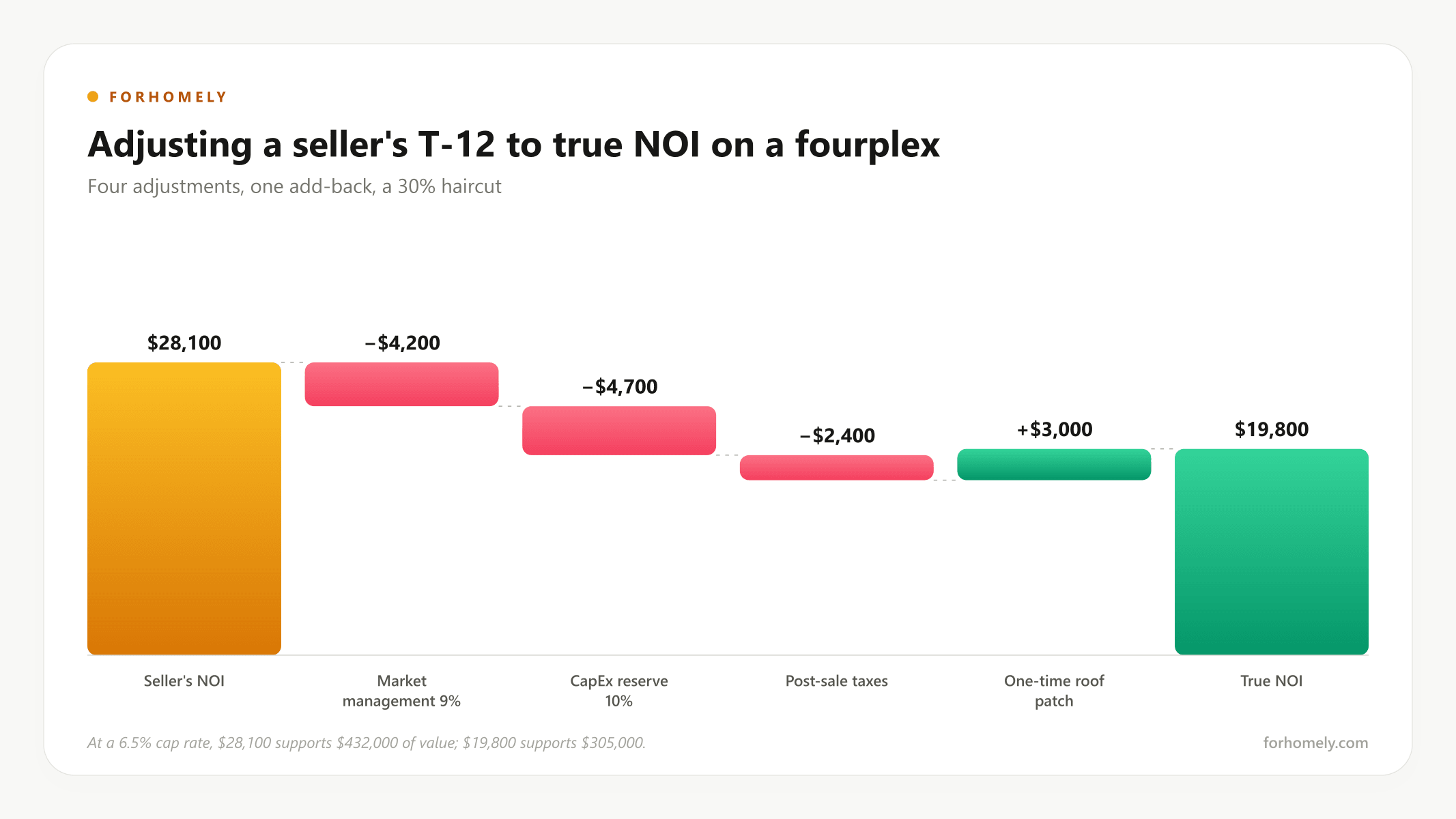
A fourplex T-12 claims income of $46,800, expenses of $18,700, and NOI of $28,100.
Your adjustments:
- Add market management (9% of EGI): −$4,200
- Add a CapEx reserve (10% of GSI): −$4,700
- Post-sale tax reassessment: −$2,400
- Remove a one-time roof patch (verified by invoice): +$3,000
True NOI: $19,800, a 30% haircut. At a 6.5% cap rate, that is the difference between a $432,000 valuation and a $305,000 one. This single exercise is why T-12 audits change offers by six figures, and why sellers resist producing the documents.
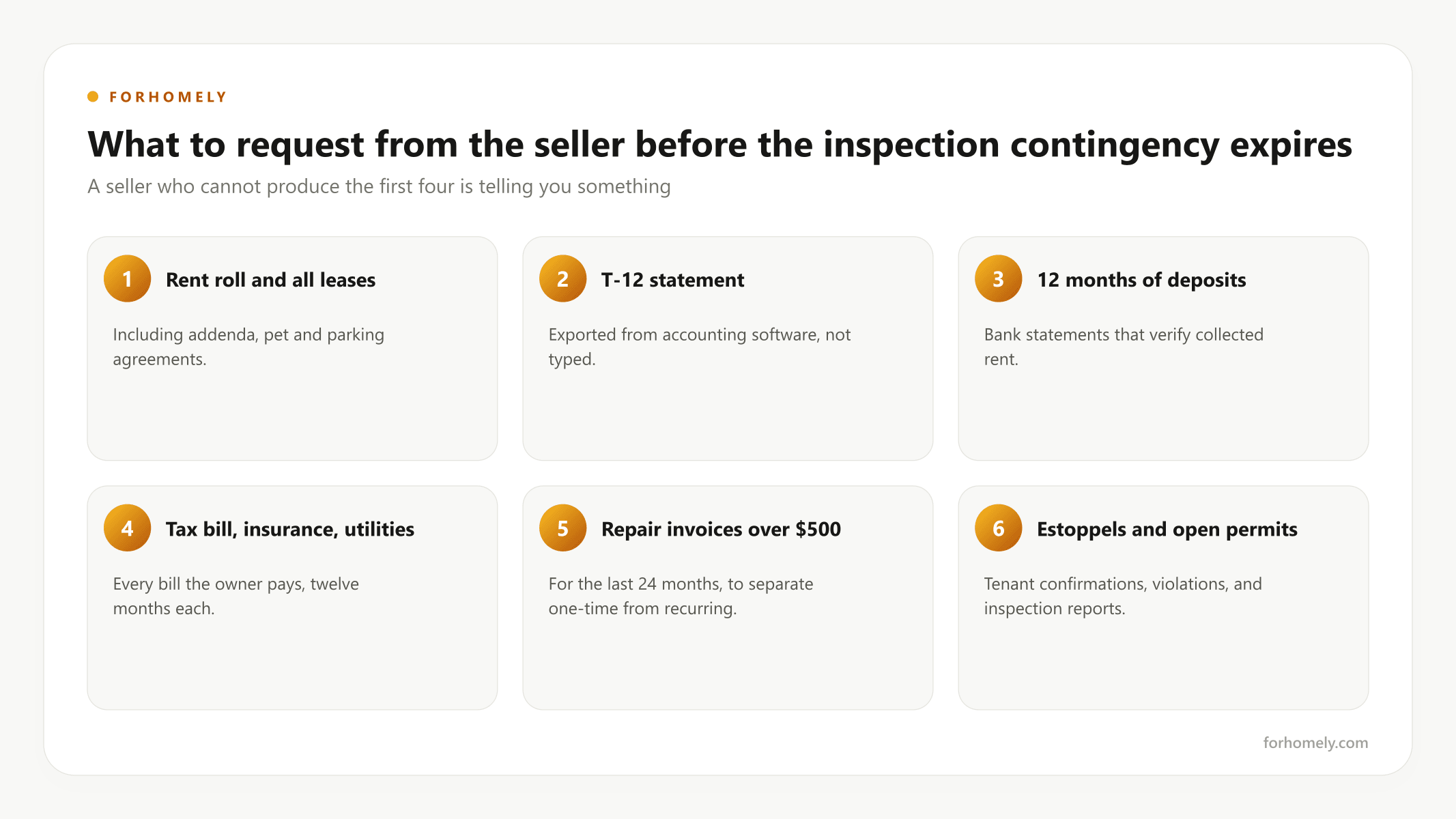
What to request from the seller
- Current rent roll and all leases, including any addenda and pet or parking agreements
- T-12 income and expense statement, ideally exported from accounting software rather than typed
- Twelve months of bank statements or deposit records to verify income
- The current tax bill, the insurance declarations page, and twelve months of every utility bill the owner pays
- Invoices for any repair or improvement over $500 in the last 24 months
- Estoppel certificates from each tenant before closing
- Any open permits, code violations, or inspection reports
A seller who will not produce items 1-4 is either disorganized or hiding something. Both are negotiating leverage; only one is a reason to walk.
Reading the numbers as a story
The T-12 and the rent roll together tell you what the building has been and what it could be. Below-market leases expiring in the next six months are upside; a spike in repairs last spring plus a suspiciously new roof line is a building that had a problem and may still have it. Zero vacancy, zero management, and a tax bill from 2009 is a pro forma wearing a T-12's clothes. Read them the way a lender will, because a lender will.
Run the corrected numbers
Once you have adjusted the T-12, plug the verified figures into the Multifamily Cash Flow Calculator to get the NOI, cap rate, and cash-on-cash return that reflect reality, then make your offer from there. If the corrected cap rate is far below the local range, the guide to cap rate versus cash-on-cash will show you exactly how much price has to move.