Net Operating Income is the single most important number in rental property analysis. Every other metric you will use, cap rate, debt service coverage, cash-on-cash return, and the value an appraiser assigns to a small multifamily building, is derived from NOI. Calculate it wrong and every decision downstream is wrong by the same amount.
Quick definition: Net Operating Income is the annual income a property generates after vacancy and all operating expenses (taxes, insurance, utilities, maintenance, reserves, management) are subtracted from gross income. Mortgage payments, income taxes, and depreciation are excluded.
Investor insight from Toheeb Ekundayo, MBA: "Never accept a seller's expense figures without the tax bill, the insurance declarations page, and twelve months of utility statements. In five years of underwriting small buildings, the two lines I see understated most are the CapEx reserve and the utilities the owner pays. True NOI is the bedrock of every good purchase."
The NOI formula
NOI = Effective Gross Income − Operating Expenses
Build it in order:
- Gross Scheduled Income (GSI): all rent if every unit were occupied all year at the scheduled rent, plus other income (laundry, parking, storage, pet fees, utility reimbursements).
- Vacancy and credit loss: GSI × a vacancy rate. Use 5-10% for small residential; 6% is a reasonable default in a stable market.
- Effective Gross Income (EGI): GSI − vacancy and credit loss. This is the income you can plan around.
- Operating expenses: everything required to run the property, including reserves, but not the mortgage.
- NOI: EGI − operating expenses.
Step by step: a $450,000 duplex
Income
| Item | Annual |
|---|---|
| Unit 1 rent ($1,600 × 12) | $19,200 |
| Unit 2 rent ($1,500 × 12) | $18,000 |
| Laundry and storage income | $1,200 |
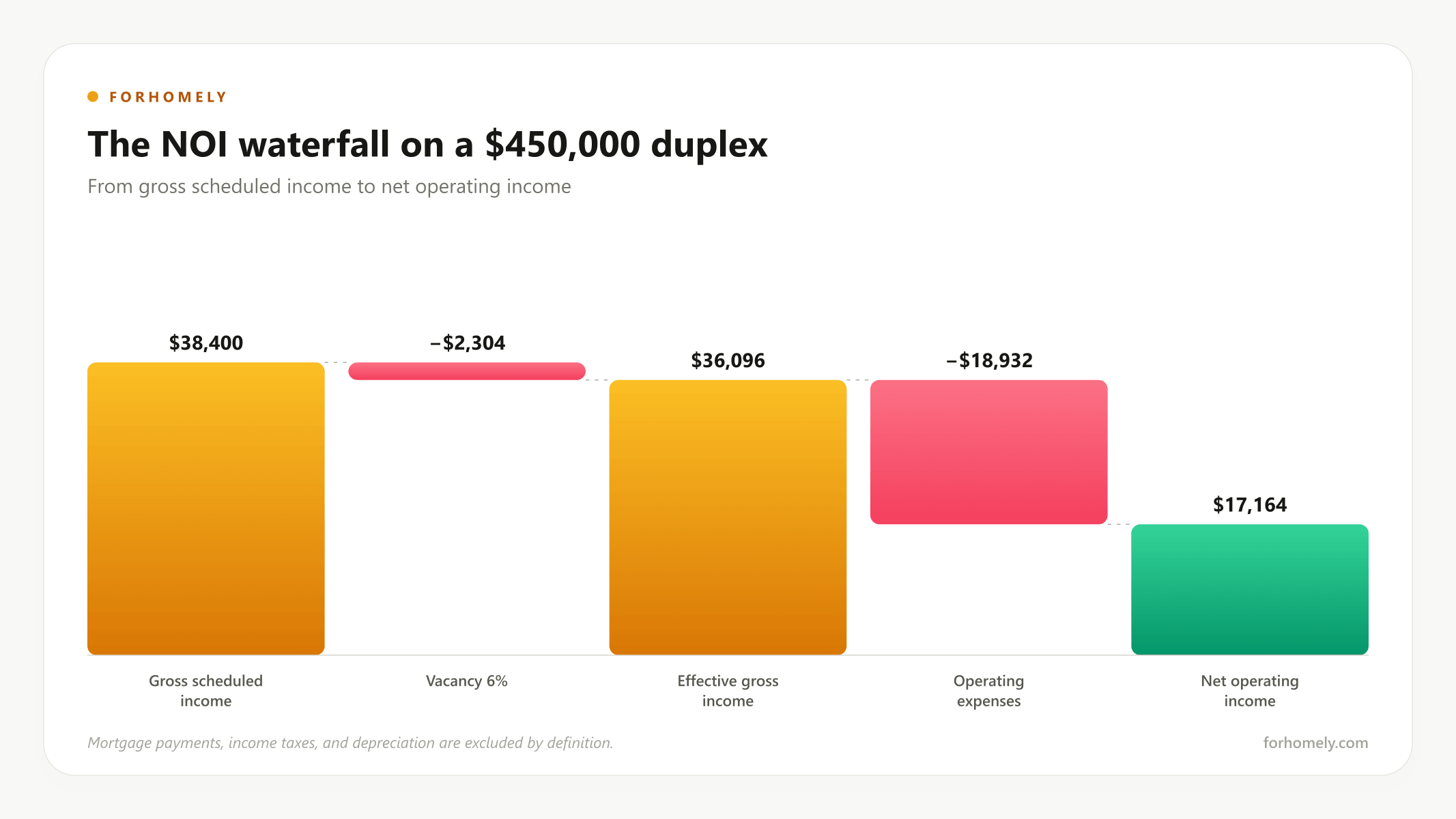
| Gross Scheduled Income | $38,400 |
| Vacancy and credit loss (6%) | −$2,304 |
| Effective Gross Income | $36,096 |
Operating expenses
| Item | Annual | Basis |
|---|---|---|
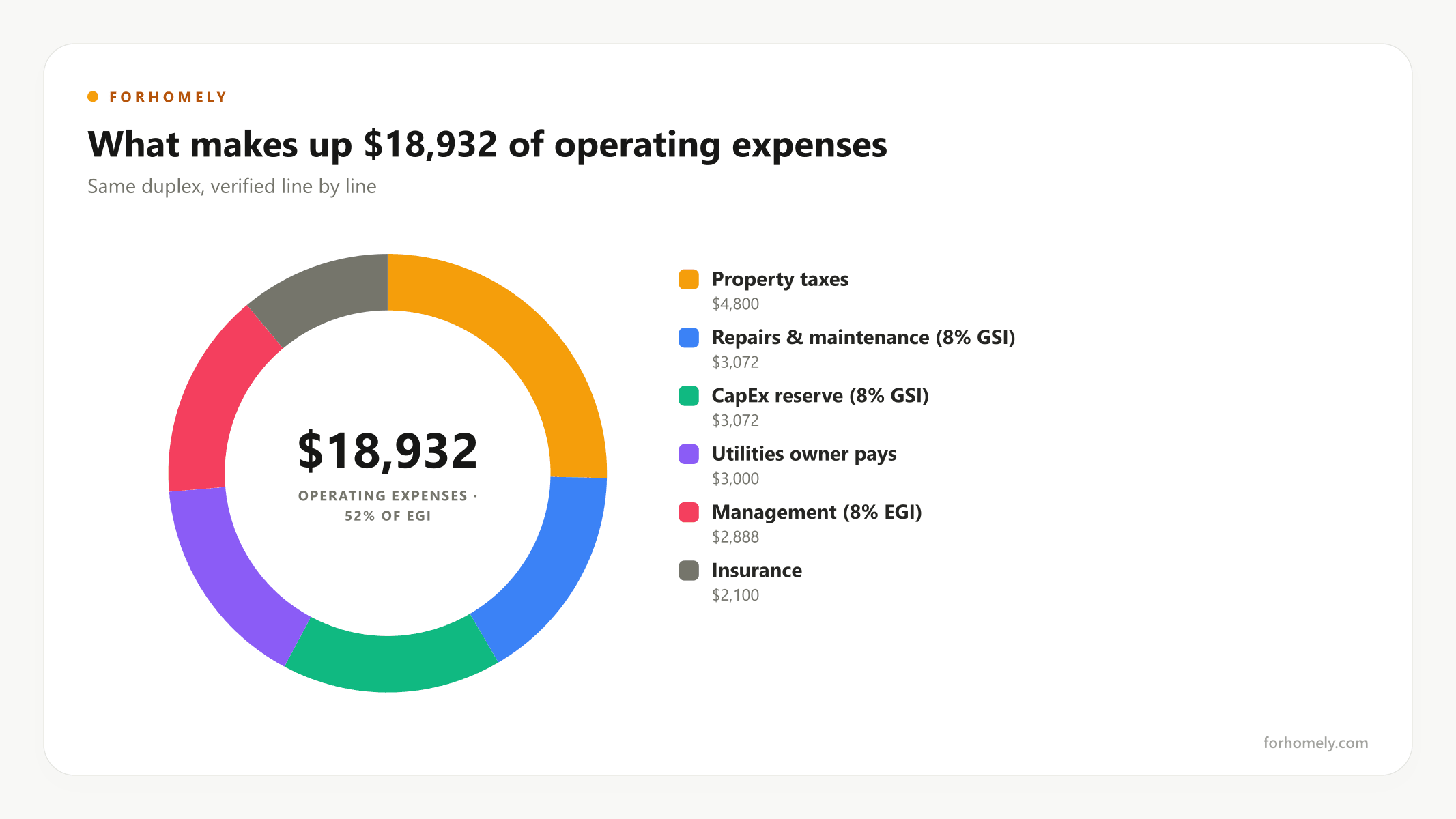
| Property taxes | $4,800 | County bill, adjusted for reassessment |
| Landlord insurance | $2,100 | Carrier quote, DP-3 policy |
| Water, sewer, and trash | $2,400 | Twelve months of bills |
| Common-area electric | $600 | Twelve months of bills |
| Repairs and maintenance | $3,072 | 8% of GSI |
| CapEx reserve | $3,072 | 8% of GSI |
| Property management | $2,888 | 8% of EGI |
| Total operating expenses | $18,932 | 52% of EGI |
NOI = $36,096 − $18,932 = $17,164 per year
At a $450,000 asking price, that is a 3.8% cap rate. In a market where duplexes trade at 6%, the income approach supports a value of about $286,000, which tells you the asking price is a bet on appreciation, not on income.
Every operating expense line, and how to verify it
- Property taxes. Pull the current bill from the county. Then check whether the jurisdiction reassesses on sale; many do, and a building assessed at $250,000 selling for $450,000 can see taxes rise 40-80% the following year. Use the post-sale estimate.
- Insurance. Get a landlord (DP-3) quote for the building at your purchase price, not the seller's premium from a policy bought years ago. Add the rental share of an umbrella policy if you carry one.
- Utilities the owner pays. Water, sewer, trash, common electric, and heat if the building is master-metered. Twelve months of actual bills; the seller's "estimate" is not a source.
- Repairs and maintenance. Turnover cleaning, small repairs, lawn and snow, pest control. Eight percent of GSI is a reasonable planning figure for a building in decent condition; older buildings run higher.
- CapEx reserve. The roof, boiler, and sewer-line fund. Sellers omit it; buyers who omit it regret it. Eight to twelve percent of GSI on pre-1980 buildings, five to eight on newer ones, or a component-based reserve study for accuracy.
- Property management. Eight to ten percent of EGI at market rates, plus leasing fees where applicable. Include it whether or not you self-manage.
- Other. Licensing and inspection fees, HOA dues, accounting, legal, advertising, bank fees.
What does not belong in NOI
New investors routinely corrupt NOI by including:
- Mortgage principal and interest. Debt service is a financing cost, not an operating cost. This is why NOI measures the property, not the deal.
- Income taxes. They depend on the owner's bracket, not the building.
- Depreciation. A paper deduction for tax purposes, not a cash operating cost.
- Capital expenditures as one-time hits. A $14,000 roof this year is not an expense; the reserve for it is. Booking the roof as an expense makes one year look terrible and every other year look better than reality.
- Owner's personal costs. Mileage, travel, phone, and the like may be deductible on Schedule E, but they are not property operating expenses for valuation.
Why NOI matters so much
Valuation
Small multifamily properties sell on a blend of comparable sales and income, and five-plus unit buildings sell almost purely on income:
Value = NOI ÷ Cap Rate
If your duplex produces $17,164 and local cap rates are 6%, the income approach supports about $286,000. If the seller's pro forma claims $24,000 of NOI, the same math supports $400,000, which is why sellers present pro formas and buyers rebuild them. The guide to cap rate versus cash-on-cash return covers how to use the result.
Lending
Commercial lenders size loans on NOI ÷ annual debt service. Residential DSCR lenders use gross rent ÷ PITIA, which is a simpler cousin of the same ratio. An NOI of $17,164 against $13,000 of annual debt service is a 1.32 coverage ratio; the DSCR Loan Calculator shows how lenders will see it.
Comparing deals fairly
Because NOI excludes financing, two properties with different loan structures can be compared apples to apples. The building with the higher NOI relative to price is producing more income per dollar invested, whatever loan you put on it.
Separate meters change the math
If tenants pay their own heat and electric through separate meters, the owner's expense load drops by three to six percentage points of GSI compared with a master-metered building where the owner pays. A master-metered duplex at the same price is worth meaningfully less, and the submetering versus RUBS guide explains how to fix it after you buy.
Three NOI mistakes that cost the most
- Trusting the listing's expense ratio. A claimed 25% expense ratio on a 60-year-old building is not a bargain; it is a missing reserve line and a tax bill that has not been reassessed yet.
- Using current rents instead of market rents, in both directions. Below-market leases understate future income; above-market leases (a relative paying a favor) overstate it.
- Skipping the post-sale tax estimate. On a building assessed well below the price, this single line can cut NOI by 10-15%.
Run your own numbers
The Multifamily Cash Flow Calculator walks through unit-by-unit rents, vacancy, reserves, and expenses to produce GSI, EGI, NOI, cap rate, and cash-on-cash return instantly, with the same structure lenders and appraisers use. When you have a seller's T-12 in hand, the rent roll and T-12 audit guide shows how to correct it before the numbers go in.