Schedule E (Form 1040) is where rental income and expenses live. For a 2-4 unit owner, it is also a map of every deduction you are entitled to, and most landlords leave real money on the table by not tracking deductible expenses all year. Here is the line-by-line guide, the deductions people miss, the loss rules that decide whether a paper loss helps you, and the records that make it all defensible.
Educational content, not tax advice. Work with a CPA who owns rentals.
How Schedule E works for multi-unit properties
Each property gets its own column (A, B, C). A duplex is one property with two rental units: report it once, with combined income and expenses. If you live in one unit, allocate shared expenses between the rental units and your own, usually by square footage, and report only the rental share. Expenses are entered by category; the net result flows to your Form 1040, subject to the passive loss rules below.
The deduction lines, explained
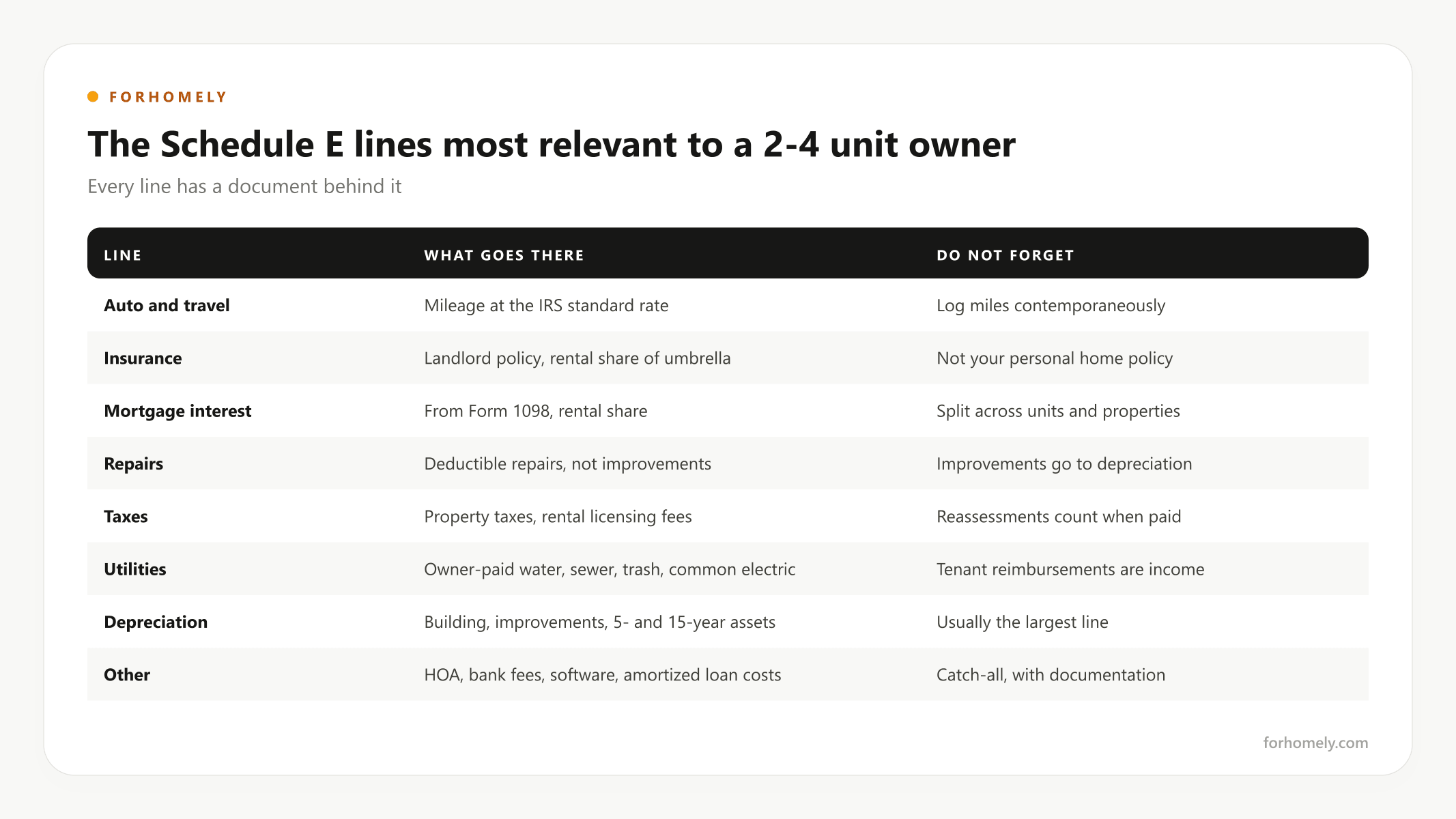
| Schedule E line | What goes there | Do not forget |
|---|---|---|
| Advertising | Listing fees, photos, signage | Vacancy marketing counts |
| Auto and travel | Mileage to the property, supply runs, at the IRS standard rate | Log miles contemporaneously |
| Cleaning and maintenance | Turnover cleaning, lawn, snow, handyman | Small frequent costs add up |
| Commissions | Leasing agent fees | Sale commissions go to basis, not here |
| Insurance | Landlord policy, rental share of umbrella | Not your personal home policy |
| Legal and professional | Attorney, CPA, bookkeeper, eviction filings | Lease drafting is deductible |
| Management fees | Property manager or software fees | Self-managers still deduct software |
| Mortgage interest | From Form 1098, rental share | Split correctly across units and properties |
| Other interest | HELOC or second-lien interest used on the rental | Document the use of proceeds |
| Repairs | Deductible repairs, not improvements | See the repairs versus improvements guide |
| Supplies | Filters, bulbs, smoke-detector batteries, hardware | Keep receipts |
| Taxes | Property taxes, rental licensing and inspection fees | Reassessments count when paid |
| Utilities | Owner-paid water, sewer, trash, common electric | Tenant reimbursements are income |
| Depreciation | Building, improvements, 5- and 15-year assets, from Form 4562 | The largest line for most owners |
| Other | HOA dues, bank fees, pest control, RUBS billing service, amortized loan costs | Catch-all with documentation |
The deductions landlords most often miss
- Mileage. Twelve trips a year at 30 miles round trip is 360 miles, roughly $250 at the current IRS rate, and most owners never log it. A mileage app makes it automatic.
- Home office. A space used regularly and exclusively for managing the rentals qualifies. The simplified method is $5 per square foot up to 300 square feet.
- Phone and internet, business-use share. The portion used to manage the property.
- Education. Landlord association dues, books, and courses tied to your existing rental activity (not to starting one).
- Bank and software fees. ACH processing, late-payment platform charges, accounting software, the dedicated business account's fees.
- Pre-rental expenses. Costs incurred getting a newly purchased property ready for its first tenant are deductible once the property is available for rent; costs that improve the property are added to basis.
- Amortized loan costs. Origination fees and points are deducted over the loan term, and any unamortized balance is deducted in full when you refinance or pay off the loan. Most owners forget them after year one.
The passive loss rules
Rental losses, common once depreciation is included, are passive by default:
- They offset passive income (other rentals, for example) without limit.
- If you actively participate (make management decisions, approve tenants and repairs) and your modified adjusted gross income is under $100,000, you may deduct up to $25,000 of rental loss against ordinary income. The allowance phases out between $100,000 and $150,000 of MAGI.
- Above that, losses are suspended and carried forward. They are not lost; they offset future rental income or are released in full when you sell the property.
- Real estate professionals (more than 750 hours and more than half of working time in real property trades, with material participation in the rentals) are not subject to the passive limitation.
A worked snapshot
A duplex: rental income $38,400, cash operating expenses $18,900 (taxes, insurance, utilities, repairs, management), mortgage interest $14,000, principal paid $3,500, depreciation $10,478.
- Schedule E result: $38,400 − $18,900 − $14,000 − $10,478 = −$4,978, a taxable loss.
- Cash flow: $38,400 − $18,900 − $14,000 − $3,500 = +$2,000 in the bank. Principal is not deductible, and depreciation is not a cash cost, which is the entire difference between the two figures.
- With active participation and MAGI of $85,000, the full $4,978 offsets W-2 income, saving about $1,200 at a 24% rate on top of the $2,000 you kept.
Positive cash flow, negative taxable income. That asymmetry, produced almost entirely by depreciation, is the core tax advantage of small multifamily ownership, and the depreciation guide shows where the $10,478 comes from.

Documentation: the three-year rule
Keep leases, receipts, invoices, mileage logs, and bank statements for at least three years after filing, six if income is substantially understated, and keep records supporting basis and depreciation for as long as you own the property plus three years. The cleanest system:
- A dedicated bank account and card for each property, or at minimum per portfolio.
- Monthly categorization in bookkeeping software mapped to Schedule E lines; the software guide covers the options.
- A year-end fixed-asset schedule for depreciation, and W-9s on file for every contractor so 1099s are painless.
Model the pre-tax numbers first
Taxes improve a good building's returns and cannot save a bad one. Run the property's real income and expenses in the Multifamily Cash Flow Calculator to see pre-tax cash flow, then let depreciation and the passive-loss allowance do their work on the return. If you are spending on the building this year, the repairs versus improvements guide decides which line each dollar goes on.