Your duplex has appreciated $120,000 since you bought it, and tenants have paid the balance down. That equity is dead money until you put it to work, and the two standard tools for unlocking it are the cash-out refinance and the home equity line of credit (HELOC). They solve different problems. Choosing the wrong one can cost you $10,000 a year, and the difference usually comes down to one number: the rate on the loan you already have.
Cash-out refinance: replace the whole loan
A cash-out refinance pays off your existing mortgage with a new, larger one and hands you the difference in cash.
Example. Current balance $210,000, property value $400,000, 2-4 unit investment property.
- Maximum new loan at 70% LTV: $280,000
- Less payoff of the existing loan: $210,000
- Less closing costs at 2-3%: about $7,000
- Cash out: about $63,000
Characteristics:
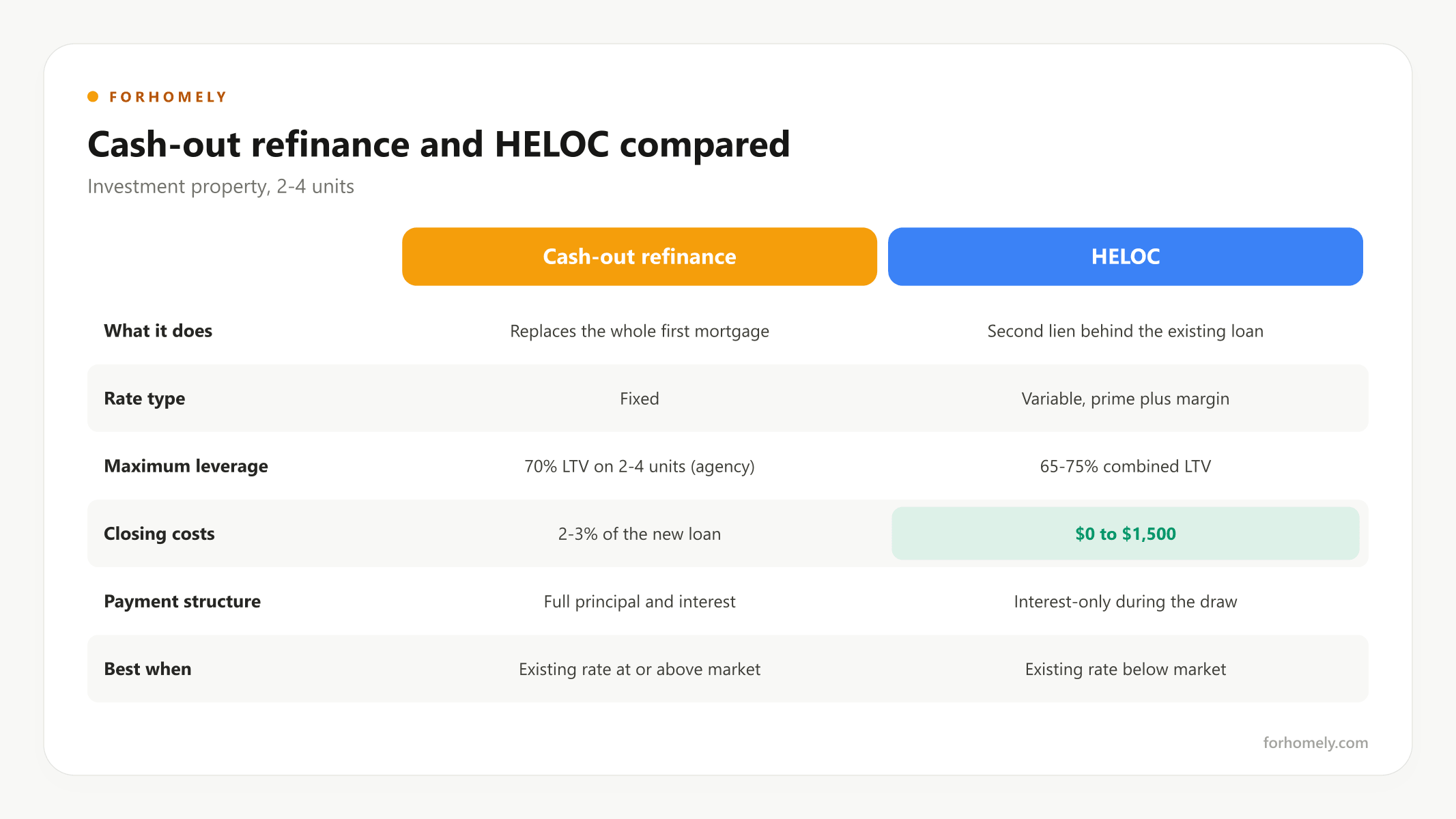
- One fixed-rate loan, fully amortizing, typically over 30 years
- Closing costs of 2-3% of the new loan, plus an appraisal
- The rate is a current market rate for the entire balance. If your existing rate is below market, you are re-pricing every dollar you already owe to extract the new ones.
- Agency LTV caps: 75% on a one-unit investment, 70% on 2-4 units; DSCR lenders are similar
- Seasoning: six months of ownership under agency rules (delayed financing excepted); DSCR and portfolio lenders commonly require three to six months, sometimes waived when a renovation created the value
- Investment cash-out pricing carries an adjustment of roughly 0.25-0.75% above a rate-and-term refinance
HELOC: a second lien behind your mortgage
A HELOC is a revolving credit line secured by your equity, sitting behind the existing first mortgage.
Characteristics:
- A draw period, usually 10 years, during which you borrow and repay as needed and pay interest only on what you have drawn
- A repayment period of 10-20 years afterward, when the line converts to an amortizing loan
- A variable rate, typically prime plus a margin; investment-property HELOCs run one to two points above primary-residence lines
- Low closing costs, often $0-$1,500
- Available on investment property mainly from credit unions and portfolio banks, at combined LTVs of 65-75%
- The first mortgage stays exactly as it is
The rate trap that decides it
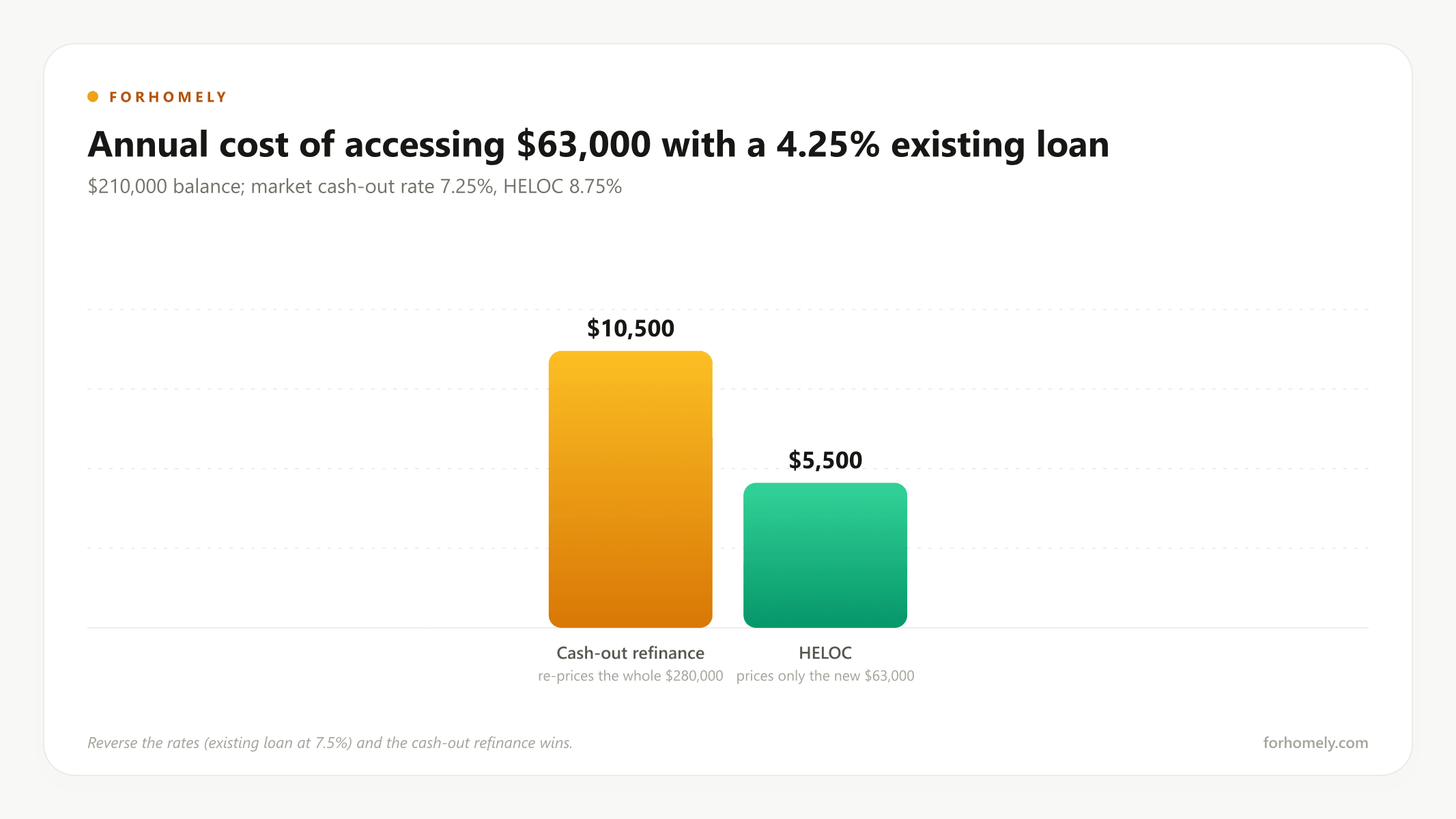
Suppose you hold a 4.25% mortgage from 2021 with a $210,000 balance, and current investment cash-out rates are about 7.25%. You want $63,000 for a down payment on the next building.
Option A: cash-out refinance to $280,000 at 7.25%.
- Old payment (P&I on $210,000 at 4.25%): about $1,033
- New payment (P&I on $280,000 at 7.25%): about $1,910
- Increase: about $877 a month, $10,500 a year, to access $63,000
Option B: HELOC for $63,000 at 8.75%, interest-only.
- First mortgage untouched at 4.25%: $1,033
- HELOC interest: about $459 a month
- Increase: about $459 a month, $5,500 a year
The HELOC costs about $5,000 less per year even though its rate is higher, because it only prices the new money. This is the classic "do not re-price good debt" outcome.
Now flip the scenario: your existing loan is at 7.5% from 2023. A cash-out refinance at 7.25% lowers the rate on the whole balance while extracting cash, the payment increase is smaller, the rate is fixed, and the single amortizing payment is simpler. The cash-out refinance wins outright.
The rule: if your existing rate is meaningfully below market, protect it and borrow the increment with a HELOC or a second mortgage. If your existing rate is at or above market, refinance the whole thing.
The full cash-out example: buy again without selling
You bought a triplex three years ago for $300,000 with 20% down ($60,000), financing $240,000 at 6%. Today it is worth $385,000 and the balance is about $230,000.
- Equity: $385,000 − $230,000 = $155,000
- Cashable equity at 70% LTV: $269,500 − $230,000 = about $39,500, before closing costs
That is enough for 20% down on a $180,000-$200,000 property, or 25% on a $150,000 one. Add a HELOC from a primary residence and the numbers scale. Two cautions before you do it:
- The triplex must still cash flow after the new payment. Going from $240,000 at 6% (about $1,439 P&I) to $269,500 at 7.25% (about $1,838) adds $400 a month. If the building was netting $500, it now nets $100.
- The new property must be real, not hypothetical. Refinancing into cash that sits in a savings account earning 4% while you pay 7.25% is a guaranteed loss. Line up the acquisition first.
Tax treatment of the proceeds
- Loan proceeds are not income. There is no tax on the cash you take out.
- Interest follows the use of the money. Under the interest-tracing rules, interest on a cash-out refinance or HELOC is deductible against rental income only to the extent the proceeds are used in a rental activity: repairs, a down payment on another rental, reserves for the rental. Proceeds spent personally produce non-deductible interest.
- Document it. Deposit the proceeds into the rental's business account and trace each expenditure. Your CPA will need the trail; the Schedule E deductions guide covers where the interest is reported.
- Loan costs on a refinance are amortized over the new loan's term, not deducted at once.
Strategic uses for small multifamily owners
- The buy-renovate-rent-refinance recycle. Force value with renovations and rent increases, refinance at the new value, recover most of your cash, and repeat. The cash-out refinance is the engine; seasoning and appraisal risk are the friction.
- Down payment for property number two. A HELOC on building one funds 20-25% down on building two without touching reserves.
- CapEx smoothing. A $25,000 boiler and roof funded by a HELOC keeps cash reserves intact; the line is repaid from cash flow over two or three years.
- Rate-and-term alternative. If you do not need cash, a plain rate-and-term refinance at 75% LTV avoids the cash-out pricing adjustment entirely. The refinancing strategy guide covers the break-even math.
Underwrite the new payment
Whatever you extract, the new debt service has to fit the building's income. Run the post-refinance PITIA through the DSCR Loan Calculator: if the ratio falls below 1.25, you are spending cash flow that future you will miss, and if it falls below 1.10, you have turned a good building into a fragile one. Then run the second property through the Multifamily Cash Flow Calculator. The move only works if the combined portfolio cash flows better than the single building did.