Refinancing a 2-4 unit property comes in two flavors: rate-and-term (same balance, better loan) and cash-out (bigger balance, money in hand). They have different LTV caps, different pricing, and different purposes, and the wrong choice can cost thousands a year for as long as you hold the loan. This guide covers the rules, the break-even math, the amortization trap, and a worked comparison against the HELOC alternative.
Rate-and-term refinance
You replace your existing loan with a new one of roughly the same balance, to:
- Lower the rate and the payment
- Change the term: 30 to 15 years to kill interest cost, or 15 to 30 to improve cash flow
- Remove mortgage insurance, for example escaping FHA's permanent MIP by refinancing to conventional at 80% LTV once you have the equity; see the MIP versus PMI guide
- Escape a balloon on a seller carry or commercial-style loan, or an adjustable rate before it resets
Rules on 2-4 unit investment property: agency LTV up to 75%; no cash back beyond a small tolerance; standard pricing adjustments for investment occupancy. Owner-occupied 2-4 units can go higher.
Cash-out refinance
You borrow more than you owe and take the difference. Investment-property cash-out is priced and capped more conservatively:
- LTV cap: 70% on 2-4 unit investment properties under agency rules (75% on one unit); DSCR lenders are similar
- Rate premium: typically 0.25-0.75% above rate-and-term pricing
- Seasoning: six months of ownership under agency rules, three to twelve at DSCR and portfolio lenders, sometimes waived when a documented renovation created the value
- Closing costs: 2-3% of the new loan
The cash-out versus HELOC guide covers the strategic uses of the cash; this guide focuses on when to refinance at all.
The break-even calculation
Break-even months = total closing costs ÷ monthly payment savings
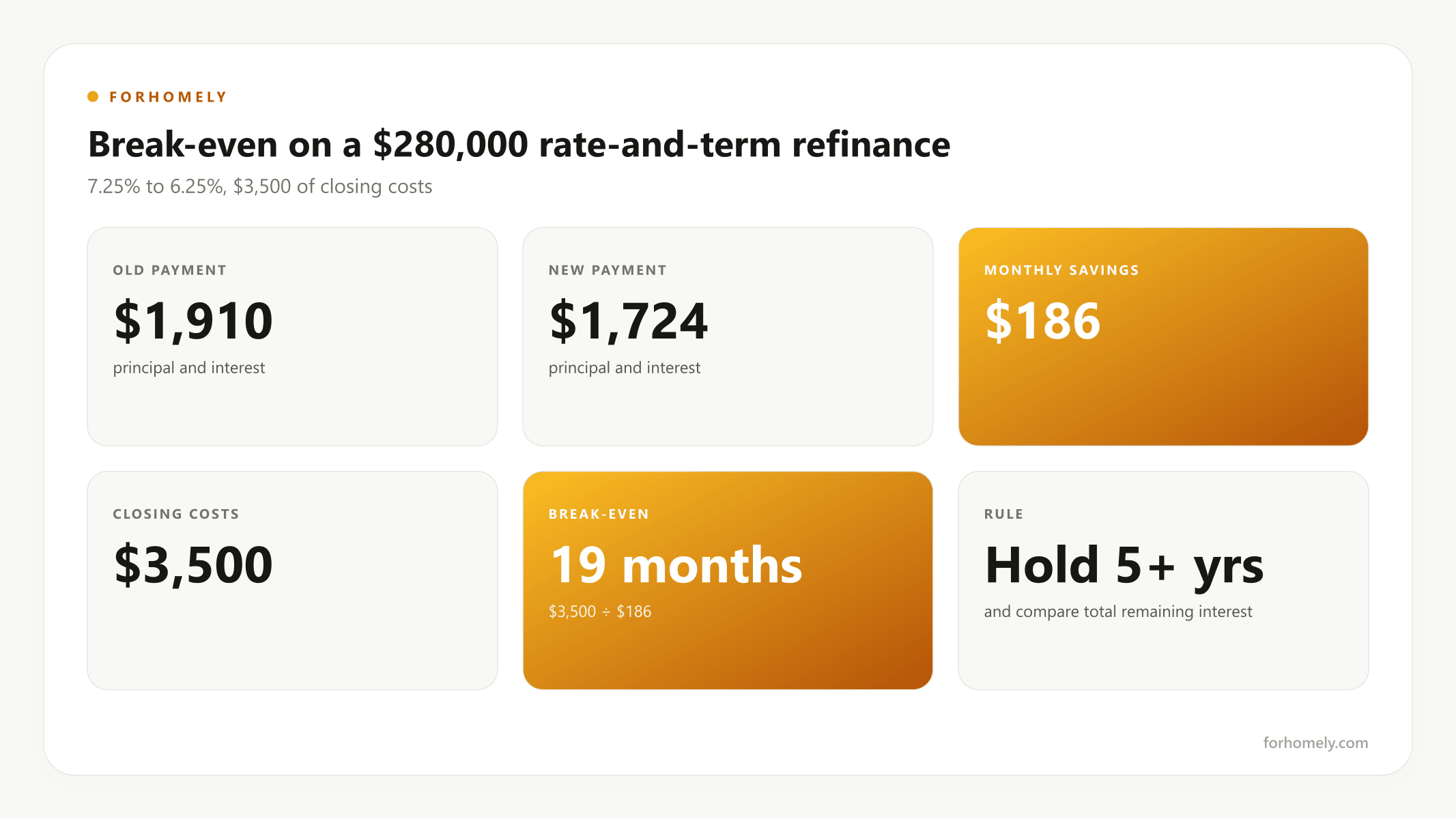
Example. A $280,000 balance at 7.25%, refinanced rate-and-term to 6.25%, with $3,500 of closing costs:
- Old principal and interest: $1,910
- New principal and interest: $1,724
- Monthly savings: $186
- Break-even: $3,500 ÷ $186 = about 19 months
If you will hold the property five years or more, refinance. If you expect to sell within two years, do not.
The amortization reset trap
A refinance restarts the clock. Twenty years into a 30-year loan, a new 30-year schedule means paying mostly interest again for years, and the "savings" in the monthly payment partly comes from stretching the remaining balance over more time. Compare total remaining interest under both loans, not just the monthly payment. If the old loan has 12 years left and the new one has 30, a lower payment can still mean far more interest. One fix is to refinance into a shorter term, or to keep paying the old payment amount on the new loan.
Worked example: cash-out refinance versus HELOC
You own a fourplex worth $500,000 with a $250,000 balance at 4.5% from 2021. Current rates: about 7% for rate-and-term, 7.5% for investment cash-out. You want $75,000 for a down payment on the next property.
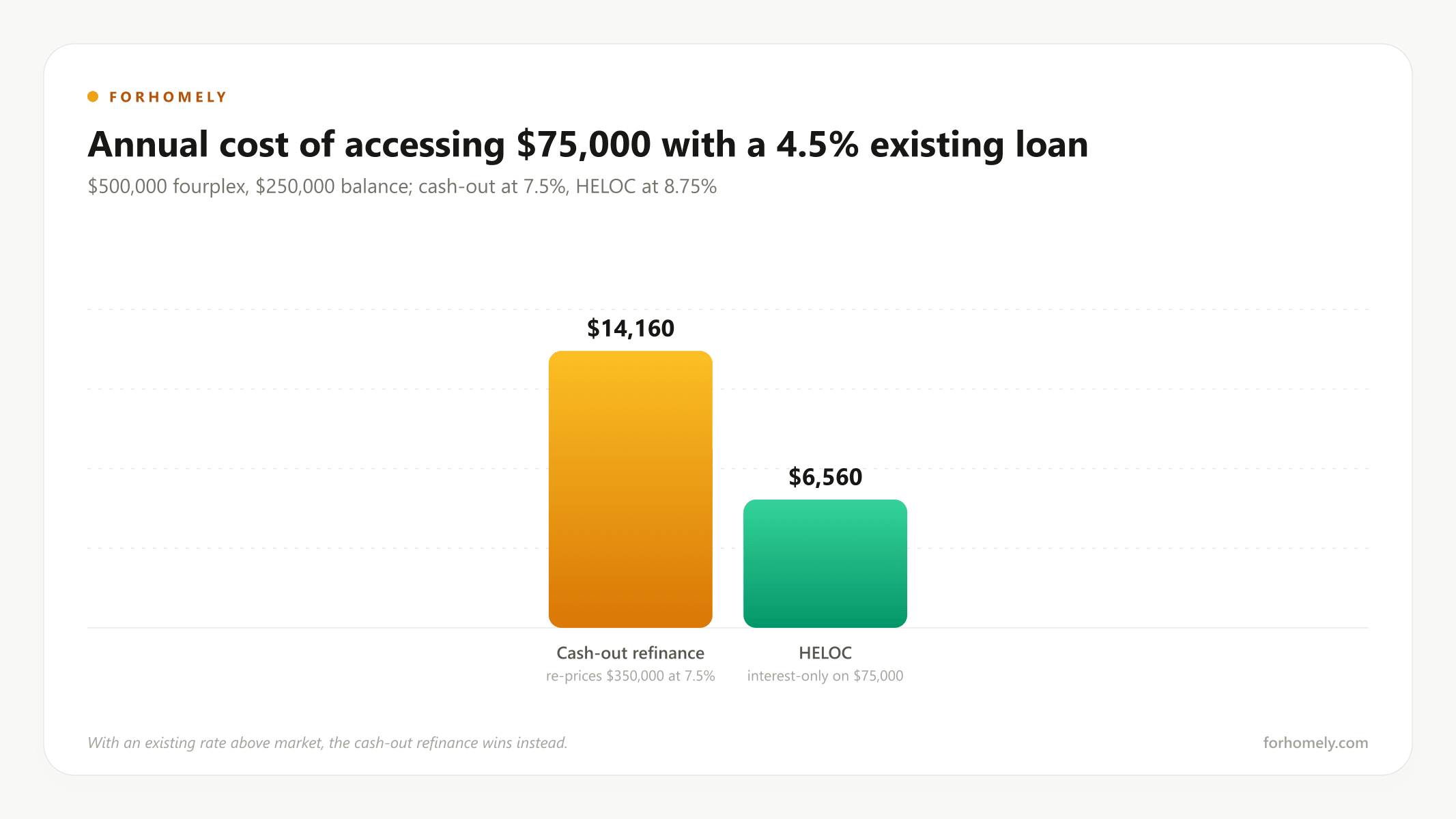
Option A: cash-out refinance at 70% LTV ($350,000) at 7.5%
- Re-prices the entire $350,000 from 4.5% to 7.5%
- New principal and interest: about $2,447, versus $1,267 today
- Increase: about $1,180 a month, $14,160 a year, to access $75,000 (net of costs, closer to $90,000 available at the cap)
Option B: HELOC of $75,000 at 8.75%, interest-only during the draw
- First mortgage untouched at 4.5%
- HELOC interest: about $547 a month
- Increase: about $6,560 a year
Option B costs roughly $7,600 less per year. The classic rule: do not re-price good debt. Reverse the scenario, a 7.5% existing loan in a 6.25% market, and the cash-out refinance wins outright, because you get the cash and a lower rate on everything.
The decision framework
- Is your current rate above market? Rate-and-term refinance first; add cash-out only if you need the money.
- Is your current rate below market? Keep the first mortgage; use a HELOC or a second lien for the increment.
- Do you need permanent capital (a major renovation, a partner buyout)? A cash-out refinance's fixed, amortizing structure fits.
- Do you need episodic capital (down payments, CapEx smoothing)? A HELOC's flexibility fits.
- Will the building still cover the new payment? Verify with the DSCR Loan Calculator before you commit; a refinance that pushes coverage below 1.20 has made the building fragile.
- Does the refinance affect your next purchase? A higher payment here raises your DTI and lowers the ratio a lender will see.
Underwriting prep checklist
- Two years of tax returns for a conventional refinance, or current leases and a rent schedule for a DSCR refinance
- Updated rent roll and a T-12-style income statement; the rent roll audit guide shows the format lenders expect
- Current insurance declarations page, with the lender listed as mortgagee
- Reserves: three to six months of PITIA on investment 2-4 units at most lenders
- Recent comparable sales, so you know the likely appraised value before you pay for the appraisal
- Lock terms before ordering the appraisal, and read the Loan Estimate's tolerance categories
Model the new payment
Run both scenarios through the First-Time Homebuyer Mortgage Calculator, which handles any loan's principal-and-interest math and amortization schedule, and compare total interest, not just the monthly payment. Then check that the building's coverage survives the new payment before you sign.