You write an offer for $350,000. The appraisal comes back at $340,000. Your lender will now base the loan on $340,000, and the $10,000 difference has to come from somewhere: your pocket, the seller's price, or a dead deal. This is an appraisal gap, and in competitive markets where offers routinely overshoot recent sales, it is one of the most common ways a purchase stalls two weeks before closing.
This guide explains exactly what a low appraisal does to your financing, walks through the formal appeal process the agencies now require lenders to offer, and gives you a decision framework for the four real options.
What a low appraisal does to the loan
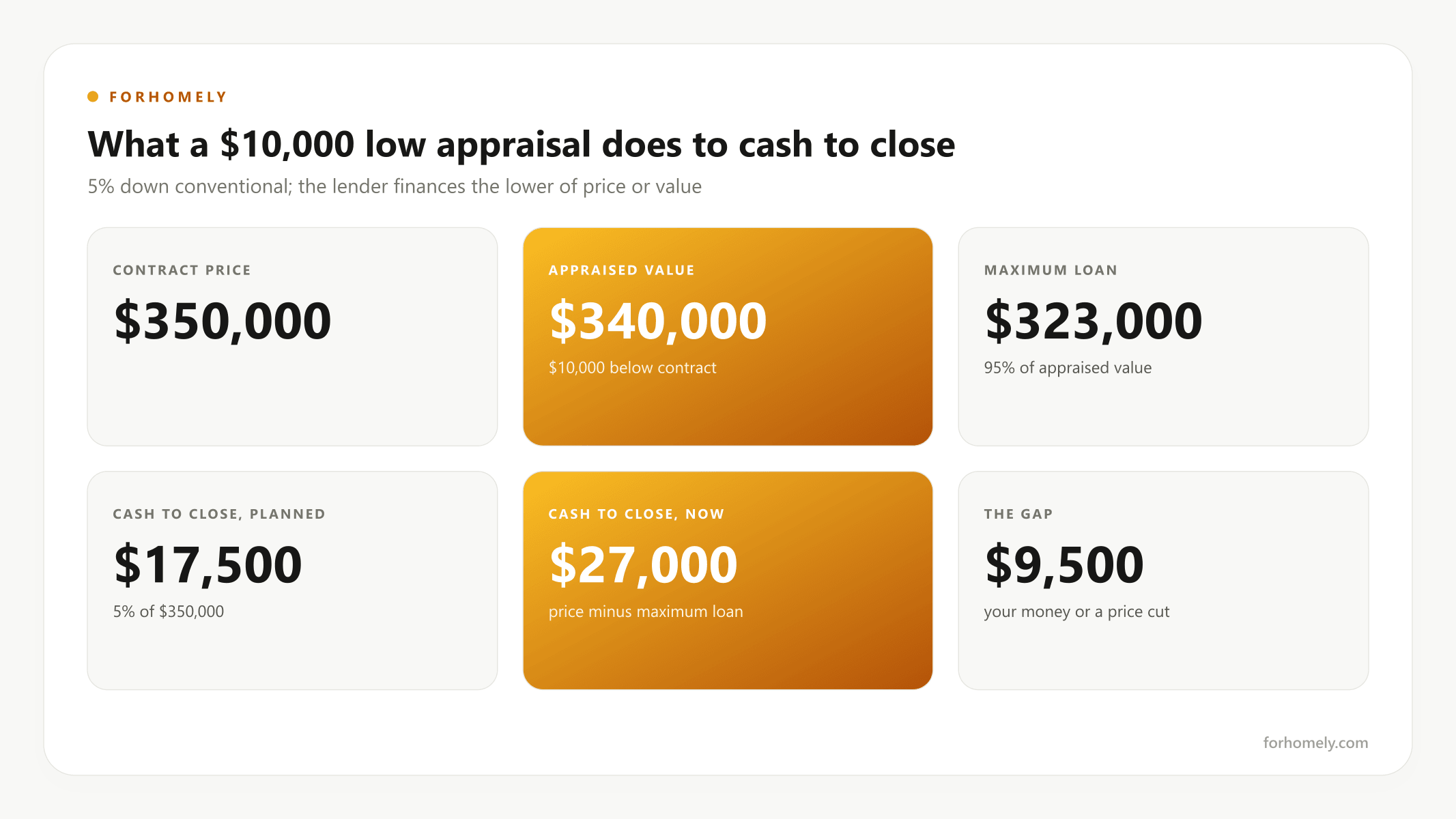
Lenders lend against the lower of the purchase price or the appraised value. With 5% down on a $350,000 contract, you planned a $332,500 loan and $17,500 down. If the appraisal is $340,000:
- Maximum loan: 95% of $340,000 = $323,000
- Contract price still $350,000
- Cash required: $350,000 − $323,000 = $27,000, up from $17,500
The extra $9,500 is the gap. Your rate and payment barely change; your cash to close rises by the full shortfall.
Why appraisals come in low
Appraisers value a property by comparing it to recent sales of similar homes (the sales comparison approach), and for 2-4 unit buildings, partly by its income. If your offer is $20,000 above what similar buildings sold for in the last six months, the appraiser has no evidence to support your price. Common causes:
- Bidding wars. Multiple offers push contract prices above the last closed sales.
- Thin comparables. Small multifamily buildings trade less often than houses, so the appraiser may reach for older or more distant sales.
- Condition and rent differences the appraiser did not credit. Renovated units or above-market rents that were not documented.
- Rising markets. Appraisals lag by nature; they look backward at closed sales.
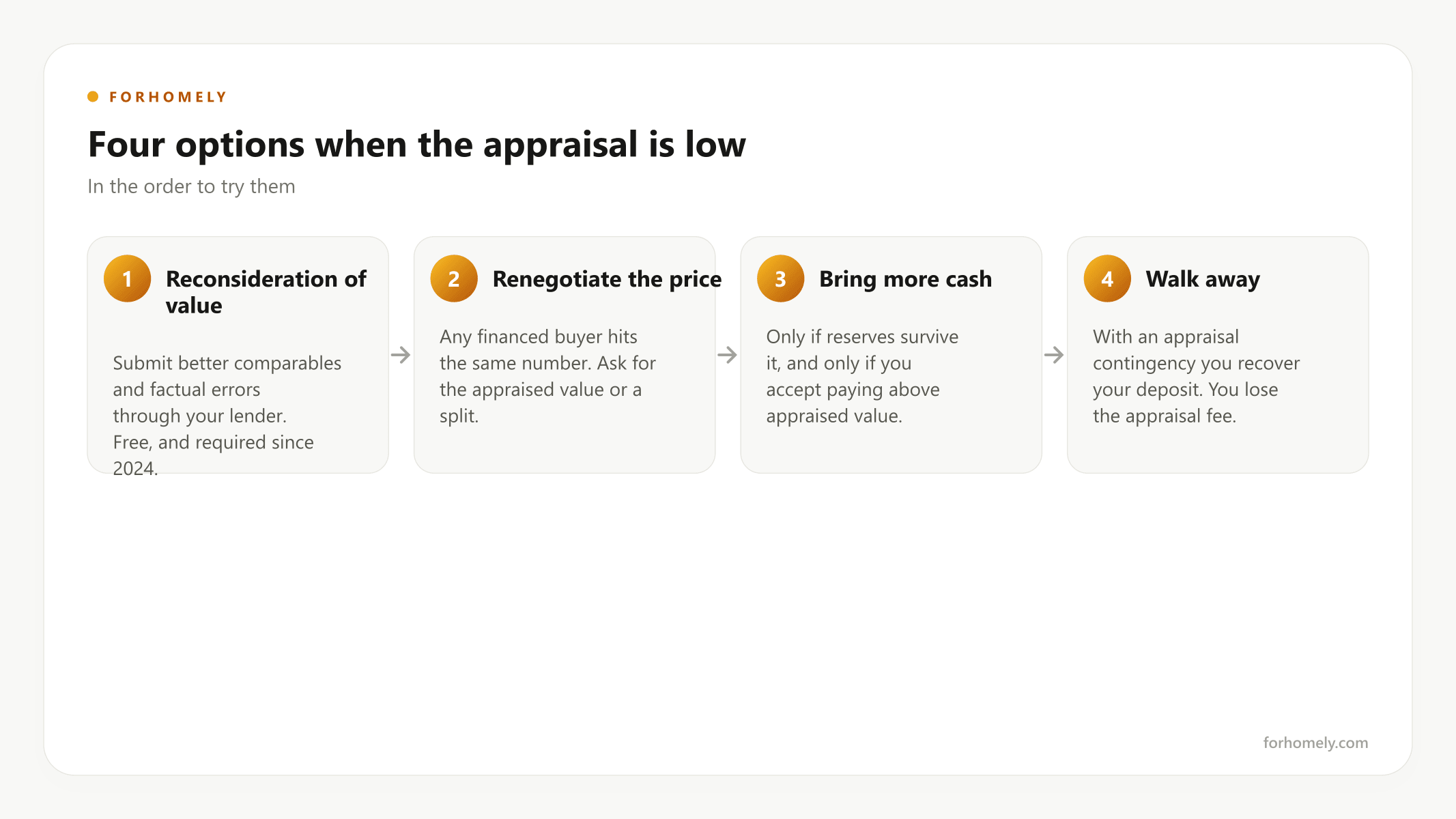
Option 1: Reconsideration of value (ROV)
Since 2024, FHA, Fannie Mae, and Freddie Mac all require lenders to have a borrower-initiated reconsideration of value process and to tell you about it. It is not a hail mary; it is a structured review, and it works when the request is specific.
How to build a strong ROV request:
- Get the appraisal from your lender (you are entitled to a copy) and read the comparables.
- Identify better comparables: more recent, closer, more similar in unit count, size, and condition. Your agent can pull these. Most lenders limit you to three to five.
- Document factual errors: wrong square footage, wrong unit count, a renovation the appraiser missed, a comparable that was a distressed sale.
- On 2-4 units, include rent comparables if the rent schedule is low. The rent figure affects your qualifying income and, on FHA 3-4 unit loans, the self-sufficiency test.
- Submit through your lender in writing. The appraiser must respond to each point, and the lender must give you the outcome.
ROVs succeed more often when the gap is small (a few percent) and the request is about specific comparables, not "the market is hot."
Option 2: Renegotiate the price
Ask the seller to reduce the price to the appraised value, or to meet you partway. Sellers often agree, because any other financed buyer will hit the same appraisal, and a cash buyer will use the number as leverage. Your negotiating position is strongest when:
- Your contract has an appraisal contingency (you can walk with your deposit).
- The property has been on the market a while, or the seller has a deadline.
- The gap is large enough that other buyers are unlikely to cover it.
A common compromise: the seller drops the price by half the gap and you cover the rest.
Option 3: Bring more cash
If the gap is small and you have the funds, paying it is the simplest path. Before you do, ask two questions. First, are you comfortable paying above what a licensed appraiser says the building is worth, knowing the next appraisal (for a refinance or sale) may agree with this one? Second, does the extra cash leave you with the reserves the loan requires and the reserves the building needs? A duplex bought with zero cash left over is a duplex one boiler away from trouble.
Option 4: Walk away
If your offer includes an appraisal contingency and the seller will not move, you can cancel and recover your earnest money. You lose the appraisal fee and inspection costs, typically $1,500-$2,500 on a 2-4 unit. That is cheap compared to overpaying by $10,000 or more.
If your offer included an appraisal gap clause instead, you have already promised to cover the shortfall up to the cap. Read the clause before you sign it, and never cap it above the cash you can actually spare.
A note on "appraisal gap coverage" products
You may see offers of appraisal gap coverage or gap insurance from brokerages, title companies, or third parties. These vary widely: some are true insurance products with premiums and caps, others are seller-paid guarantees, and some are marketing for a lender credit. Read the terms, confirm who is actually paying if the appraisal is low, and understand that most are structured for single-family purchases in bidding wars, not 2-4 unit investments. They are not a substitute for a sound offer price.
The bigger picture
Appraisal gaps are a symptom of paying above recent sales. If you routinely bid $20,000 over what comparable buildings closed at, you are overpaying by definition, and the appraiser is doing you a favor by saying so. Before you write an offer:
- Pull closed sales of similar 2-4 unit properties from the last six months.
- Run the property's income through the Multifamily Cash Flow Calculator. If the cap rate at your offer price is below the local range, an appraiser will likely agree.
- Stress-test your cash in the First-Time Homebuyer Mortgage Calculator: what happens if the appraisal is $10,000 low, or $20,000 low? Know the answer before the appraiser does.