Every investor has the same dream: a $350,000 fourplex worth $450,000 that nobody else knows about. Off-market deals exist, but they are not hiding in the trees. They come from four specific channels, each with a cost in money or time, and each with a realistic discount that is smaller than the stories suggest. This guide explains how each channel actually works for 2-4 unit buyers, the risks that are specific to each, and a system that produces steady deal flow instead of occasional luck.
Channel 1: pocket listings
A pocket listing is a property an agent has agreed to sell but has not yet exposed to the full market. Under the MLS Clear Cooperation Policy, once an agent markets a listing publicly they must enter it in the MLS within one business day, but "office exclusives" and quiet outreach to known buyers before public marketing remain common, especially on small multifamily where sellers value privacy from tenants.
How it works. An agent takes a listing from a seller who wants a quick, quiet sale. Before marketing broadly, the agent calls the investors they know will close. If one bites at a reasonable price, the seller gets certainty, the buyer gets a semi-exclusive look, and the agent avoids a month of showings.
How to get on the list. Build relationships with two or three agents who personally invest in or specialize in 2-4 unit buildings. Show them a pre-approval, a closed deal or two, and a clear buy box (unit count, price range, neighborhoods, condition). Then respond within hours when they call.
The edge. You see it before offers are flying. You can inspect calmly and make a clean offer without the $20,000 overbid that a bidding war would require.
The trap. The agent is testing you. Lowball once and you are off the list. Waffle once and you are off the list. Pocket listings reward serious buyers and punish tire-kickers.
Realistic discount: 2-5% below what an open-market sale would fetch, in exchange for speed and certainty. Close rate: high.
Channel 2: wholesalers
A wholesaler finds a distressed or motivated owner (probate, pre-foreclosure, divorce, an out-of-state landlord with a problem tenant), puts the property under contract at a low price, and sells the contract to an investor for an assignment fee of $5,000-$25,000.
How it works.
- The wholesaler contracts a $300,000-value fourplex at $240,000 from a motivated seller.
- They market the contract to their buyer list at $255,000.
- You buy the contract (or close via a double closing), paying $255,000; the wholesaler keeps $15,000.
- You own a $300,000 building for $255,000 plus whatever it needs.
The trap, in detail.
- The property usually needs work. That is why it was cheap.
- Wholesalers rarely vet deals; they chase volume, and the "after-repair value" in their email is frequently optimistic.
- Inspection contingencies are rare and closing timelines are short; you often buy as-is with earnest money at risk.
- The wholesaler disappears at closing. Any problem that surfaces afterward is yours.
- Some states now require wholesalers to be licensed or to disclose that they do not own the property; unlicensed wholesaling can create title and enforceability questions.
How to buy from wholesalers safely. Walk the property with your own contractor before you sign. Verify the ARV with your own comparables. Underwrite the rents from your own research, not the wholesaler's sheet. Have cash or a hard-money commitment ready, and never wire earnest money to anyone but a title company.
Realistic discount: 8-15% below market after the assignment fee, before repairs. Close rate: medium; many wholesale contracts fall apart when the seller or the numbers do not hold.
Channel 3: direct-to-owner marketing
You send a message (a letter, a postcard, a text where legal, or a targeted ad) to owners of 2-4 unit properties in your target area: "I buy small apartment buildings for cash; if you are thinking of selling, call me."
Cost. $500-$2,000 a month for lists and mail, or more for paid ads.
Response rate. Roughly 0.5-2% of letters produce a call. Most calls are curiosity, agents, or owners fishing for a number. A small share are genuinely motivated.
Time. Ten hours of calls per closed deal is a reasonable estimate, and the first closed deal often takes six months of consistent mailing.
Targeting that works. Owners with 15+ years of ownership, out-of-state mailing addresses, properties with code violations, tax-delinquent properties, and estates. County records and list services provide all of these.
Legal notes. Comply with the Telephone Consumer Protection Act and state rules on texting and calling; do not text owners who have not opted in. Keep your marketing honest: "cash offer" means you can actually close for cash.
Realistic discount: 10-20% below market on the deals that close, because you are solving a problem. Close rate: low per letter; consistent over a year.
Channel 4: networking
The most consistent source of off-market deals is your own network: other investors who are selling or sizing down, contractors who see distressed buildings every week, property managers whose clients want out, probate attorneys, estate sale companies, and lenders who know when a borrower is struggling.
How it works. Your contractor mentions a property manager whose out-of-state client is done with a triplex. The manager calls you before it is listed. You tour, offer a fair price, and close in thirty days with no bidding war.
Cost. Minimal in cash; real in time. Show up at investor meetups, local landlord association meetings, and small-business events. Be useful before you ask for anything.
Realistic discount: 5-10%, usually in exchange for a clean, fast transaction with someone the seller trusts. Close rate: high.
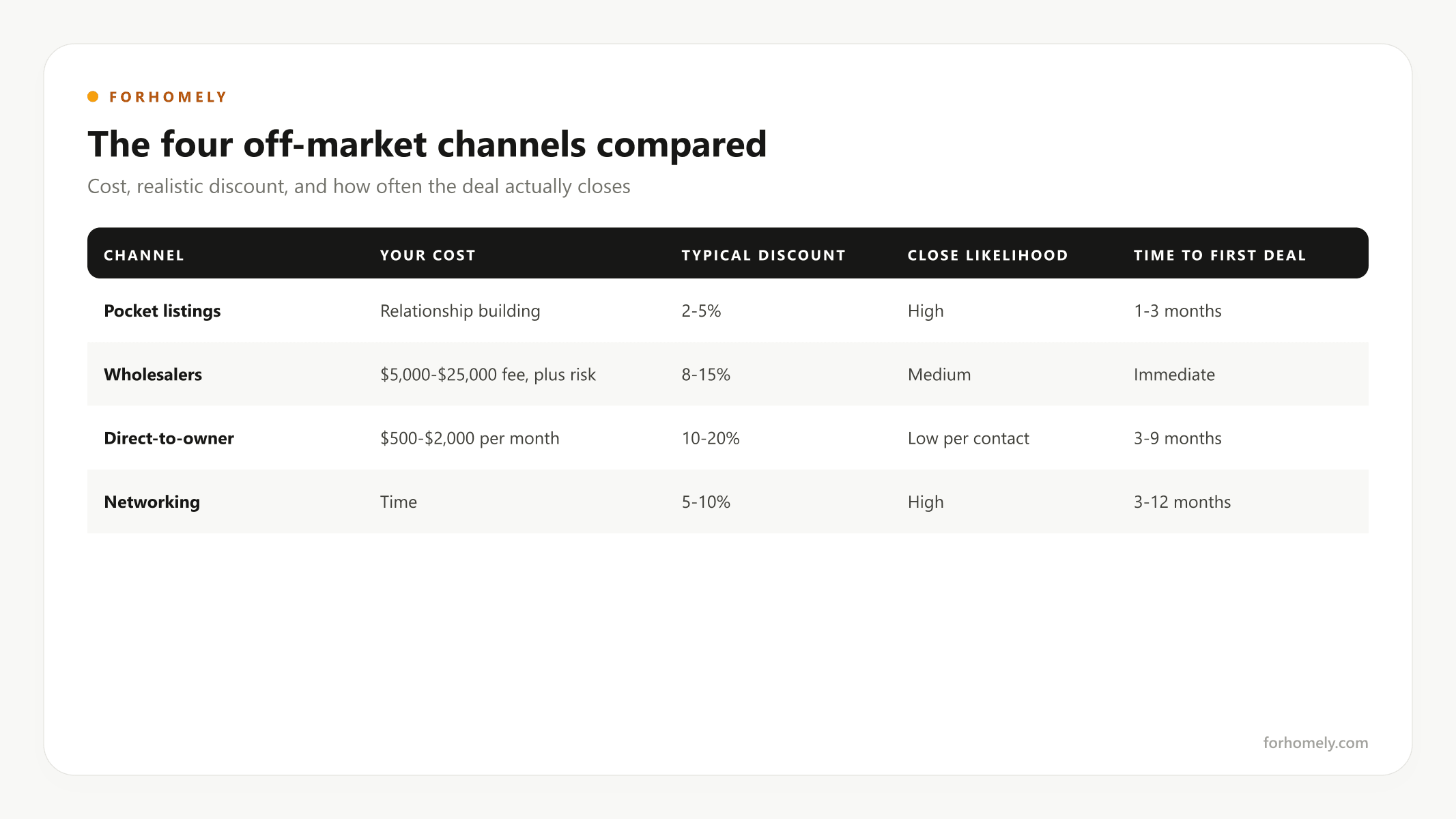
The economics, side by side
| Channel | Your cost | Typical discount | Likelihood of closing | Time to first deal |
|---|---|---|---|---|
| Pocket listings | Relationship building | 2-5% | High | 1-3 months |
| Wholesalers | $5,000-$25,000 fee, plus risk | 8-15% | Medium | Immediate, if you accept the risk |
| Direct-to-owner | $500-$2,000 a month | 10-20% | Low per contact | 3-9 months |
| Networking | Time | 5-10% | High | 3-12 months |
A repeatable system
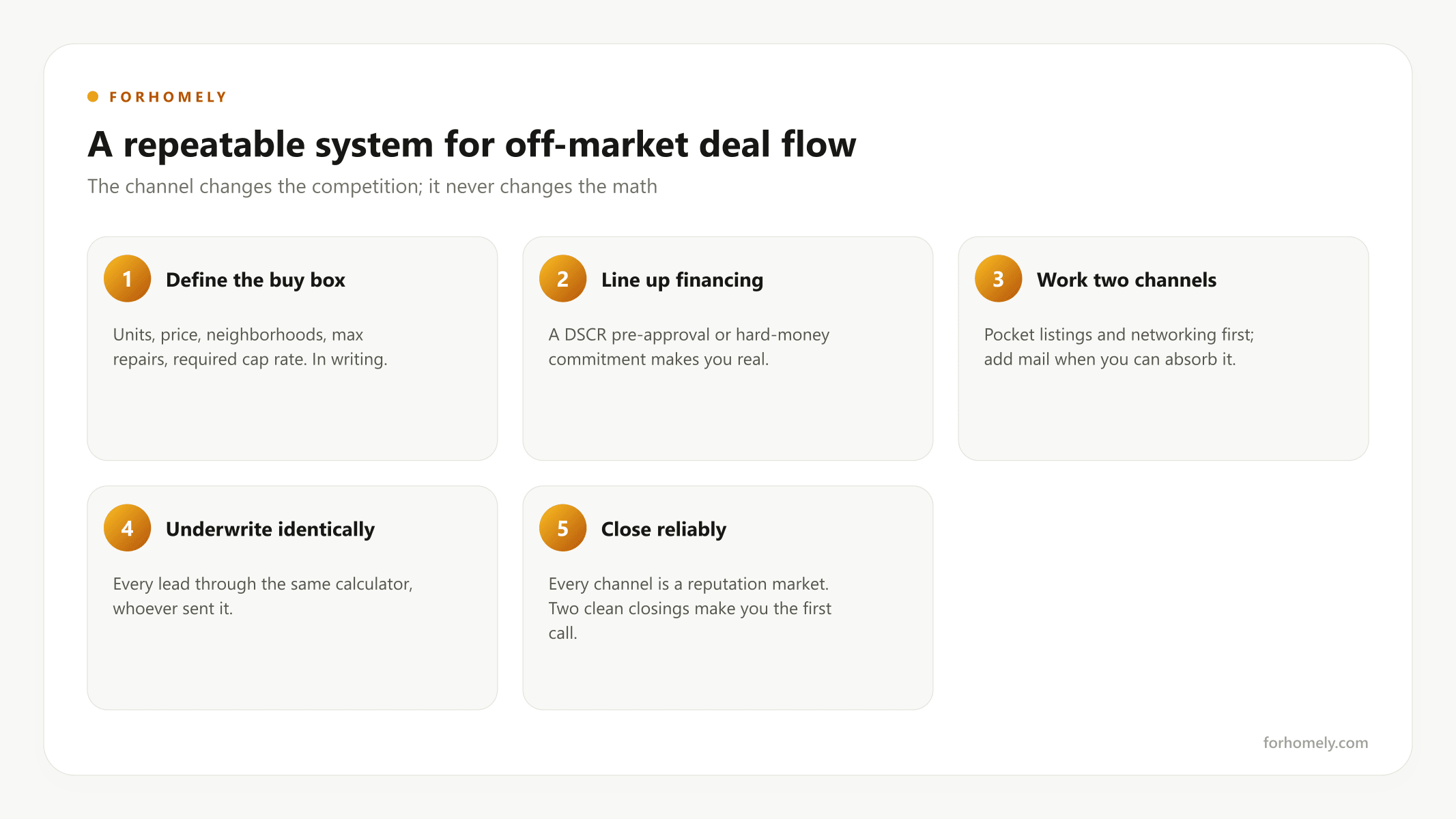
- Define the buy box in writing: unit count, price range, neighborhoods, maximum repairs, and the cap rate you need. Share it with every agent, wholesaler, and investor you meet.
- Get financing lined up before you look. A DSCR pre-approval or a hard-money commitment makes you a real buyer to every channel.
- Work two channels at once, typically pocket listings and networking, and add direct mail once you can absorb the time.
- Underwrite every lead identically, in the Multifamily Cash Flow Calculator, regardless of who sent it. The channel changes the competition; it never changes the math.
- Respond fast and close reliably. Every channel is a reputation market. Two clean closings make you the first call.
The honest take
Off-market deals are real, and they come from consistent effort across channels, not from a secret list. The "$300,000 building for $180,000" almost never happens; buying at 92-97% of market value with no bidding war and time to inspect happens regularly, and over a portfolio of five to ten buildings, that compounds into real returns.
The biggest advantage is not the discount. It is that you see fewer competing offers and can think clearly about whether the deal makes sense, which is the whole point of reading the rent roll and T-12 before you write the number.