You own a fourplex. A tenant's guest slips on an icy step, breaks a hip, and sues for $600,000. Your landlord policy has a $300,000 liability limit. After the insurer pays its limit and defense costs, you personally owe the rest, and the plaintiff's attorney knows exactly what the building is worth. This is why umbrella insurance exists, and why a proper insurance structure is the cheapest asset protection a small landlord can buy.
What a standard landlord policy covers
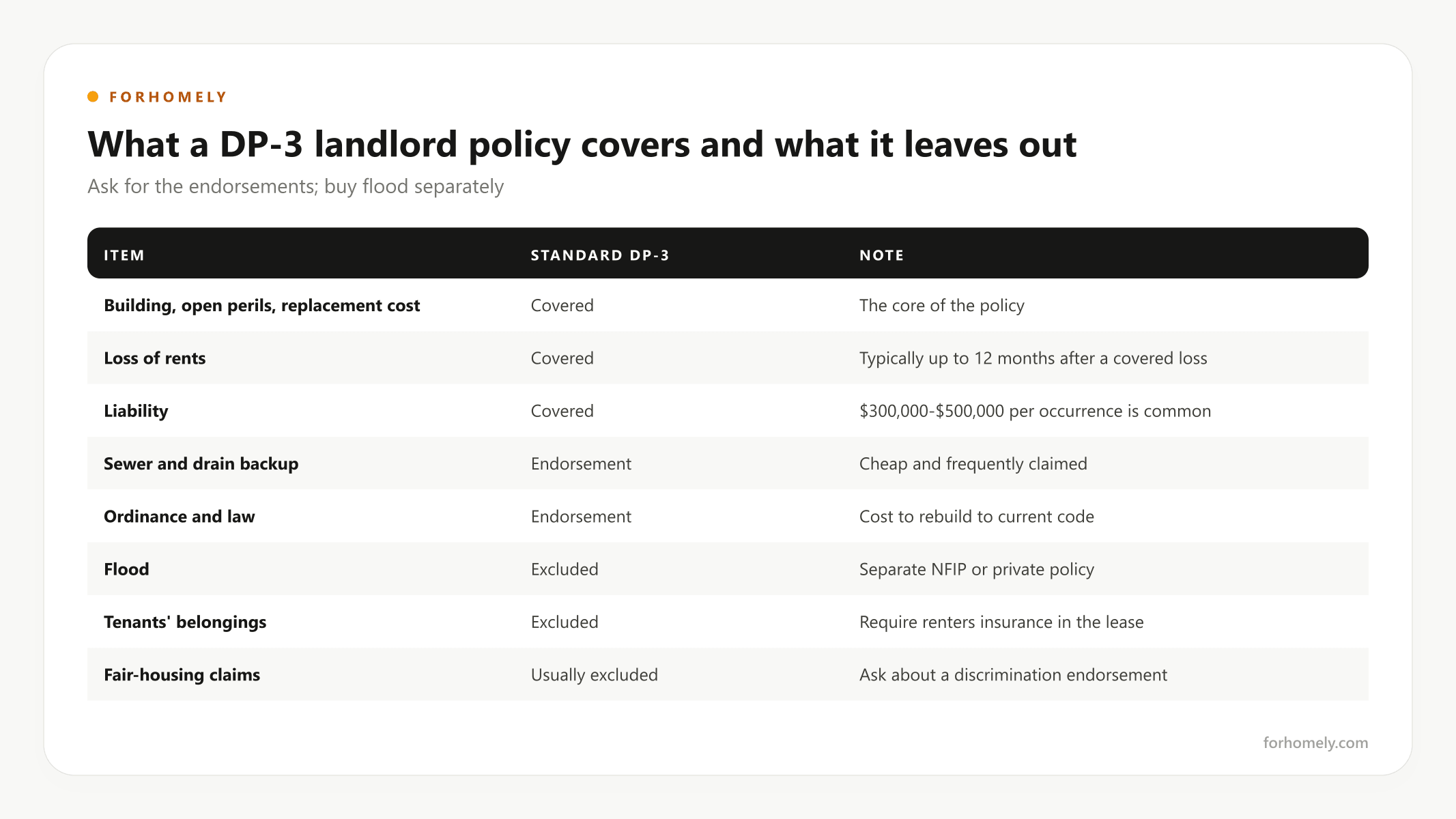
Rental property is insured under a dwelling policy, and for a building you intend to keep, the form to buy is the DP-3: open-perils coverage on the structure at replacement cost.
Typical coverage:
- Dwelling: the building, attached structures, and built-in systems, for any cause of loss not specifically excluded (fire, wind, hail, vandalism, water damage from a burst pipe, and so on).
- Other structures: detached garages, fences, sheds.
- Loss of rents (fair rental value): rent you cannot collect while covered damage makes units uninhabitable, typically for up to 12 months.
- Liability: legal defense and damages if someone is injured on the property or you are held responsible for property damage, commonly $300,000-$500,000 per occurrence.
- Medical payments to others: $1,000-$5,000 for minor injuries, paid without a finding of fault.
Typical cost: $1,200-$2,500 a year for a $350,000-$500,000 duplex or triplex, varying widely by state, age of building, claims history, and deductible.
What it excludes or limits: flood, earthquake, sewer and drain backup (an endorsement), ordinance-and-law costs to rebuild to current code (an endorsement), mold (sub-limited), intentional acts, tenants' belongings, business equipment, and in most cases fair-housing discrimination claims.
The liability limit problem
A $300,000 liability limit sounds substantial until you see what injury claims actually settle for:
| Claim type | Typical range |
|---|---|
| Slip and fall, moderate injury | $25,000-$150,000 |
| Slip and fall, fracture or surgery | $100,000-$400,000 |
| Child injured on a property defect | $150,000-$750,000 or more |
| Fire with injuries, alleged smoke-detector failure | $250,000-$1,000,000 or more |
| Mold or habitability claim with health effects | $50,000-$300,000 |
| Fair-housing complaint with damages | $25,000-$250,000 or more |
Most claims settle inside a standard limit. The one that does not is the one that takes the building, and defense costs on a serious claim can consume a meaningful share of the limit before any settlement.
Umbrella (excess) liability
An umbrella policy adds coverage above the liability limits of your underlying policies (landlord, auto, homeowners). It also often broadens coverage and pays defense costs above the underlying limit.
- Typical limits: $1 million to $2 million for small landlords; higher for larger portfolios
- Typical cost: $200-$500 a year for $1 million, and each additional million is usually cheaper than the first
- Requirements: underlying policies with minimum limits, commonly $300,000-$500,000 on the landlord policy and $250,000-$500,000 on auto, all with the same carrier or an approved carrier
- Schedule every property. An umbrella only covers the properties and vehicles listed on it. Add each new acquisition at closing.
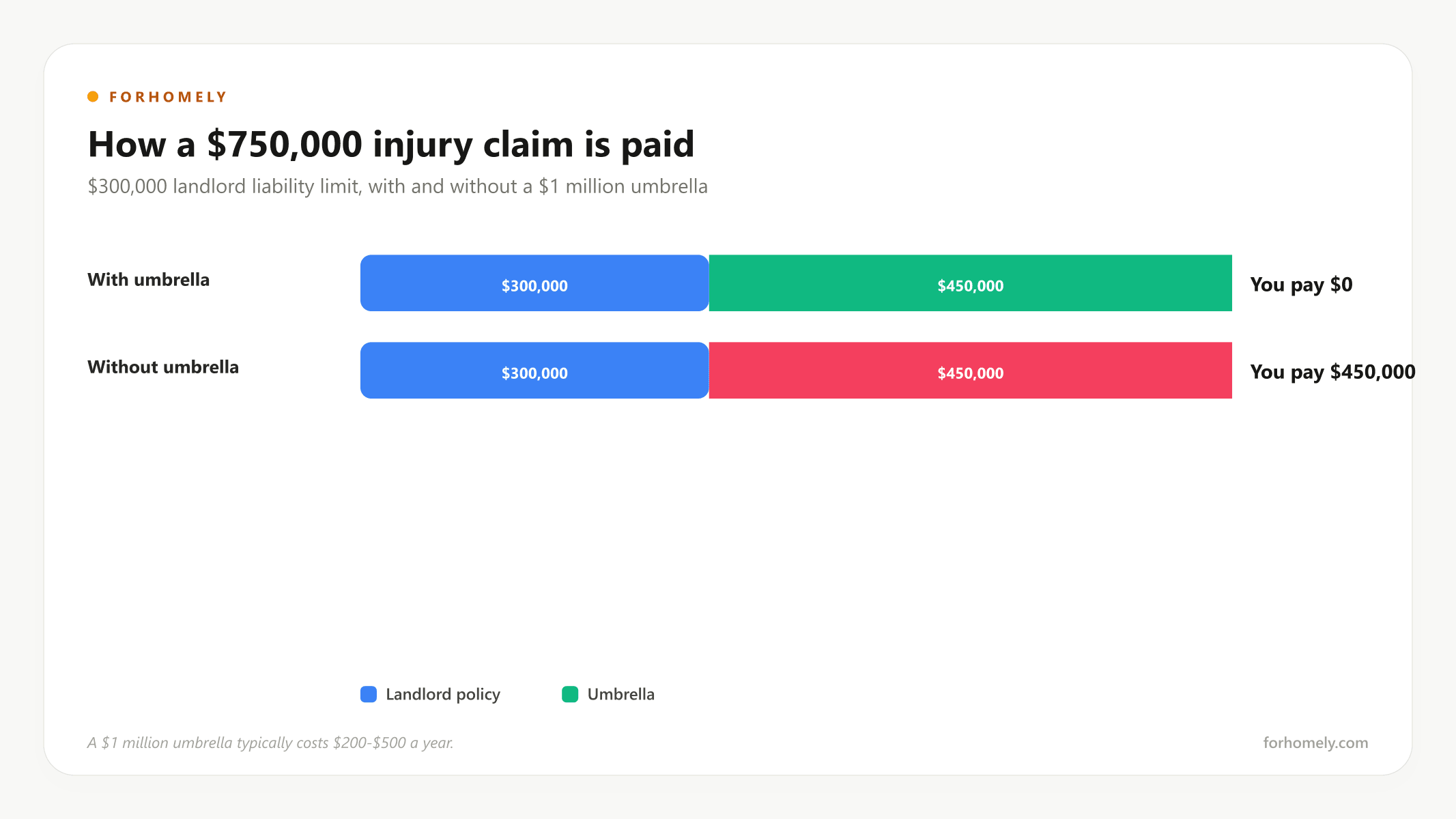
The math. A tenant sues for $750,000. Your landlord policy pays $300,000 and the $1 million umbrella pays the remaining $450,000. You pay $0. The umbrella cost you a few hundred dollars that year.
Coverage structure by portfolio size
1-2 units, self-managed: DP-3 with $500,000 liability, sewer-backup and ordinance-and-law endorsements, plus a $1 million umbrella. Roughly $1,500-$2,500 a year in total.
3-4 units, self-managed: DP-3 with $500,000 liability and the same endorsements, a $1-$2 million umbrella, and a requirement in every lease that tenants carry renters insurance naming you as additional interest. Roughly $2,000-$3,500 a year.
5-10 units, or managing for others: a commercial package or business owner's policy with $1 million per occurrence, a $2-$5 million umbrella, and, if you manage for others, errors-and-omissions coverage. Get an agent who writes multifamily.
Everywhere: confirm flood zone status and buy flood coverage if there is any doubt; standard policies never cover it.
Where an LLC fits
An LLC that owns the property separates its liabilities from your personal assets, so a judgment against the property does not automatically reach your home or savings. That is real protection, with limits:
- The property and its equity are inside the LLC and fully exposed to a judgment above the policy limit.
- Personal involvement (you shoveled the step, you did the repair) can be pleaded around the entity.
- Lenders may require a personal guarantee, and transferring a property with a mortgage into an LLC can trigger a due-on-sale clause; ask the lender first.
- Single-member LLCs receive less protection in some states.
The working structure is insurance first, entity second: adequate underlying limits plus an umbrella, held in whatever entity your attorney and lender support. An LLC without an umbrella is an LLC that loses the building.
Reducing the risk at the source
Insurance pays claims; management prevents them. Working smoke and carbon monoxide detectors in every unit with documented annual tests, handrails and lighting on every stair, prompt snow and ice removal with a log, a written response to every maintenance request, and screening criteria applied identically to every applicant (the tenant screening guide covers the rules) are the difference between a claim that settles quickly inside the limit and one that goes to a jury.
Budget for it correctly
Insurance is an operating expense that belongs in NOI, and the umbrella's rental share is deductible on Schedule E. Enter the real premiums, not the seller's, in the Multifamily Cash Flow Calculator; a $1,000 gap between the seller's old policy and your new one is a $16,000 valuation difference at a 6% cap rate, and it is far smaller than the gap between being insured and being sued.