Bad tenants cost more than the rent they owe. A tenant who stops paying for six months, damages the unit, and leaves can cost $15,000 or more in lost rent, repairs, and legal fees on a single unit of a fourplex. Screening takes thirty minutes per applicant; an eviction takes months and thousands of dollars. This guide lays out a screening process that is predictive, consistent, and legal, in that order, because the order matters.
Educational content, not legal advice. Landlord-tenant and fair-housing law vary by state and city; confirm your local rules.
Step 0: write the criteria down first
Before the first application, write a one-page screening policy: the income multiple, the credit thresholds, how far back you look at evictions, how you treat criminal history, what references you require, and how you handle co-signers. Publish the key points in your listing. Then apply the policy identically to every applicant, in the order applications are received. Consistency is both your best predictor of good tenants and your entire defense in a discrimination complaint.
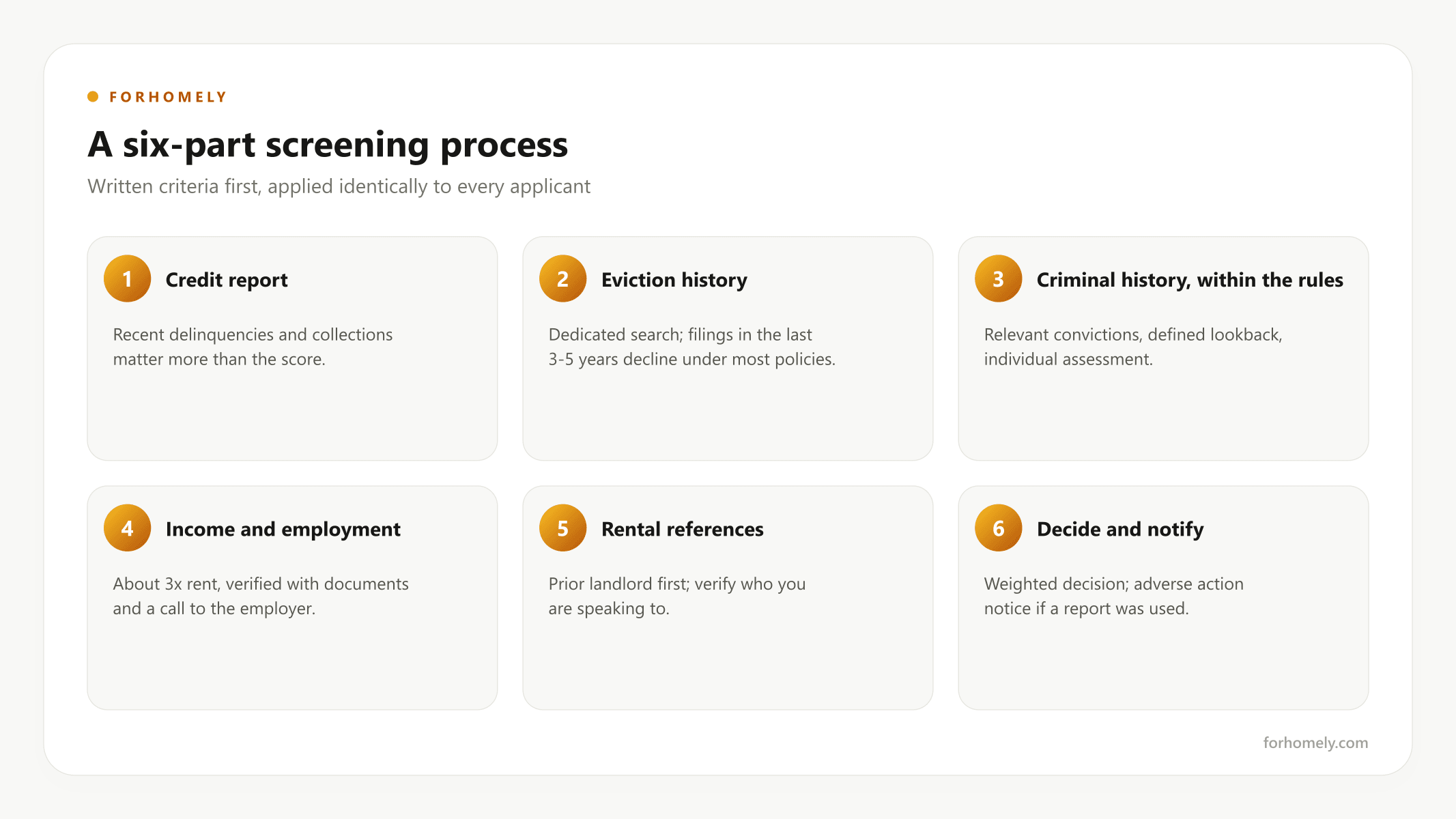
Step 1: the credit report
Order it through a tenant screening service (with the applicant's written authorization and, ideally, paid by the applicant), or have the applicant initiate a report they share with you.
What to read, in order of importance:
- Recent delinquencies (last 24 months). Late payments in the last two years are the strongest single predictor of future non-payment. A 580 score with a clean recent history is a better risk than a 650 with three 60-day lates last spring.
- Collections and charge-offs. Medical collections are common and weakly predictive; a charged-off utility, phone, or rental debt is a red flag.
- Evictions and rental collections. Some reports include them; the dedicated eviction search below is more reliable.
- Total debt load relative to income, which affects the applicant's ability to absorb a surprise.
- The score itself, as a summary, not a verdict. Common thresholds: 650+ approve, 600-649 approve with a larger deposit or co-signer where legal, under 600 decline. Set yours in writing.
Step 2: eviction history
Run a dedicated eviction search through the screening service and, where practical, the county court records for the applicant's prior addresses.
- Any eviction filing in the last three to five years: decline under most written policies. Note that some states now seal or limit reporting of older or dismissed filings; use what the law allows you to see.
- Older filings: ask for an explanation and weigh it. Job loss or a medical event with several years of clean history since is different from a pattern.
- Filings that were dismissed or settled are weaker evidence than judgments; read the disposition.
Step 3: criminal history, within the rules
Criminal screening is permitted in most jurisdictions but is the area with the most legal risk:
- HUD's 2016 guidance concludes that blanket bans on anyone with a criminal record have a disparate impact on protected classes and are hard to justify. Arrests without convictions should not be considered at all.
- Several states and cities restrict criminal screening: some prohibit asking until after a conditional offer, some limit lookback periods, and some bar consideration of most convictions entirely.
- A defensible policy considers only convictions relevant to the safety of other residents or the property, within a defined lookback (often seven years), and allows the applicant to provide context.
Many small landlords conclude that a narrowly written policy applied with individual assessment is manageable, and others skip criminal screening entirely and rely on credit, eviction, and income. Either choice is defensible; an inconsistent or blanket policy is not.
Step 4: income and employment
- Income standard: gross monthly income of about three times the rent, verified. For a $1,500 unit, $4,500 a month.
- Documentation: the last two or three pay stubs; an offer letter for a new job; two years of tax returns or bank statements for self-employed applicants; award letters for disability, retirement, or other benefit income.
- Employment verification: call the employer's main line (not a number the applicant provides) and confirm position, start date, and whether employment is ongoing.
- Source-of-income laws. Many states and cities require landlords to accept housing vouchers and other lawful income. Where they apply, the income multiple is applied to the tenant's portion of rent, and refusing voucher holders is illegal.
- Red flag: an applicant who will not provide income documentation. Decline under your written policy.
Step 5: rental references
Call the current and prior landlords. The prior landlord is often more candid, because the current one may want the tenant gone.
Ask: Did they pay on time? Did they give proper notice? Was the unit left in good condition? Any complaints from neighbors? Would you rent to them again? Verify that the reference is actually the landlord (check property records) rather than a friend.
Step 6: weigh the evidence
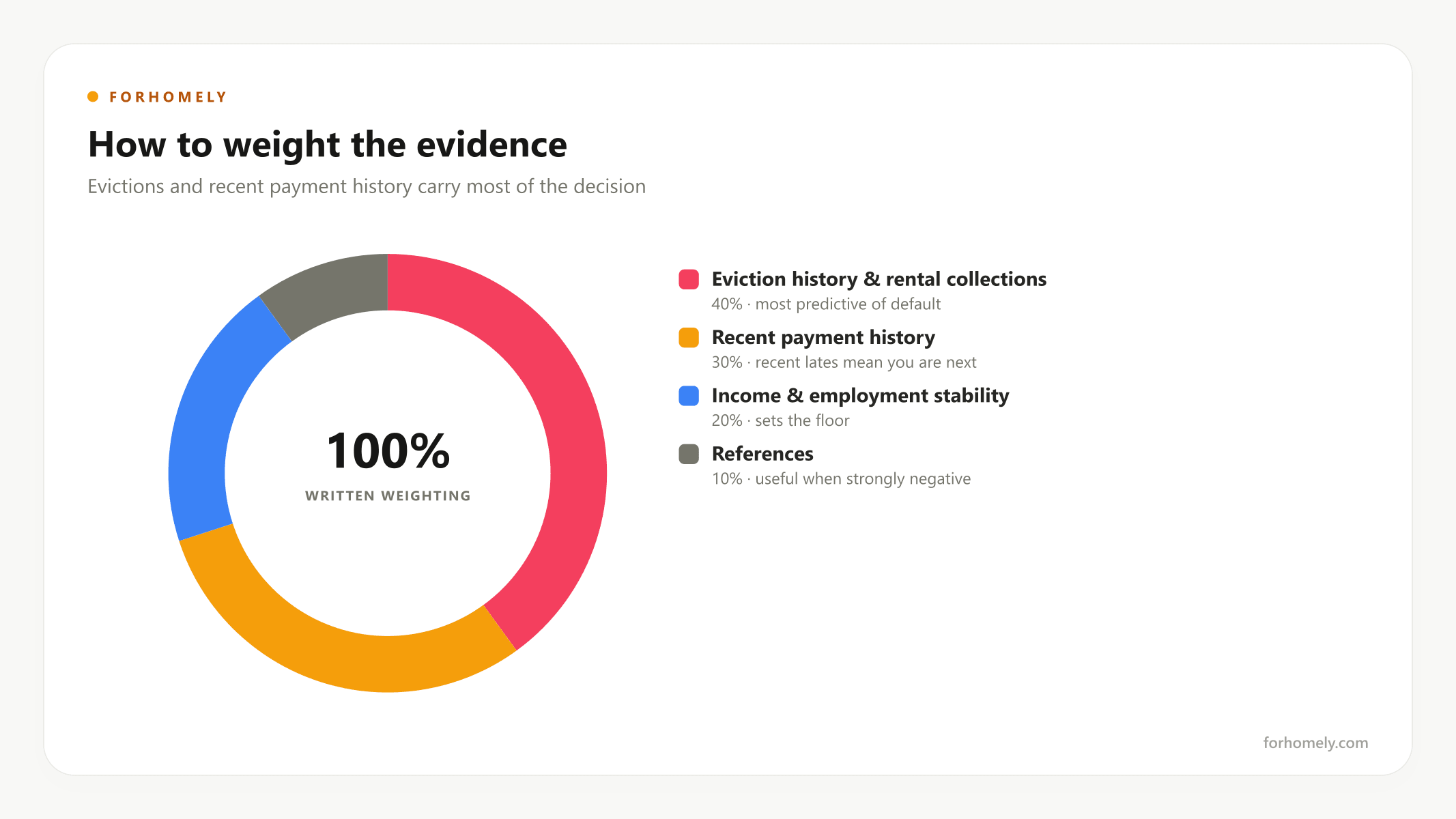
You will get mixed signals. A written weighting keeps decisions consistent:
- Eviction history and rental collections: about 40% of the decision; the most predictive of default.
- Recent payment history on the credit report: about 30%; recent lates mean you are next.
- Income and employment stability: about 20%; ability to pay matters less than willingness, but it sets the floor.
- References: about 10%; useful mainly when strongly negative.
A 600 score with zero evictions, five years at the same employer, and a clean 24-month payment history is often a good tenant. A 690 with an eviction filing two years ago and a fresh collection is not.
The legal guardrails
- Fair Housing Act. You may not discriminate based on race, color, religion, sex (including sexual orientation and gender identity under current HUD interpretation), familial status, national origin, or disability. Many states and cities add source of income, age, marital status, and more. Criteria must be applied uniformly, and advertising must not signal preferences.
- Fair Credit Reporting Act. You need a permissible purpose and the applicant's authorization to pull a report. If you deny, require a co-signer, raise the deposit, or take any adverse action based in whole or in part on a consumer report, you must give an adverse action notice that names the reporting agency, states that the agency did not make the decision, and explains the applicant's right to a free copy and to dispute the contents. There is no fixed federal deadline, but send it promptly, in writing. Dispose of reports securely when no longer needed.
- Application fees and deposits are capped or regulated in many states. Check before you set them.
- Consistency. Same criteria, same order, same documentation, for every applicant. Keep applications, reports, decisions, and notices for at least three years.
The reality check
In a competitive market, the perfect applicant (720 credit, ten years at one job, glowing references) is rare and gets chosen quickly. Your job is not to find perfection; it is to avoid the applicants your written criteria say are too risky (recent eviction, current delinquencies, unverifiable income) and to take the reasonable ones without bias. An applicant who meets four of five criteria and narrowly misses one is usually a yes, with a deposit adjustment where legal. Two misses is a no.
Screening costs $30-$50 per applicant and thirty minutes of your time. The vacancy, damage, and legal costs of a bad placement are one to two orders of magnitude larger, and they land directly on the cash flow you modeled in the Multifamily Cash Flow Calculator. Good tenants are the operating strategy; everything else is cleanup, and the landlord insurance guide covers what happens when cleanup is not enough.