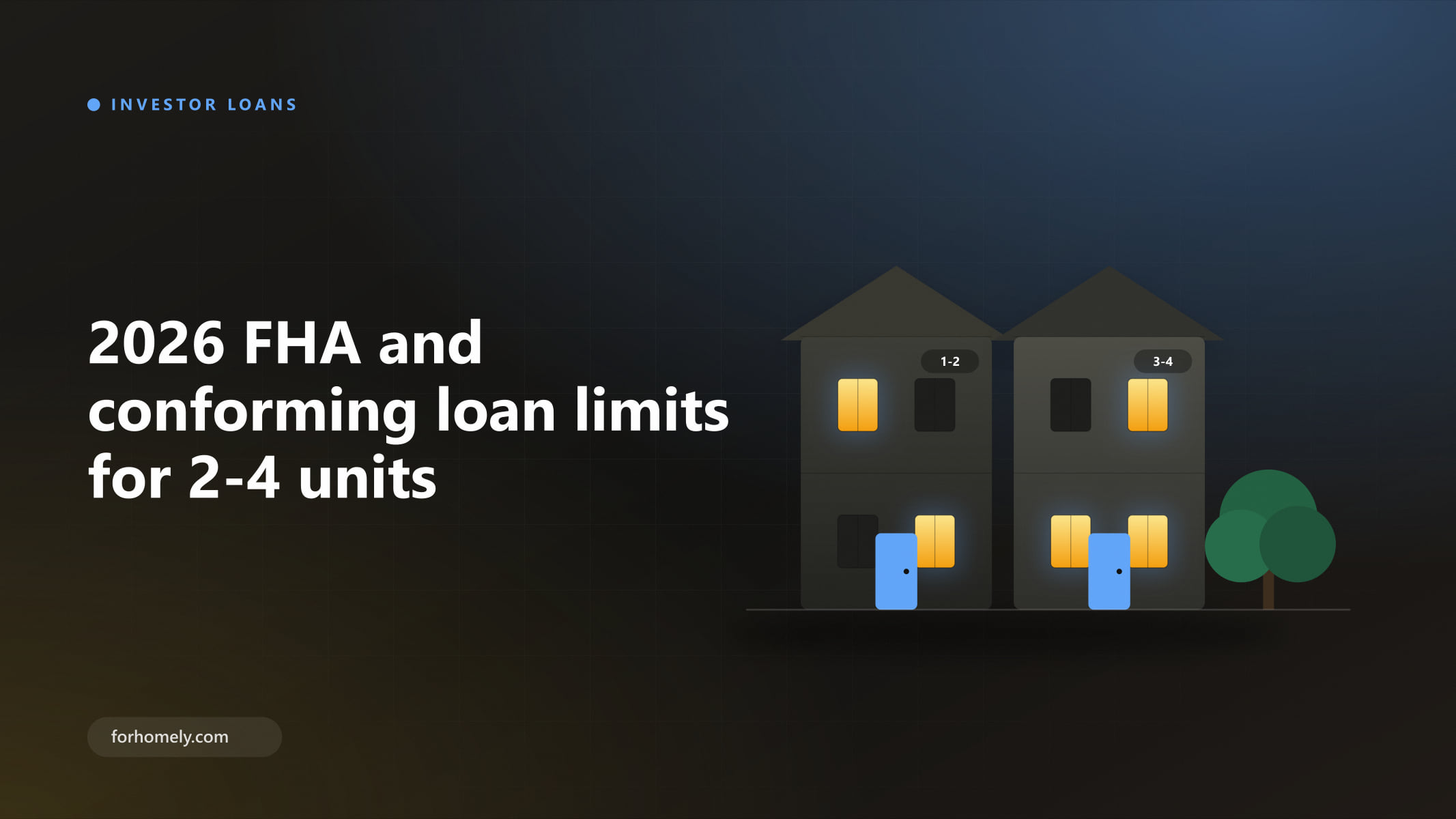
Loan limits are the ceiling on how much you can borrow under FHA and conforming (Fannie Mae and Freddie Mac) programs, and they scale with the number of units. If you are shopping duplexes or fourplexes, the limits define your maximum purchase price at each down payment level. For most 2-4 unit buyers, they turn out to be far less constraining than the down payment and qualifying rules, but you should know where the line is before you fall in love with a building above it.
How the limits are set
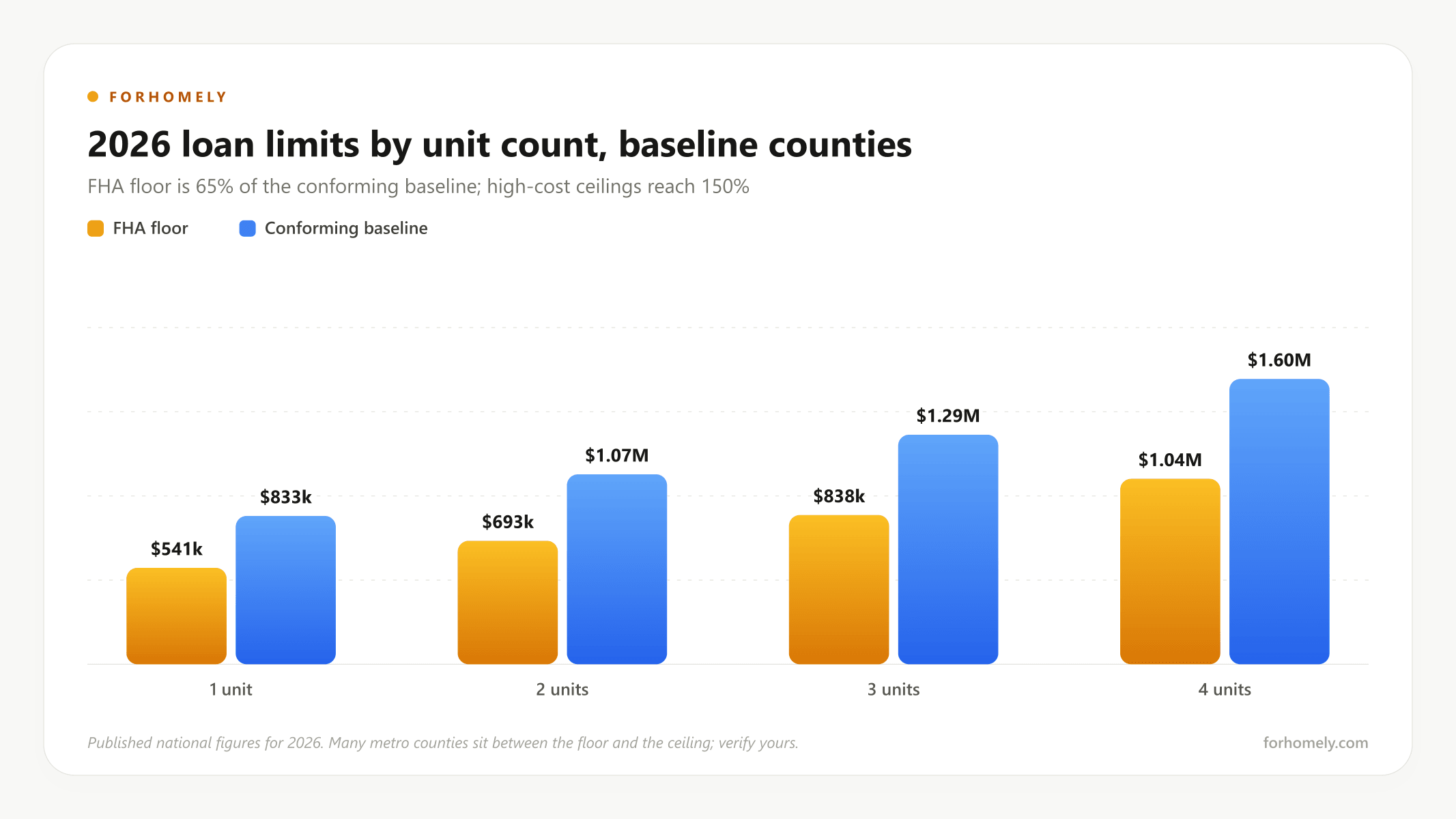
Each November, the Federal Housing Finance Agency announces conforming limits for the following year, based on the change in the national average home price. The baseline applies to most of the country; counties where 115% of the median home price exceeds the baseline get a higher local limit, up to a ceiling of 150% of the baseline.
FHA limits derive from the conforming numbers: the FHA floor is 65% of the conforming baseline, the FHA ceiling in high-cost areas equals the conforming ceiling, and counties in between get a limit tied to local median prices.
The 2026 limits by unit count
| Units | Conforming baseline | Conforming ceiling (high-cost) | FHA floor | FHA ceiling (high-cost) |
|---|---|---|---|---|
| 1 unit | $832,750 | $1,249,125 | $541,287 | $1,249,125 |
| 2 units | $1,066,250 | $1,599,375 | $693,062 | $1,599,375 |
| 3 units | $1,288,750 | $1,933,125 | $837,687 | $1,933,125 |
| 4 units | $1,601,750 | $2,402,625 | $1,041,137 | $2,402,625 |
These are the national figures published for 2026. Alaska, Hawaii, Guam, and the U.S. Virgin Islands have higher statutory limits. Verify your county in the FHFA map and the HUD lookup, because many metro counties sit between the floor and the ceiling.
The limit applies to the loan, not the price
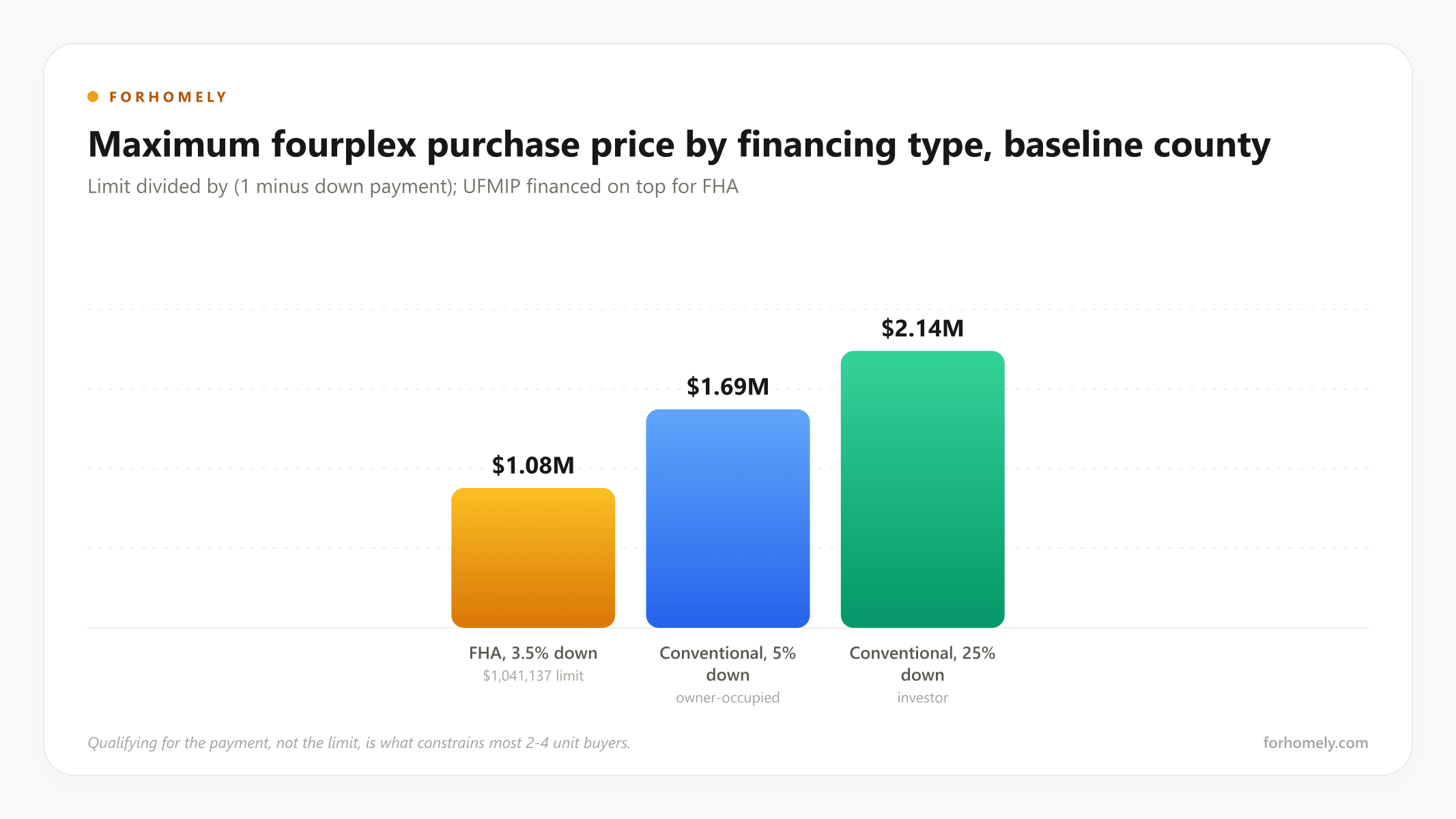
With FHA's 3.5% minimum down payment, the maximum purchase price in a baseline county is the limit divided by 0.965 (the UFMIP is financed on top). With conventional financing at 5% down owner-occupied or 25% down for an investor, the math is the limit divided by 0.95 or 0.75.
Worked example: a fourplex in a baseline county
- FHA, 3.5% down: $1,041,137 ÷ 0.965 = about $1,078,900 maximum price
- Conventional owner-occupied, 5% down: $1,601,750 ÷ 0.95 = about $1,686,000
- Conventional investor, 25% down: $1,601,750 ÷ 0.75 = about $2,135,700
In a high-cost county, the fourplex FHA ceiling of $2,402,625 supports a purchase price of nearly $2.5 million at 3.5% down, at least on paper.
Worked example: a duplex
- FHA, 3.5% down, baseline county: $693,062 ÷ 0.965 = about $718,200
- Conventional, 5% down: $1,066,250 ÷ 0.95 = about $1,122,400
In most of the country, duplexes trade well below those numbers. The limit is not what stops you.
The limits that actually bite
On 2-4 unit purchases, five other rules almost always constrain you before the loan limit:
- The FHA self-sufficiency test on 3-4 units. Seventy-five percent of appraised market rent must cover the full PITIA. A million-dollar fourplex with a $7,800 payment needs about $10,400 of monthly rent to pass. The self-sufficiency guide has the math.
- Debt-to-income. Even with 75% of the rents counted as income, the borrower's DTI has to clear roughly 45-50%. The rental income qualifying guide shows how the calculation works.
- Down payment and reserves. Conventional multi-unit loans commonly require six months of PITIA in reserves; on a $7,000 payment that is $42,000 of cash after closing, on top of the down payment.
- Investor LTV caps. Non-owner-occupied 2-4 unit conventional purchases are capped at 75% LTV; cash-out refinances at 70%.
- The ten-financed-property cap. Conventional lending stops at ten financed properties per borrower. After that, DSCR and portfolio lenders take over, with their own limits.
When the limit does matter: jumbo territory
If your needed loan exceeds the limit for your unit count and county, you are in jumbo territory:
- Jumbo 2-4 unit loans typically require 20-25% down, a 700+ credit score, and 6-12 months of reserves.
- Jumbo rates are sometimes competitive with conforming, but fewer lenders offer them on 3-4 units, and underwriting is manual.
- Options include a larger down payment to bring the loan under the limit, a portfolio loan, or a DSCR loan, since DSCR lenders are not bound by agency limits.
How to check your county's exact limits
- Open FHFA's conforming loan limit map (linked in the sources) and select your state and county; it lists 1-4 unit values.
- Open HUD's FHA mortgage limits lookup and do the same for FHA.
- Confirm with your lender; they verify limits on every pre-approval and will know if your county changed this year.
Size your deal correctly
Enter your target price, down payment, and unit count in the First-Time Homebuyer Mortgage Calculator to see the exact base loan amount, the financed UFMIP, and whether the loan fits under your county's limit. Then check the payment against the rents, because that, not the limit, is what decides whether you can buy the building.